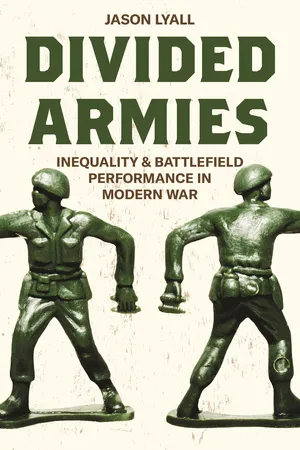
How do armies fight and what makes them victorious on the modern battlefield? In Divided Armies, Jason Lyall challenges long-standing answers to this classic question by linking the fate of armies to their levels of inequality. Introducing the concept of military inequality, Lyall demonstrates how a state's prewar choices about the citizenship status of ethnic groups within its population determine subsequent battlefield performance. Treating certain ethnic groups as second-class citizens, either by subjecting them to state-sanctioned discrimination or, worse, violence, undermines interethnic trust, fuels grievances, and leads victimized soldiers to subvert military authorities once war begins. The higher an army's inequality, Lyall finds, the greater its rates of desertion, side-switching, casualties, and use of coercion to force soldiers to fight.
In a sweeping historical investigation, Lyall draws on Project Mars, a new dataset of 250 conventional wars fought since 1800, to test this argument. Project Mars breaks with prior efforts by including overlooked non-Western wars while cataloguing new patterns of inequality and wartime conduct across hundreds of belligerents. Combining historical comparisons and statistical analysis, Lyall also marshals evidence from nine wars, ranging from the Eastern Fronts of World Wars I and II to less familiar wars in Africa and Central Asia, to illustrate inequality's effects.
Sounding the alarm on the dangers of inequality for battlefield performance, Divided Armies offers important lessons about warfare over the past two centuries—and for wars still to come.
- 376 pages
- English
- ePUB (mobile friendly)
- Available on iOS & Android
eBook - ePub
About this book
Information
Publisher
Princeton University PressYear
2020Print ISBN
9780691192444
9780691192437
eBook ISBN
9780691194158
1
Introduction
What a society gets in its armed services is exactly what it asks for, no more and no less. What it asks for tends to be a reflection of what it is. When a country looks at its fighting forces it is looking in a mirror; the mirror is a true one and the face that it sees will be its own.
SIR JOHN HACKETT, THE PROFESSION OF ARMS, 1983
THE RHYTHM OF HISTORY is set by the clash and din of armies fighting and dying in battle. Yet for all their importance in deciding the fate of nations and empires, the drivers of battlefield performance in modern war are still only poorly understood. This is due partly to the complexity of battle itself, and the near-bewildering variation on display in the ability of armies to generate and deploy coercive violence against their foes. Some armies, for example, have imposed stunning defeat on their adversaries while suffering almost no losses of their own. Outnumbered Anglo-Egyptian forces destroyed an opposing force of nearly 60,000 Mahdist soldiers in a single morning on the fields outside Omdurman in 1898, a victory so lopsided that some have suggested that its outcome was best characterized as murder, not war. In other cases, armies have staggered back into the fight, showing remarkable resilience after initial setbacks. Bolshevik forces turned the tide against more capable White armies at Petrograd in 1919, carving out a beachhead from which the revolution could be exported and then consolidated throughout Russia. Still other armies struggled simply to field their soldiers, wracked by the twin scourges of desertion and defection that thinned their ranks during, and sometimes before, battle commenced. Soldiers of the Spanish Royalist forces, seeking to snuff out the independence-seeking Third Republic of Venezuela (1815–21), often fled military service or switched sides, gutting its combat power and contributing to its eventual defeat. Armies have even turned their guns on themselves to manufacture cohesion through coercion. The Fengtian Clique’s Zhili Army, one of the largest and best-equipped armies of China’s Warlord Era, deployed “anti-retreat formations” staffed by teenagers who fired artillery into Fengtian forces if they wavered during the Northern Expedition (1926–28). Repression can sometimes escalate to almost unimaginable levels. Desperation drove the Red Army to backstop its beleaguered forces with blocking detachments that executed an estimated 158,000 of their fellow soldiers from 1942–44, dwarfing total American casualties in the entire Pacific campaign.1
This book therefore asks a simple question: What explains battlefield performance in modern war? I argue that the patterns and dynamics of battlefield performance in modern war since 1800 can be explained by the degree of inequality within belligerent armies, or what I term military inequality. Specifically, battlefield fortunes are shaped by a belligerent’s prewar treatment of its constituent ethnic groups and the ethnic composition of its armed forces, which combine to create predictable patterns in how armies produce violence once they enter combat. The greater the level of military inequality—that is, the more these ethnic groups were subjected to prewar discrimination or repression by the state—the worse a belligerent’s expected wartime performance, for two reasons.
First, soldiers drawn from marginalized or repressed “non-core” ethnic groups will be reluctant to fight and die on behalf of the regime and its war. Absent common cause, and possessing strong ethnic ties, these soldiers will use their existing networks to resist or subvert military authorities collectively. Second, military commanders, recognizing the dangers of incorporating these soldiers, will take steps to prevent indiscipline, including the specter of mass desertion or defection. Commanders may rig the ethnic composition of their units to prevent coethnic collusion, and often deliberately simplify their tactics to foreclose opportunities for these soldiers to escape. These measures impose steep penalties, however, increasing casualties by reducing battlefield flexibility and survivability. As inequality rises, wielding violence against one’s own soldiers becomes increasingly attractive as armies seek to compel what they cannot command. Groaning under the combined weight of rising casualties, narrowed tactical choices, and embittered soldiers, these divided armies enter battle at a significant disadvantage to more egalitarian foes.
Divided armies, in other words, are flawed by design. Armies, in this view, are political constructions, both reflective of and captive to the identity politics that define a political community. For that reason, divided armies represent conscious decisions to impose limitations on the belligerent’s full exercise of military power on the modern battlefield. This characterization stands sharply at odds with prevailing theories of military effectiveness in political science, where armies more closely resemble Emperor Qin’s famed terra-cotta warriors: disciplined, obedient, uniform, and silent. Indeed, these theories cast armies as organizations obsessed with efficiency and optimization, of wringing the most from the least, with eyes firmly fixed on the dangers of international hierarchies of military power, not domestic hierarchies of status and belonging. The book’s privileging of prewar drivers of military inequality also contrasts with the current preoccupation in the study of political violence (especially civil wars) with fast-moving dynamics to the exclusion of structural factors that shove and shape patterns of wartime violence. My approach shares much with the recent turn toward social history in the study of military affairs, including problematizing the notion of a universal, faceless soldier by considering the “view from below.” Yet I part company with its focus on the particular to the exclusion of the general. The argument offered here is designed to explain battlefield performance across all armies, or as many as possible, rather than a single army or individual unit. Military inequality is thus the red thread that runs through the still-unfolding narrative of modern war.
In that spirit, the book seeks to nudge the study of battlefield performance in four new directions. First, it introduces an expanded conceptual framework for understanding battlefield performance, one that integrates previously neglected issues such as desertion, defection, and fratricidal violence. Second, it makes the case for viewing military inequality as an important, if overlooked, independent variable for explaining battlefield performance over the past 200 years. Third, it resets our empirical baseline for battlefield performance by introducing a new dataset, Project Mars, that greatly expands our coverage of conventional wars and belligerents, pushing us away from Western-centric accounts toward a more global view of military affairs. Finally, it aims to shape how we study battlefield performance by adopting a research design that marries diverse streams of qualitative and quantitative evidence with the explicit use of counterfactuals to isolate military inequality’s effects across (and within) armies. The book will have achieved its ambition if it persuades others to join in a common effort to build a more global history of battlefield performance, one that recognizes how prewar patterns of inequality can trap divided armies on paths of battlefield ruin.
1.1. Inequality Goes to War
While inequality has waxed and waned throughout the centuries, its current resurgence in the United States and abroad has led academics to sound the alarm about its negative consequences. Economists, who define inequality principally in terms of income and wealth distributions, have linked rising inequality to stunted economic growth, increased crime, worsened health outcomes, and diminished governance.2 Political scientists have also entered the fray, viewing inequality as a function of access to political power, especially executive decision-making authority, in a given country. Lamenting recent democratic reversals around the world, these scholars have drawn a connection between political inequality and the onset of armed rebellion, full-blown civil war, and even state collapse due to vicious cycles of inter-elite struggles to acquire, or maintain, a stranglehold on power.3 Historians, too, have issued cautionary tales, warning that economic and political inequalities, once entrenched, can be exceedingly hard to uproot. In one especially troubling reading, inequality can only be beaten back through massively wrenching events such as total wars and pandemics that quite literally level societies for a time before inequality inevitably reestablishes itself.4
I share this sense of unease but adopt a different, perhaps more fundamental, view of inequality. I define inequality in terms of membership within a political community rather than the distribution of income or political power. All political communities must answer a basic question: who belongs, and how much? Inequality here refers to the uneven distribution of membership within a given political community across the groups that find themselves nestled within the boundaries of the same territorial unit, whether a state, empire, or other form of political organization. All political leaders construct or inherit collective visions of their political communities that are meant to legitimate their rule. Some political communities are expansive, drawing their boundaries in an inclusive manner that does not single out specific groups for unequal treatment; all groups hold equal status in the community. Some communities are defined more narrowly, relegating certain groups to second-class status that justifies group-based discrimination against them. Other communities have even steeper gradations of belonging, viewing targeted groups as aliens, outsiders trapped within but not members of the broader political community. In these situations, collective violence is deemed permissible to deny or destroy their group claims and sometimes their existence. Inequality here is thus a political construct, one that establishes categories of membership within the community. It is also group-based, not individual-centric, in its focus. Groups are assigned to particular categories of membership from which relative societal status is derived. Inequality is therefore relational in nature, establishing a pecking order for groups that defines their rights and obligations to the state, and the state to them. Finally, inequality here is top-down, implemented by political leaders and enforced by the machinery of the state. Inequality, in other words, is official state business. It is intended, not incidental; authorized, not accidental.
Inequality in communal membership takes its shape from the type of group identity (or identities) that leaders make salient for political purposes. Religion, ideology, gender, class, and sexual orientation, among others, can all provide the basis for collectively unequal treatment by the state. Here I concentrate on a particularly powerful form of group identification: ethnicity.5 Historically, stratification across ethnic lines has been one of the most persistent and durable forms of inequality across all manner of political communities. From the regime’s standpoint, ethnicity offers a potent means for identifying its supporters, especially amidst the uncertainty that characterizes initial nation- and state-building campaigns. Presumed shared interests and values among coethnics not only facilitate the redistribution of resources toward one’s own group but also make it easier to predict their behavior. From the standpoint of marginalized ethnic groups, ethnicity provides the building block for organizing collective action to challenge the regime’s vision that shunts them into second-class status. Ethnicity provides the framework for defining the political community and for potentially challenging its unequal nature if leaders choose to activate latent ethnic cleavages as the basis for their continued rule. Put differently, ethnicity is a group identity that not only defines who you are and your category of membership within the broader community but also what can be done to you by political authorities.6
If m...
Table of contents
- Cover Page
- Series Page
- Title Page
- Copyright Page
- Contents
- List of Tables
- List of Figures and Maps
- Acknowledgments
- A Note to Readers
- 1. Introduction
- Part I. Setting the Stage: Theory and Initial Evidence
- Part II. To the Battlefield: Historical Evidence
- Part III. Extensions and Conclusions
- Part IV. Appendixes
- Bibliography
- Index
Trusted by 375,005 students
Access to over 1.5 million titles for a fair monthly price.
Study more efficiently using our study tools.
Frequently asked questions
Yes, you can cancel anytime from the Subscription tab in your account settings on the Perlego website. Your subscription will stay active until the end of your current billing period. Learn how to cancel your subscription
No, books cannot be downloaded as external files, such as PDFs, for use outside of Perlego. However, you can download books within the Perlego app for offline reading on mobile or tablet. Learn how to download books offline
Perlego offers two plans: Essential and Complete
- Essential is ideal for learners and professionals who enjoy exploring a wide range of subjects. Access the Essential Library with 800,000+ trusted titles and best-sellers across business, personal growth, and the humanities. Includes unlimited reading time and Standard Read Aloud voice.
- Complete: Perfect for advanced learners and researchers needing full, unrestricted access. Unlock 1.5M+ books across hundreds of subjects, including academic and specialized titles. The Complete Plan also includes advanced features like Premium Read Aloud and Research Assistant.
We are an online textbook subscription service, where you can get access to an entire online library for less than the price of a single book per month. With over 1.5 million books across 990+ topics, we’ve got you covered! Learn about our mission
Look out for the read-aloud symbol on your next book to see if you can listen to it. The read-aloud tool reads text aloud for you, highlighting the text as it is being read. You can pause it, speed it up and slow it down. Learn more about Read Aloud
Yes! You can use the Perlego app on both iOS and Android devices to read anytime, anywhere — even offline. Perfect for commutes or when you’re on the go.
Please note we cannot support devices running on iOS 13 and Android 7 or earlier. Learn more about using the app
Please note we cannot support devices running on iOS 13 and Android 7 or earlier. Learn more about using the app
Yes, you can access Divided Armies by Jason Lyall in PDF and/or ePUB format, as well as other popular books in Politica e relazioni internazionali & Storia militare e marittima. We have over 1.5 million books available in our catalogue for you to explore.