This book, a concise introduction to modern probability theory and certain of its ramifications, deals with a subject indispensable to natural scientists and mathematicians alike. Here the readers, with some knowledge of mathematics, will find an excellent treatment of the elements of probability together with numerous applications. Professor Y. A. Rozanov, an internationally known mathematician whose work in probability theory and stochastic processes has received wide acclaim, combines succinctness of style with a judicious selection of topics. His book is highly readable, fast-moving, and self-contained. The author begins with basic concepts and moves on to combination of events, dependent events and random variables. He then covers Bernoulli trials and the De Moivre-Laplace theorem, which involve three important probability distributions (binomial, Poisson, and normal or Gaussian). The last three chapters are devoted to limit theorems, a detailed treatment of Markov chains, continuous Markov processes. Also included are appendixes on information theory, game theory, branching processes, and problems of optimal control. Each of the eight chapters and four appendixes has been equipped with numerous relevant problems (150 of them), many with hints and answers. This volume is another in the popular series of fine translations from the Russian by Richard A. Silverman. Dr. Silverman, a former member of the Courant Institute of Mathematical Sciences of New York University and the Lincoln Laboratory of the Massachusetts Institute of Technology, is himself the author of numerous papers on applied probability theory. He has heavily revised the English edition and added new material. The clear exposition, the ample illustrations and problems, the cross-references, index, and bibliography make this book useful for self-study or the classroom.
Frequently asked questions
Yes, you can cancel anytime from the Subscription tab in your account settings on the Perlego website. Your subscription will stay active until the end of your current billing period. Learn how to cancel your subscription.
No, books cannot be downloaded as external files, such as PDFs, for use outside of Perlego. However, you can download books within the Perlego app for offline reading on mobile or tablet. Learn more here.
Perlego offers two plans: Essential and Complete
Essential is ideal for learners and professionals who enjoy exploring a wide range of subjects. Access the Essential Library with 800,000+ trusted titles and best-sellers across business, personal growth, and the humanities. Includes unlimited reading time and Standard Read Aloud voice.
Complete: Perfect for advanced learners and researchers needing full, unrestricted access. Unlock 1.4M+ books across hundreds of subjects, including academic and specialized titles. The Complete Plan also includes advanced features like Premium Read Aloud and Research Assistant.
Both plans are available with monthly, semester, or annual billing cycles.
We are an online textbook subscription service, where you can get access to an entire online library for less than the price of a single book per month. With over 1 million books across 1000+ topics, weâve got you covered! Learn more here.
Look out for the read-aloud symbol on your next book to see if you can listen to it. The read-aloud tool reads text aloud for you, highlighting the text as it is being read. You can pause it, speed it up and slow it down. Learn more here.
Yes! You can use the Perlego app on both iOS or Android devices to read anytime, anywhere â even offline. Perfect for commutes or when youâre on the go. Please note we cannot support devices running on iOS 13 and Android 7 or earlier. Learn more about using the app.
Yes, you can access Probability Theory by Y. A. Rozanov in PDF and/or ePUB format, as well as other popular books in Mathematics & Probability & Statistics. We have over one million books available in our catalogue for you to explore.
Consider the simple experiment of tossing an unbiased coin. This experiment has two mutually exclusive outcomes, namely âheadsâ and âtails.â The various factors influencing the outcome of the experiment are too numerous to take into account, at least if the coin tossing is âfair.â Therefore the outcome of the experiment is said to be ârandom.â Everyone would certainly agree that the âprobability of getting headsâ and the âprobability of getting tailsâ both equal
. Intuitively, this answer is based on the idea that the two outcomes are âequally likelyâ or âequiprobable,â because of the very nature of the experiment. But hardly anyone will bother at this point to clarify just what he means by âprobability.â
Continuing in this vein and taking these ideas at face value, consider an experiment with a finite number of mutually exclusive outcomes which are equiprobable, i.e., âequally likely because of the nature of the experiment.â Let A denote some event associated with the possible outcomes of the experiment. Then the probability P(A) of the event A is defined as the fraction of the outcomes in which A occurs. More exactly,
where N is the total number of outcomes of the experiment and N(A) is the number of outcomes leading to the occurrence of the event A.
Example 1. In tossing a well-balanced coin, there are N = 2 mutually exclusive equiprobable outcomes (âheadsâ and âtailsâ). Let A be either of these two outcomes. Then N(A) = 1, and hence
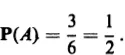
Example 2. In throwing a single unbiased die, there are N = 6 mutually exclusive equiprobable outcomes, namely getting a number of spots equal to each of the numbers 1 through 6. Let A be the event consisting of getting an even number of spots. Then there are N(A) = 3 outcomes leading to the occurrence of A (which ones?), and hence
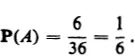
Example 3. In throwing a pair of dice, there are N = 36 mutually exclusive equiprobable events, each represented by an ordered pair (a, b), where a is the number of spots showing on the first die and b the number showing on the second die. Let A be the event that both dice show the same number of spots. Then A occurs whenever a = b, i.e., n(A) = 6. Therefore
Remark. Despite its seeming simplicity, formula (1.1) can lead to nontrivial calculations. In fact, before using (1.1) in a given problem, we must find all the equiprobable outcomes, and then identify all those leading to the occurrence of the event A in question.
The accumulated experience of innumerable observations reveals a remarkable regularity of behavior, allowing us to assign a precise meaning to the concept of probability not only in the case of experiments with equiprobable outcomes, but also in the most general case. Suppose the experiment under consideration can be repeated any number of times, so that, in principle at least, we can produce a whole series of âindependent trials under identical conditions,â1 in each of which, depending on chance, a partic...