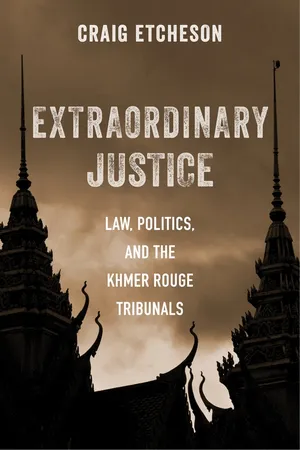
In just a few short years, the Khmer Rouge presided over one of the twentieth century's cruelest reigns of terror. Since its 1979 overthrow, there have been several attempts to hold the perpetrators accountable, from a People's Revolutionary Tribunal shortly afterward through the early 2000s Extraordinary Chambers in the Courts of Cambodia, also known as the Khmer Rouge Tribunal. Extraordinary Justice offers a definitive account of the quest for justice in Cambodia that uses this history to develop a theoretical framework for understanding the interaction between law and politics in war crimes tribunals.
Craig Etcheson, one of the world's foremost experts on the Cambodian genocide and its aftermath, draws on decades of experience to trace the evolution of transitional justice in the country from the late 1970s to the present. He considers how war crimes tribunals come into existence, how they operate and unfold, and what happens in their wake. Etcheson argues that the concepts of legality that hold sway in such tribunals should be understood in terms of their orientation toward politics, both in the Khmer Rouge Tribunal and generally. A magisterial chronicle of the inner workings of postconflict justice, Extraordinary Justice challenges understandings of the relationship between politics and the law, with important implications for the future of attempts to seek accountability for crimes against humanity.
- English
- ePUB (mobile friendly)
- Available on iOS & Android
eBook - ePub
About this book
Information
Subtopic
Asian HistoryNOTES
INTRODUCTION
1. For example, as one newspaper reported, “critics of Mr. Trump quickly denounced what they called ‘banana republic’ politics of retribution, akin to autocratic nations where election losers are jailed by winners.” Peter Baker, “Playing Down Trump’s Effort to Get Clinton,” The New York Times, November 15, 2017.
2. Judith N. Shklar, Legalism: Laws, Morals, and Political Trials (Cambridge, MA: Harvard University Press, 1964), 167.
3. Shklar, Legalism, 168.
4. Otto Kirchheimer, Political Justice: The Use of Legal Procedure for Political Ends (Princeton, NJ: Princeton University Press, 1961), 334.
5. Peter Maguire, Law and War: An American Story (New York: Columbia University Press, 2000), 130.
6. Shklar, Legalism, 1.
7. Shklar, Legalism, 111.
8. A more prosaic example comes from an outsider. In the mid-1990s, a Cambodian Buddhist monk visited the United States and toured numerous states and several big cities, taking in many sights. At the end of his visit, he was asked by his guide what was the most amazing thing he had seen. The monk thought for a moment, and replied simply, “Stoplights. When the light changes, all the cars stop, without anyone ordering them or threatening them.” I am grateful to Bill Herod for this anecdote.
9. “Report to the President by Mr. Justice Jackson, June 6, 1945,” Report of Robert H. Jackson, United States Representative to the International Conference on Military Trials: London, 1945 (Washington, DC: GPO, 1949).
10. Robert H. Jackson, “The Rule of Law Among Nations,” American Bar Association Journal 31 (June 1945): 290–94.
11. Maguire, Law and War.
12. Maguire, Law and War, 9.
13. Edward Hallett Carr, The Twenty Years’ Crisis, 1919–1939: An Introduction to the Study of International Relations (New York: Harper and Row, 1964), 177.
14. John N. Hazard, “Legal Policy in the Soviet Union,” in The Soviet Union in the 1980s, ed. Erik P. Hoffmann (New York: The Academy of Political Science, 1984), 57.
1. REVOLUTIONARY JUSTICE
1. D.G.E. Hall, A History of Southeast Asia, 4th ed. (New York: St. Martin’s Press, 1981), 119.
2. G. Coedès, The Indianized States of Southeast Asia, ed. Walter F. Vella, trans. Susan Brown Cowing. (Honolulu: University Press of Hawaii, 1968), 58; R. C. Majumdar, Kambuja-Desa or An Ancient Hindu Colony in Cambodia (Philadelphia: Institute for the Study of Human Issues, 1980), 37.
3. David Chandler, “Royally Sponsored Human Sacrifices in Nineteenth Century Cambodia,” in David Chandler, Facing the Cambodian Past (Chaing Mai: Silkworm Books, 1996), 119–135. In the context of the pre-Angkorian period, Vickery casts doubt about the practice. Michael Vickery, Society, Economy and Politics in Pre-Angkor Cambodia: The 7th–8th Century (Tokyo: The Centre for East Asian Cultural Studies for UNESCO, 1998), 247.
4. Roderic Broadhurst, Thierry Bouhours, and Brigette Bouhours, Violence and the Civilizing Process in Cambodia (Cambridge: Cambridge University Press, 2015).
5. David P. Chandler, A History of Cambodia, 2nd ed. (Chiang Mai: Silkworm Books, 1993), 155.
6. Hor Peng, “The Modern Era of Cambodian Constitutionalism,” in Introduction to Cambodian Law, ed. Hor Peng, Kong Phallack and Jorg Menzel (Phnom Penh: Konrad-Adenauer-Stiftung, 2012), 32–33.
7. Hor Peng, “The Modern Era of Cambodian Constitutionalism,” 33 n. 34.
8. Steve Heder, “Hun Sen and Genocide Trials in Cambodia,” in Cambodia Emerges from the Past: Eight Essays, ed. Judy Ledgerwood (DeKalb, IL: Southeast Asia Publications, 2002), 176–223.
9. Milton Osborne, Sihanouk: Prince of Light, Prince of Darkness (Chiang Mai: Silkworm Books, 1994), 157.
10. Osbo...
Table of contents
- Cover
- Title Page
- Copyright
- Contents
- Acknowledgments
- List of Acronyms
- Introduction
- One: Revolutionary Justice
- Two: Victor’s Justice
- Three: Negotiating Justice
- Four: Justice Delayed
- Five: Hybrid Justice
- Six: Transitional Justice
- Seven: Selective Justice
- Eight: Genocide Justice
- Nine: Justice Denied
- Ten: Extraordinary Justice
- Notes
- Select Bibliography
- Index
Trusted by 375,005 students
Access to over 1.5 million titles for a fair monthly price.
Study more efficiently using our study tools.
Frequently asked questions
Yes, you can cancel anytime from the Subscription tab in your account settings on the Perlego website. Your subscription will stay active until the end of your current billing period. Learn how to cancel your subscription
No, books cannot be downloaded as external files, such as PDFs, for use outside of Perlego. However, you can download books within the Perlego app for offline reading on mobile or tablet. Learn how to download books offline
Perlego offers two plans: Essential and Complete
- Essential is ideal for learners and professionals who enjoy exploring a wide range of subjects. Access the Essential Library with 800,000+ trusted titles and best-sellers across business, personal growth, and the humanities. Includes unlimited reading time and Standard Read Aloud voice.
- Complete: Perfect for advanced learners and researchers needing full, unrestricted access. Unlock 1.5M+ books across hundreds of subjects, including academic and specialized titles. The Complete Plan also includes advanced features like Premium Read Aloud and Research Assistant.
We are an online textbook subscription service, where you can get access to an entire online library for less than the price of a single book per month. With over 1.5 million books across 990+ topics, we’ve got you covered! Learn about our mission
Look out for the read-aloud symbol on your next book to see if you can listen to it. The read-aloud tool reads text aloud for you, highlighting the text as it is being read. You can pause it, speed it up and slow it down. Learn more about Read Aloud
Yes! You can use the Perlego app on both iOS and Android devices to read anytime, anywhere — even offline. Perfect for commutes or when you’re on the go.
Please note we cannot support devices running on iOS 13 and Android 7 or earlier. Learn more about using the app
Please note we cannot support devices running on iOS 13 and Android 7 or earlier. Learn more about using the app
Yes, you can access Extraordinary Justice by Craig Etcheson in PDF and/or ePUB format, as well as other popular books in Politics & International Relations & Asian History. We have over 1.5 million books available in our catalogue for you to explore.