The most influential work of its kind ever written, appraising the musical qualities and potential of over 60 commonly used stringed, wind and percussion instruments. With 150 illustrative full-score musical examples from works by Berlioz, Mozart, Beethoven, Gluck, Weber, Wagner, and others, and numerous smaller musical examples. Complete with Berlioz' chapters on the orchestra and on conducting. Translated by Theodore Front. Foreword by Richard Strauss. Glossary.
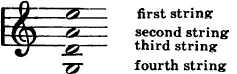
The four strings of the violin are usually tuned in fifths:
The highest string, E, is generally known as me chanterelle.
These strings are called open strings if the fingers of the left hand do not modify the sound by shortening the part of the string which is set in vibration by the bow. The notes to be played on an open string are indicated by a zero (0) placed above or below them.
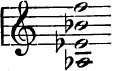
Some great virtuosos and composers have deviated from this system of tuning the violin. Paganini raised all strings a semitone in order to give more brilliance to the instrument:
Consequently, he transposed the solo part, playing for instance in D when the orchestra played in E
, or in A when the orchestra played in B
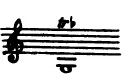
. Open strings being more sonorous than those stopped by fingers, he could thus frequently use them also in keys in which they would otherwise not be possible. De Bériot frequently raised only the G-string a semitone in his concertos. Baillot, on the other hand, sometimes tuned the G-string a semitone lower for the sake of tender or somber effects. Winter, for the same reason, used even the lower F instead of G.
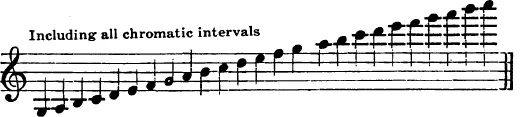
In view of the high degree of skill attained nowadays by our young violinists, the violin may be assigned the following range in a good and fully staffed orchestra:
Great virtuosos carry the range several tones higher. By means of harmonics considerably higher notes can be reached, even in the orchestra (more about this below).
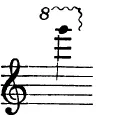
In the meantime this range has been frequently extended in the orchestra to
Trills are practicable on all steps of this far-ranging scale of three and a half octaves. But those on the three highest notes, A, B, C, are very difficult; it is advisable not to use them in the orchestra.
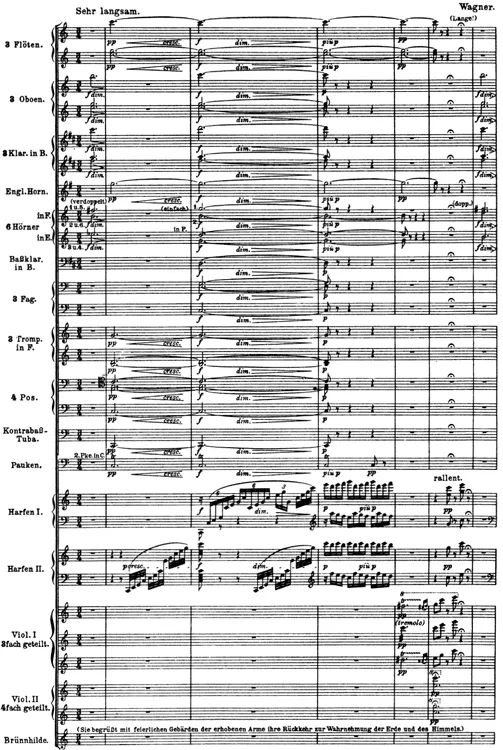
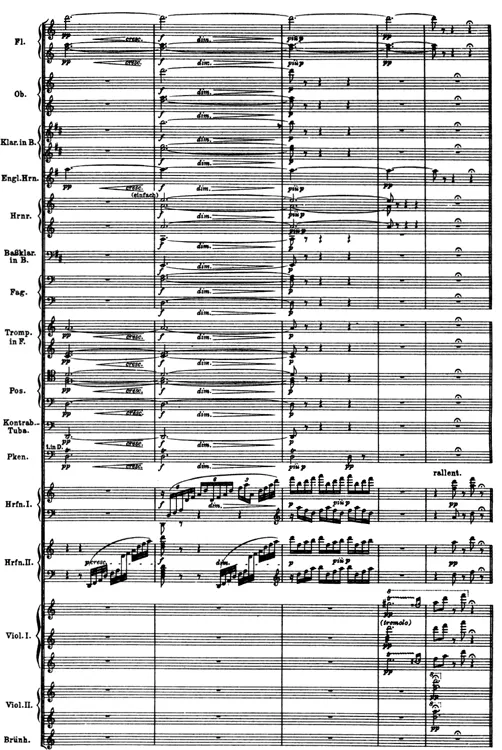
See the wonderful trill passage in the third act of “Siegfried” during Bruennhilde’s awakening as she looks into the light of the sun, enchanted and at the same time blinded by the unwonted radiance (Example 1).
No. 1. Siegfried, Act III.
The minor trill on the fourth string between G and A
is to be avoided as much as possible; it is harsh and has an unpleasant effect.
Numerous chords of two, three and four notes can be played on the violin, simultaneously or arpeggio; they vary considerably in their effect.
Chords of two notes, produced by so-called double stopping on two strings, are well suited, both in forte and in piano, to melodic phrases as well as to all kinds of accompaniments and tremolos.
The chords of three and four notes, however, are not of a good effect when played piano. They have vitality only in forte; for then only can the bow strike the strings together and make them sound well simultaneously. It should not be forgotten that in these three and four-part chords two tones at most can be sustained, the bow having to quit the others as soon as they are struck. In a moderate or slow tempo it is therefore useless to write:
for only the two upper notes can be sustained. In this case it is better to write
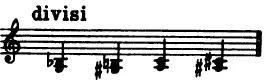
Of course, between the low G and D all chords are impossible since there is only one string (G) to produce the two tones. Should it be necessary to use chords at this extreme end of the scale, they can be obtained in the orchestra only by dividing the violins. This division is indicated in Italian by divisi or a due, in French by divisés or à deux, in German by geteilt, written over the passage:
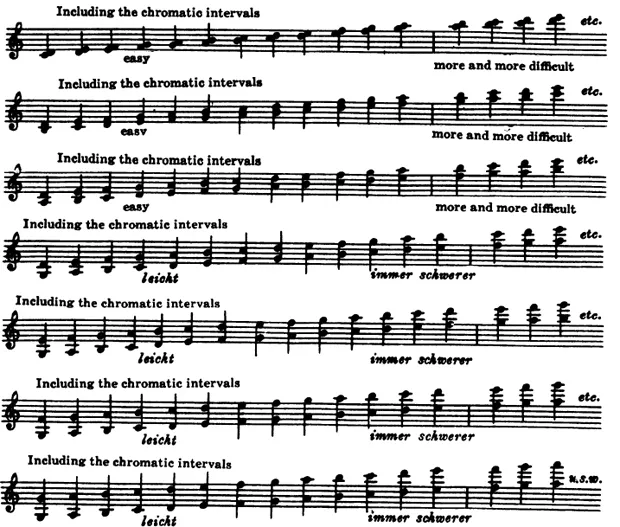
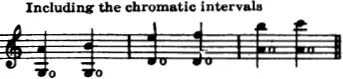
The violins are then divided, one group playing the upper and the other the lower part. Starting from the third (D) string upward, all chords of two notes in seconds, thirds, fourths, fifths, sixths, sevenths and octaves are playable; but they become progressively more difficult on the two higher strings.
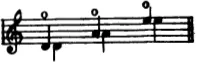
Occasionally one note is played on two strings simultaneously. It is advisable to limit this effect to D, A and E. Only these three notes are easy to execute on two strings; they have a different timbre on each and a full tone, due to the open string:
There is no open string in the other unisons:
Their execution is rather difficult and, hence, their intonation rarely exact.
A lower string can cross a higher open string if it is given an ascending movement while the open string continues in the manner of a pedal-point:
The D remains open while the ascending scale is played on the fourth string throughout.
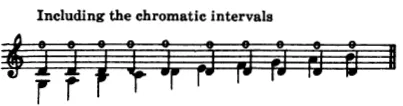
Ninths and tenths are possible, but far less easy than the preceding intervals. It is better to write them for the orchestra only if the lower string remains open; in this case they offer no difficulty:
Leaps between double ...
Table of contents
Cover
Title Page
Copyright Page
Contents
Foreword by R. Strauss
Introduction
The Instruments
Stringed Instruments
Instruments with Plucked Strings
Stringed Instruments with Keyboard
The Oboe d’amore
Instruments Without Reeds
Wind Instruments With Keyboard
Brass Instruments with Mouthpiece
Wind Instruments of Wood with Mouthpiece
Percussion Instruments
New Instruments
The Orchestra
On Conducting
Glossary of German terms and phrases used in the full-score examples
Index
Trusted by 375,005 students
Access to over 1.5 million titles for a fair monthly price.
Study more efficiently using our study tools.
Frequently asked questions
Yes, you can cancel anytime from the Subscription tab in your account settings on the Perlego website. Your subscription will stay active until the end of your current billing period. Learn how to cancel your subscription
No, books cannot be downloaded as external files, such as PDFs, for use outside of Perlego. However, you can download books within the Perlego app for offline reading on mobile or tablet. Learn how to download books offline
Perlego offers two plans: Essential and Complete
Essential is ideal for learners and professionals who enjoy exploring a wide range of subjects. Access the Essential Library with 800,000+ trusted titles and best-sellers across business, personal growth, and the humanities. Includes unlimited reading time and Standard Read Aloud voice.
Complete: Perfect for advanced learners and researchers needing full, unrestricted access. Unlock 1.5M+ books across hundreds of subjects, including academic and specialized titles. The Complete Plan also includes advanced features like Premium Read Aloud and Research Assistant.
Both plans are available with monthly, semester, or annual billing cycles.
We are an online textbook subscription service, where you can get access to an entire online library for less than the price of a single book per month. With over 1.5 million books across 990+ topics, we’ve got you covered! Learn about our mission
Look out for the read-aloud symbol on your next book to see if you can listen to it. The read-aloud tool reads text aloud for you, highlighting the text as it is being read. You can pause it, speed it up and slow it down. Learn more about Read Aloud
Yes! You can use the Perlego app on both iOS and Android devices to read anytime, anywhere — even offline. Perfect for commutes or when you’re on the go. Please note we cannot support devices running on iOS 13 and Android 7 or earlier. Learn more about using the app
Yes, you can access Treatise on Instrumentation by Hector Berlioz,Richard Strauss, Richard Strauss in PDF and/or ePUB format, as well as other popular books in Media & Performing Arts & Classical Music. We have over 1.5 million books available in our catalogue for you to explore.