Albrecht Dürer's 96 engravings, six etchings, and three dynamic drypoints are counted among his finest and best-known works. By the very nature of the medium, each fine line of an engraving is controlled by the artist and is dependent upon the pressure of the burin in his hand. In the engravings, Dürer was therefore able to achieve an unprecedented intricacy of detail, subtlety of line, and three-dimensionality.
All 105 of Dürer's works in these three mediums are reproduced in this edition. Among them are his most famous works, `Knight, Death and Devil,` `Melencolia I,` and `St. Jerome in His Study`; also portraits of his contemporaries, including Erasmus of Rotterdam and Frederick the Wise, popular and religious subjects sold by Dürer's wife at fairs, `Adam and Eve,` the Engraved Passion (15 subjects), and `The Virgin with the Dragonfly.` Many of these show him even more charming and subtle than do the comparative woodcuts. Reproductions of experimental impression offer the opportunity to study Dürer's working method. Dürer's subjects range from scenes of the New Testament and the life of the Saints to portrayals of peasant personalities and representations of portentous events, such as `The Four Witches` and `Sol Justitae,` done in 1499 in anticipation of the Final Judgment that was widely predicted for the end of the century. The engraving `The Monstrous Sow of Landser,` a pig born with one head, four ears, two bodies, eight feet, on six of which it stood, and with two tongues,` similarly recorded in event that was regarded as an ill omen.
In the present edition, by means of shooting in most instances directly to lithographic film from the finest impressions, the engravings, where possible, have been printed so that even under a magnifying glass Dürer's exact lines can be seen. Likewise, except in a very few cases, the sizes have been kept exactly to the originals, complete with border-lines where indicated. Walter L. Strauss has prepared the commentary for this edition with references to major catalogs, a summary of the statements of earlier commentators, and background material on the engravings, on Dürer, and on the subjects of the works. If you are interested in Dürer, a copy of this edition of the engravings is a must.

- 235 pages
- English
- ePUB (mobile friendly)
- Available on iOS & Android
eBook - ePub
The Complete Engravings, Etchings and Drypoints of Albrecht Dürer
About this book
Information
Topic
ArtSubtopic
Artist MonographsTHE PLATES
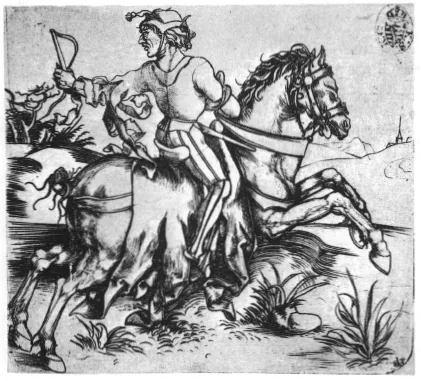
1. THE GREAT COURIER
No date [1495].1 A monogram added subsequently. Rounded corners.
100 X 113 mm; 3 7/8 X 4 3/8 in.
Only at Dresden, Melbourne, Paris and Vienna.
B.81; K.103; D.1; T.A19; M.78; P.188. [Abbreviations are explained on p. xviii.]
Earlier doubts have given way to the opinion that this is Dürer’s first experimental engraving since a drawing was found at Danzig which apparently served as the model for this subject.2 This drawing (W.9) is inscribed by Dürer: “Dz hat wofgang pewrer gemacht Jm 1484 Jor” (This was drawn by Wolfgang Peurer in the year 1484). Nothing else is known about Peurer.3 He may have been an apprentice or an assistant in the goldsmith’s shop of Dürer the Elder or in the workshop of Dürer’s teacher, the painter Michael Wolgemut.4
The watermark of the paper used for the printing of this engraving, “Cardinal’s Hat,” was used by Dürer infrequently beginning in 1507. It was also used for the posthumous edition of Dürer’s book Unterweisung der Messung (Instructions on Measurement). The rarity of this print, as well as the watermark, suggests that the remaining impressions are posthumous.
1 Throughout, dates within square brackets are approximate.
2 H. Secker, “Der grosse Postreiter,” Zeitschrift für bildende Kunst, 1918, vol. LIII, p. 256.
3 Recently Peurer has been tentatively identified as being identical with the Housebook Master. Cf. V. M. Strocka, “Albrecht Dürer und Wolfgang Peurer,” Festschrift für Kurt Badt, Cologne, 1970, pp. 249–260.
4 E. Flechsig, 1928, vol. I, p. 234. [References given by name and date only will be found in Part A of the Bibliography (p. 229), “Chronological List of Prior Catalogs and Commentaries,” under the respective data.]
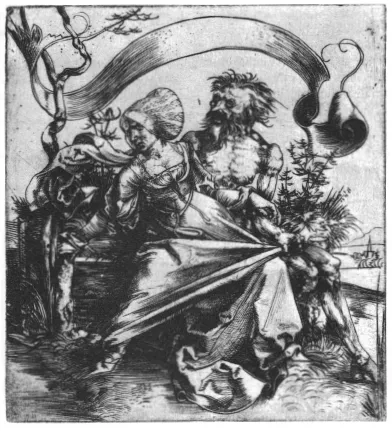
2. YOUNG WOMAN ATTACKED BY DEATH; or, THE RAVISHER
Without monogram or date [1495].
113 X 100 mm; 4 3/8 X 3 7/8 in.
Partial border lines at upper left and on the right side.
B.92; K.1; D.3; T.41; M.76; P. 199.
This engraving is today generally accepted as being by Dürer, although it is reminiscent of the Housebook Master in several respects. The thistle-like plant in the background, eryngium (sea holly), occurs in several of Dürer’s early works. Its reputedly aphrodisiac qualities were, according to Pliny,1 known already to the ancient Greeks, and apparently fascinated the young Dürer.
Perhaps this print is related to a Nuremberg news item of the year 1489, when a man was hanged for a number of attacks on women.2
1 Pliny, Natural History, Book 22, chapter 9; M. Stahlhelm, “Das Liebeskraut Eryngium auf den Bildern Albrecht Dürers,” Nürnberger Hefte, vol. I, no. 7, 1949.
2 F. Lippmann, Kunstgeschichtliche Gesellschaft, vol. V (cited by Tietze, 1928).
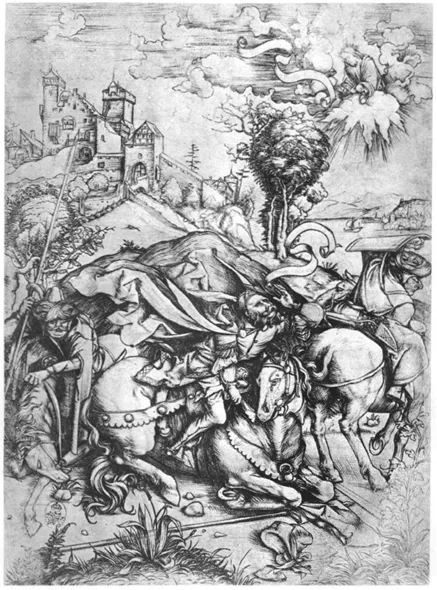
3. THE CONVERSION OF ST. PAUL
Without monogram or date [1495].
295 X 217 mm; 11 1/2 X 8 1/2 in.
Only at Dresden.
D.2; T.A20; M.46; P.217.
The authenticity of this work, which was first described in 1854,1 is still not fully established. Unquestionably it bears a resemblance to both “The Great Courier” (No. 1) and “The Ravisher” (No. 2). While Panofsky doubts the authenticity because all other early engravings by Dürer are of smaller size and unheroic in character, Winkler2 insists on the authenticity, asserting that this is the first instance in which Dürer dares to picture a dramatic event, turning away from the style of Schongauer. The lower right-hand corner is missing and has been reconstituted in ink.
1 J. G. A. Frenzel, Die Bekehrung des Paulus, ein Dürer zugeeignetes bis jetzt unbekanntes Kupferblatt aus des Meisters frühester Periode, Leipzig, 1854.
2 1957, p. 55.
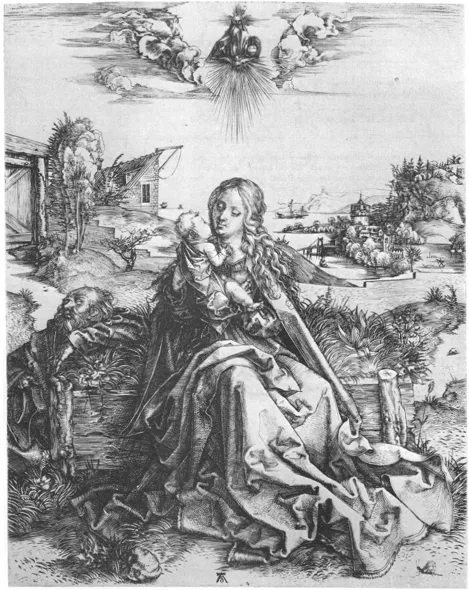
4. THE VIRGIN WITH THE DRAGONFLY
Monogram (capital A, small d); no date [1495].
240 X 186 mm; 9 3/8 X 7 1/4 in.
No border lines. The upper right corner rounded.
B.44; K.2; D.4; T.42; M.42; P.151.
The first of Dürer’s engravings bearing a monogram and the only one with this archaic version of it. The dragonfly has been variously identified as a grasshopper, a praying mantis and a butterfly. The composition is still primitive, although the severely foreshortened head of St. Joseph—asleep and old to stress the notion of Mary’s virginity—is in marked contrast to earlier still extant drawings by Dürer of this subject (W.23, 24, 30, 35). The face of the Virgin bears a great resemblance to Thalia of the series of drawings by Dürer known as “Tarocchi” (W.122).
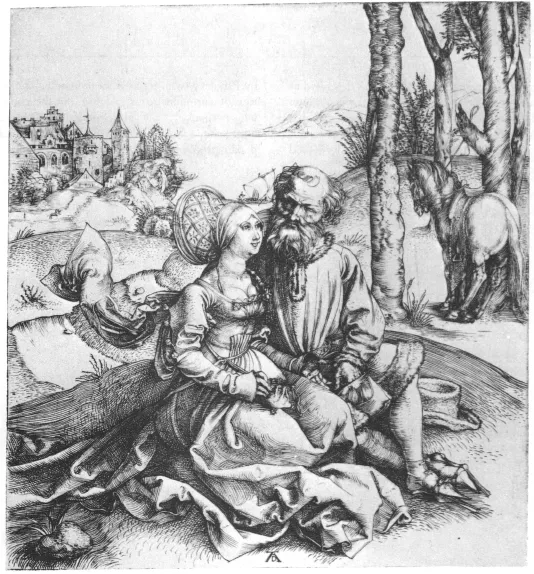
5. THE ILL-ASSORTED COUPLE; or, THE OFFER OF LOVE
Monogram; no date [1495].
151 X 139 mm; 5 7/8 X 5 3/8 in.
No border lines.
B.93; K.4; D.5; T.47; M.77; P.200.
The style of the monogram indicates that it is one of Dürer’s earliest engravings. The left-handedness of the subjects may be due to Dürer’s use of an earlier model.1 Although a moralizing theme was read into this episode by some early commentators, Dürer probably intended to do no more than to portray purchased love.
1 Thausing, 1876, vol. I, p. 210.
6. FIVE LANSQUENETS AND AN ORIENT...
Table of contents
- Cover Page
- Title Page
- Copyright Page
- THE PLATES
- Bibliography
- Index of Plates According to Subject (and Concordance with Bartsch Numbers)
- Back Cover
Trusted by 375,005 students
Access to over 1.5 million titles for a fair monthly price.
Study more efficiently using our study tools.
Frequently asked questions
Yes, you can cancel anytime from the Subscription tab in your account settings on the Perlego website. Your subscription will stay active until the end of your current billing period. Learn how to cancel your subscription
No, books cannot be downloaded as external files, such as PDFs, for use outside of Perlego. However, you can download books within the Perlego app for offline reading on mobile or tablet. Learn how to download books offline
Perlego offers two plans: Essential and Complete
- Essential is ideal for learners and professionals who enjoy exploring a wide range of subjects. Access the Essential Library with 800,000+ trusted titles and best-sellers across business, personal growth, and the humanities. Includes unlimited reading time and Standard Read Aloud voice.
- Complete: Perfect for advanced learners and researchers needing full, unrestricted access. Unlock 1.5M+ books across hundreds of subjects, including academic and specialized titles. The Complete Plan also includes advanced features like Premium Read Aloud and Research Assistant.
We are an online textbook subscription service, where you can get access to an entire online library for less than the price of a single book per month. With over 1.5 million books across 990+ topics, we’ve got you covered! Learn about our mission
Look out for the read-aloud symbol on your next book to see if you can listen to it. The read-aloud tool reads text aloud for you, highlighting the text as it is being read. You can pause it, speed it up and slow it down. Learn more about Read Aloud
Yes! You can use the Perlego app on both iOS and Android devices to read anytime, anywhere — even offline. Perfect for commutes or when you’re on the go.
Please note we cannot support devices running on iOS 13 and Android 7 or earlier. Learn more about using the app
Please note we cannot support devices running on iOS 13 and Android 7 or earlier. Learn more about using the app
Yes, you can access The Complete Engravings, Etchings and Drypoints of Albrecht Dürer by Albrecht Dürer in PDF and/or ePUB format, as well as other popular books in Art & Artist Monographs. We have over 1.5 million books available in our catalogue for you to explore.