Designed for advanced high school students, undergraduates, graduate students, mathematics teachers, and any lover of mathematical challenges, this two-volume set offers a broad spectrum of challenging problems — ranging from relatively simple to extremely difficult. Indeed, some rank among the finest achievements of outstanding mathematicians.
Translated from a well-known Russian work entitled Non-Elementary Problems in an Elementary Exposition, the chief aim of the book is to acquaint the readers with a variety of new mathematical facts, ideas, and methods. And while the majority of the problems represent questions in higher ("non-elementary") mathematics, most can be solved with elementary mathematics. In fact, for the most part, no knowledge of mathematics beyond a good high school course is required.
Volume One contains 100 problems, with detailed solutions, all dealing with probability theory and combinatorial analysis. Topics include the representation of integers as sums and products, combinatorial problems on the chessboard, geometric problems on combinatorial analysis, problems on the binomial coefficients, problems on computing probabilities, experiments with infinitely many possible outcomes, and experiments with a continuum of possible outcomes.
Volume Two contains 74 problems from various branches of mathematics, dealing with such topics as points and lines, lattices of points in the plane, topology, convex polygons, distribution of objects, nondecimal counting, theory of primes, and more. In both volumes the statements of the problems are given first, followed by a section giving complete solutions. Answers and hints are given at the end of the book.
Ideal as a text, for self-study, or as a working resource for a mathematics club, this wide-ranging compilation offers 174 carefully chosen problems that will test the mathematical acuity and problem-solving skills of almost any student, teacher, or mathematician.
eBook - ePub
Challenging Mathematical Problems with Elementary Solutions, Vol. I
- 239 pages
- English
- ePUB (mobile friendly)
- Available on iOS & Android
eBook - ePub
Challenging Mathematical Problems with Elementary Solutions, Vol. I
About this book
Information
Subtopic
Counting & NumerationIndex
MathematicsSOLUTIONS
I. INTRODUCTORY PROBLEMS
1. Let A, B, C be the three given points, and suppose l is a line equidistant from them. If A, B, C were all on the same side of l, they would lie on a line parallel to l, contradicting the hypothesis. Therefore two of the points are on one side of l and the third point is on the other side of l. Suppose for example that A and B are on one side of l while C is on the other side. Then l must be parallel to the line AB and must pass through the midpoint of the perpendicular CP from P to the line AB (fig. 12).
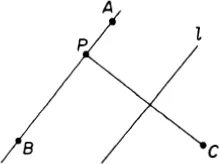
Fig. 12
These conditions completely determine l; conversely the line l so determined is actually equidistant from A, B, C. Hence there is a total of three lines equidistant from A, B, C (one separating each of the points from the other two points).
2. Let A, B, C, D be the four given points, and suppose Π is a plane which is equidistant from them. If A, B, C, D were all on the same side of Π, they would lie in a plane parallel to Π, contradicting the conditions of the problem. Consequently, only the following two cases are possible: (1) Three of the points lie on one side of Π and the fourth point is on the other side. (2) There are two of the points on each side of Π.
Consider case 1. Let A, B, C lie on one side of II and D on the other side (fig. 13). The points A, B, C cannot be collinear, since if they were, all four points would be coplanar. Therefore A, B, C determine a unique plane, which must be parallel to Π. Moreover, Π must pass through the midpoint of the perpendicular DP which joins D to the plane ABC. Thus there is one and only one plane Π equidistant from A,B,C, D with A,B,C on one side of it and D on the other side.
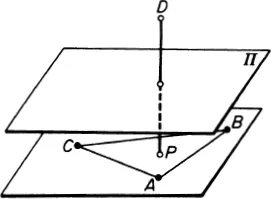
Fig. 13
By the same reasoning there is exactly one plane equidistant from A, B, C, D with C (or B or A) on one side of it and the other three points on the other side of it. Thus there are a total of four planes in case 1.
Consider case 2. Let A, B lie on one side of Π and C, D on the other side (fig. 14). Since Π is equidistant from A and B, it must be parallel to the line AB. Likewise Π must be parallel to the line CD. Since A, B, C, D are not coplanar, the lines AB and CD must be skew. Now draw a plane Π1 containing AB and parallel to CD (this can be done by drawing a line l through A parallel to CD; then Π1 is the plane containing l and B). Also draw a plane Π2 containing CD and parallel to AB. Then II is parallel to these planes and equidistant from them, so it must pass through the midpoint of any perpendicular joining them (fig. 14). Thus there is one and only one plane Π equidistant from A, B, C, D with A, B on one side and C, D on the other.
The same reasoning shows that there is exactly one plane equidistant from A,B,C, D with A, C on one side and B, D on the other; and exactly one with A, D on one side and B, C on the other. Thus there are a total of three planes in case 2.
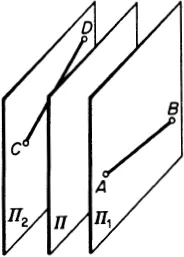
Fig. 14
Combining the two cases gives a total of 4 + 3 = 7 equidistant planes. If one considers the tetrahedron (triangular pyramid) with vertices A, B, C, D, then four of these seven planes are parallel to the faces of the tetrahedron and will pass through ...
Table of contents
- Cover
- Title Page
- Copyright Page
- Contents
- Preface to the American Edition
- Suggestions for using the Book
- Problems
- Solutions
- Answers and Hints
Trusted by 375,005 students
Access to over 1.5 million titles for a fair monthly price.
Study more efficiently using our study tools.
Frequently asked questions
Yes, you can cancel anytime from the Subscription tab in your account settings on the Perlego website. Your subscription will stay active until the end of your current billing period. Learn how to cancel your subscription
No, books cannot be downloaded as external files, such as PDFs, for use outside of Perlego. However, you can download books within the Perlego app for offline reading on mobile or tablet. Learn how to download books offline
Perlego offers two plans: Essential and Complete
- Essential is ideal for learners and professionals who enjoy exploring a wide range of subjects. Access the Essential Library with 800,000+ trusted titles and best-sellers across business, personal growth, and the humanities. Includes unlimited reading time and Standard Read Aloud voice.
- Complete: Perfect for advanced learners and researchers needing full, unrestricted access. Unlock 1.5M+ books across hundreds of subjects, including academic and specialized titles. The Complete Plan also includes advanced features like Premium Read Aloud and Research Assistant.
We are an online textbook subscription service, where you can get access to an entire online library for less than the price of a single book per month. With over 1.5 million books across 990+ topics, we’ve got you covered! Learn about our mission
Look out for the read-aloud symbol on your next book to see if you can listen to it. The read-aloud tool reads text aloud for you, highlighting the text as it is being read. You can pause it, speed it up and slow it down. Learn more about Read Aloud
Yes! You can use the Perlego app on both iOS and Android devices to read anytime, anywhere — even offline. Perfect for commutes or when you’re on the go.
Please note we cannot support devices running on iOS 13 and Android 7 or earlier. Learn more about using the app
Please note we cannot support devices running on iOS 13 and Android 7 or earlier. Learn more about using the app
Yes, you can access Challenging Mathematical Problems with Elementary Solutions, Vol. I by A. M. Yaglom,I. M. Yaglom, I. M. Yaglom in PDF and/or ePUB format, as well as other popular books in Mathematics & Counting & Numeration. We have over 1.5 million books available in our catalogue for you to explore.