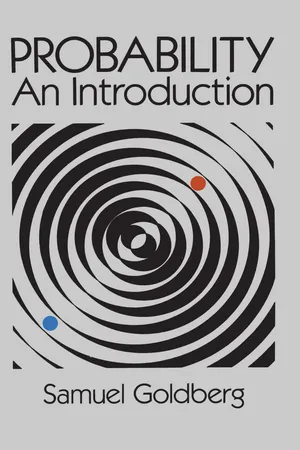
Excellent basic text covers set theory, probability theory for finite sample spaces, binomial theorem, probability distributions, means, standard deviations, probability function of binomial distribution, and other key concepts and methods essential to a thorough understanding of probability. Designed for use by math or statistics departments offering a first course in probability. 360 illustrative problems with answers for half. Only high school algebra needed. Chapter bibliographies.
- 352 pages
- English
- ePUB (mobile friendly)
- Available on iOS & Android
eBook - ePub
About this book
Information
Chapter 1
SETS

1. Examples of sets; basic notation
The concept of a set, whose fundamental role in mathematics was first pointed out in the work of the mathematician Georg Cantor (1845–1918), has significantly affected the structure and language of modern mathematics. In particular, the mathematical theory of probability is now most effectively formulated by using the terminology and notation of sets. For this reason, we devote Chapter 1 to the elementary mathematics of sets. Additional topics in set theory are included throughout the text, as the need for this material becomes apparent.
The notion of a set is sufficiently deep in the foundation of mathematics to defy being defined (at the level of this book) in terms of still more basic concepts. Hence, we can only aim here, by taking advantage of the reader’s knowledge of the English language and his experience with the real and conceptual world, to make clear the denotation of the word “set.”
A set is merely an aggregate or collection of objects of any sort: people, numbers, books, outcomes of experiments, geometrical figures, etc. Thus, we can speak of the set of all integers, or the set of all oceans, or the set of all possible sums when two dice are rolled and the number of dots on the uppermost faces are added, or the set consisting of the cities of Cambridge and Oberlin and all their residents, or the set of all straight lines (in a given plane) which pass through a given point.
The collection of objects must be well-defined, by which we mean that, for any object whatsoever, the question “Does this object belong to the collection?” has an unequivocal “yes” or “no” answer. It is not necessary that we personally have the knowledge required to decide which answer is correct. We must know only that, of the answers “yes” and “no,” exactly one is correct.
Let us also agree that no object in a set is counted twice; i.e., the objects are distinct. It follows that, when listing the objects in a set, we do not repeat an object after it is once recorded. For example, according to this convention, the set of letters in the word “banana” is a set containing not six letters, but rather the three distinct letters b, a and n.
The following definition summarizes our discussion to this point and introduces some additional terminology and notation.
Definition 1.1. A set is a well-defined collection of distinct objects. The individual objects that collectively make up a given set are called its elements, and each element belongs to or is a member of or is contained in the set. If a is an object and A a set, then we write a ∈ A as an abbreviation for “a is an element of A.” and a ∉ Λ for “a is not an element of A.” If a set has a finite number of elements, then it is called...
Table of contents
- Cover
- Title Page
- Copyright Page
- Preface
- Acknowledgments
- Contents
- Chapter 1. SETS
- Chapter 2. Probability in Finite Sample Spaces
- Chapter 3. Sophisticated Counting
- Chapter 4. Random Variables
- Cahpter 5. Binomial Distribution and some Applications
- Answers to Odd–Numbered Problems
- Index
Trusted by 375,005 students
Access to over 1.5 million titles for a fair monthly price.
Study more efficiently using our study tools.
Frequently asked questions
Yes, you can cancel anytime from the Subscription tab in your account settings on the Perlego website. Your subscription will stay active until the end of your current billing period. Learn how to cancel your subscription
No, books cannot be downloaded as external files, such as PDFs, for use outside of Perlego. However, you can download books within the Perlego app for offline reading on mobile or tablet. Learn how to download books offline
Perlego offers two plans: Essential and Complete
- Essential is ideal for learners and professionals who enjoy exploring a wide range of subjects. Access the Essential Library with 800,000+ trusted titles and best-sellers across business, personal growth, and the humanities. Includes unlimited reading time and Standard Read Aloud voice.
- Complete: Perfect for advanced learners and researchers needing full, unrestricted access. Unlock 1.5M+ books across hundreds of subjects, including academic and specialized titles. The Complete Plan also includes advanced features like Premium Read Aloud and Research Assistant.
We are an online textbook subscription service, where you can get access to an entire online library for less than the price of a single book per month. With over 1.5 million books across 990+ topics, we’ve got you covered! Learn about our mission
Look out for the read-aloud symbol on your next book to see if you can listen to it. The read-aloud tool reads text aloud for you, highlighting the text as it is being read. You can pause it, speed it up and slow it down. Learn more about Read Aloud
Yes! You can use the Perlego app on both iOS and Android devices to read anytime, anywhere — even offline. Perfect for commutes or when you’re on the go.
Please note we cannot support devices running on iOS 13 and Android 7 or earlier. Learn more about using the app
Please note we cannot support devices running on iOS 13 and Android 7 or earlier. Learn more about using the app
Yes, you can access Probability by Samuel Goldberg in PDF and/or ePUB format, as well as other popular books in Mathematics & Probability & Statistics. We have over 1.5 million books available in our catalogue for you to explore.