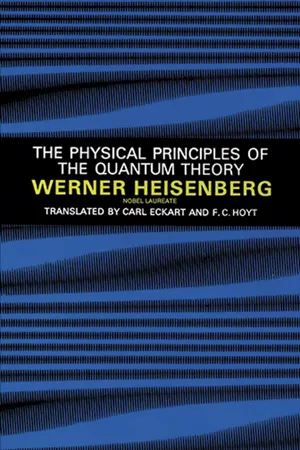
The contributions of few contemporary scientists have been as far reaching in their effects as those of Nobel Laureate Werner Heisenberg. His matrix theory is one of the bases of modern quantum mechanics, while his "uncertainty principle" has altered our whole philosophy of science. In this classic, based on lectures delivered at the University of Chicago, Heisenberg presents a complete physical picture of quantum theory. He covers not only his own contributions, but also those of Bohr, Dirac, Bose, de Broglie, Fermi, Einstein, Pauli, Schrodinger, Somerfield, Rupp, ·Wilson, Germer, and others in a text written for the physical scientist who is not a specialist in quantum theory or in modern mathematics. Partial contents: introduction (theory and experiment, fundamental concepts); critique of physical concepts of the corpuscular theory (uncertainty relations and their illustration); critique of the physical concepts of the wave theory (uncertainty relations for waves, discussion of an actual measurement of the electromagnetic field); statistical interpretation of quantum theory (mathematical considerations, interference of probabilities, Bohr's complementarity); discussion of important experiments (C. T. R. Wilson, diffraction , Einstein-Rupp, emission, absorption and dispersion of radiation, interference and conservation laws, Compton effect, radiation fluctuation phenomena, relativistic formulation of the quantum theory). An 80-page appendix on the mathematical apparatus of the quantum theory is provided for the specialist.
For the derivation of the mathematical scheme of the quantum theory, whether based on the wave or the particle picture, two sources are available: empirical facts and the correspondence principle. The correspondence principle, which is due to Bohr,3 postulates a detailed analogy between the quantum theory and the classical theory appropriate to the mental picture employed. This analogy does not merely serve as a guide to the discovery of formal laws; its special value is that it furnishes the interpretation of the laws that are found in terms of the mental picture used.
We commence with a derivation of the mathematical structure of quantum mechanics from the corpuscular analogy.4
§ 1. THE CORPUSCULAR CONCEPT OF MATTER
The fundamental equations of classical mechanics for a system of f-degrees of freedom may be written in the so-called “canonical” form,
where q1q2 …., qf are the generalized co-ordinates, p1p2, …., pf their conjugate momenta, and H the Hamiltonian function. When H does not depend explicitly on the time the energy equation
where W, the total energy, is a constant, follows at once. For simplicity it may be assumed that the system is multiply periodic, in which case any co-ordinate qk as a function of the time may be written as a Fourier series, that is, as a sum of harmonic terms in the form
The
are amplitudes independent of the time and v1v2 …., vj are the fundamental frequencies of the motion. Similar expressions involving the same frequencies may be written for the pk and in general for any function of the pk and qk.
By a canonical transformation – that is, one which leaves invariant the form of equations (1) – it is possible to introduce a new set of canonical conjugates Jk, wk, known as “action-angle variables.” These are essentially defined by the following properties: The Hamiltonian H depends on the Jk only and the wk are related to the fundamental frequencies of the motion by equations of the form
where the βk are constants. In these variables the equations of motion therefore become
According to classical electrodynamics the frequencies of the spectral lines emitted by an atom will be the frequencies of the harmonic terms in equation (3) and the amplitudes will determine the corresponding intensities.
According to the correspondence principle there must exist a close relationship between the mechanics of classical particles as outlined above and the mechanics of the quantum theory. For the latter we must therefore seek a set of equations analogous in form to the equations of classical theory, but which also take account of certain well-established empirical facts of atomic physics. Primary among these are the following:
1. The Rydberg-Ritz combination principle. – The observed spectral frequencies of an atom possess a characteristic term structure. That is, all the spectral lines of an element may be represented as the differences of a relatively small number of terms. If these terms are arranged in a one-dimensional array T1T2 …., the atomic frequencies form a two-dimensional array
from which follows at once the combination principle
2. The existence of discrete energy values. – The fundamental experiments of Franck and Hertz on electronic impacts show that the energy of an atom can take on only certain definite discrete5 values, W1, W2, ….
3. The Bohr frequency relation. – The characteristic frequencies of an atom are related to its characteri...
Table of contents
Cover
Title Page
Copyright Page
Foreword
Preface
Table of Contents
I. Introductory
II. Critique of the Physical Concepts of the Corpuscular Theory
III. Critique of the Physical Concepts of the Wave Theory
IV. The Statistical Interpretation of Quantum Theory
V. Discussion of Important Experiments
Appendix: The Mathematical Apparatus of the Quantum Theory
Index
Trusted by 375,005 students
Access to over 1.5 million titles for a fair monthly price.
Study more efficiently using our study tools.
Frequently asked questions
Yes, you can cancel anytime from the Subscription tab in your account settings on the Perlego website. Your subscription will stay active until the end of your current billing period. Learn how to cancel your subscription
No, books cannot be downloaded as external files, such as PDFs, for use outside of Perlego. However, you can download books within the Perlego app for offline reading on mobile or tablet. Learn how to download books offline
Perlego offers two plans: Essential and Complete
Essential is ideal for learners and professionals who enjoy exploring a wide range of subjects. Access the Essential Library with 800,000+ trusted titles and best-sellers across business, personal growth, and the humanities. Includes unlimited reading time and Standard Read Aloud voice.
Complete: Perfect for advanced learners and researchers needing full, unrestricted access. Unlock 1.5M+ books across hundreds of subjects, including academic and specialized titles. The Complete Plan also includes advanced features like Premium Read Aloud and Research Assistant.
Both plans are available with monthly, semester, or annual billing cycles.
We are an online textbook subscription service, where you can get access to an entire online library for less than the price of a single book per month. With over 1.5 million books across 990+ topics, we’ve got you covered! Learn about our mission
Look out for the read-aloud symbol on your next book to see if you can listen to it. The read-aloud tool reads text aloud for you, highlighting the text as it is being read. You can pause it, speed it up and slow it down. Learn more about Read Aloud
Yes! You can use the Perlego app on both iOS and Android devices to read anytime, anywhere — even offline. Perfect for commutes or when you’re on the go. Please note we cannot support devices running on iOS 13 and Android 7 or earlier. Learn more about using the app
Yes, you can access The Physical Principles of the Quantum Theory by Werner Heisenberg in PDF and/or ePUB format, as well as other popular books in Physical Sciences & Physics. We have over 1.5 million books available in our catalogue for you to explore.