![]()
PUPPIS
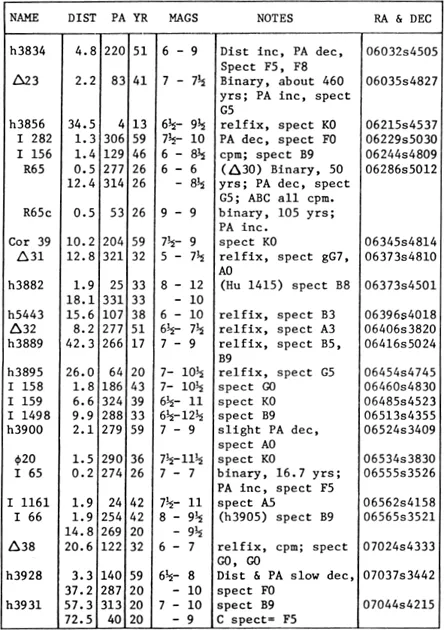
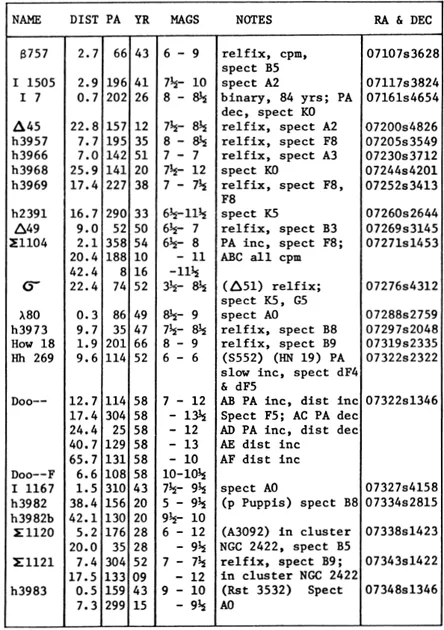
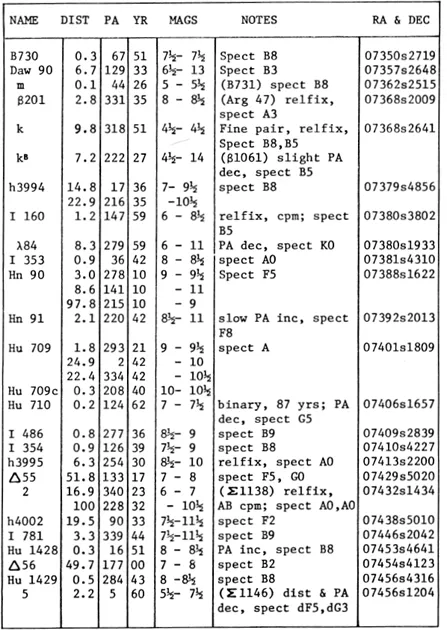
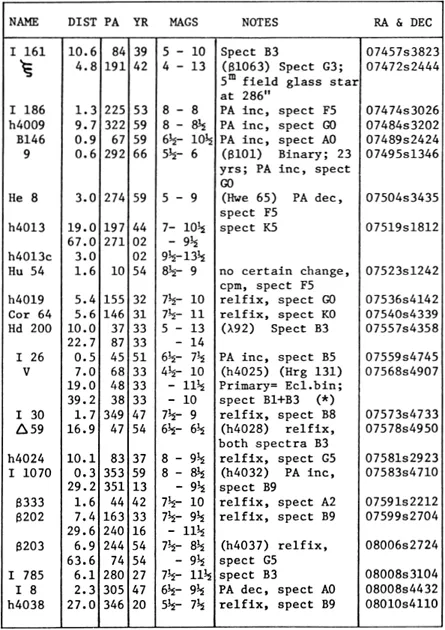
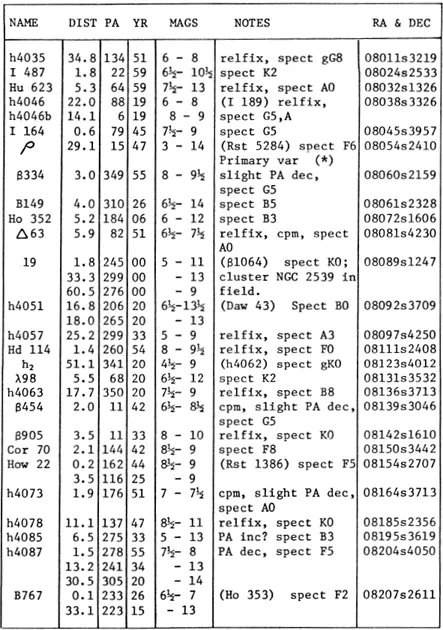
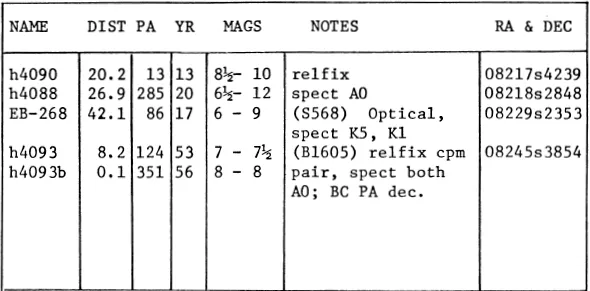
LIST OF DOUBLE AND MULTIPLE STARS
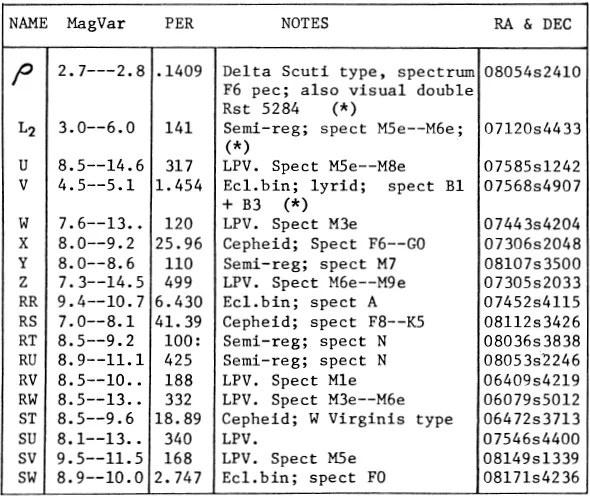
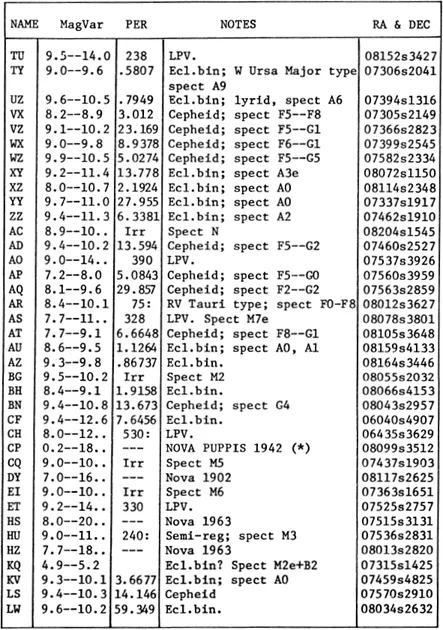
LIST OF VARIABLE STARS
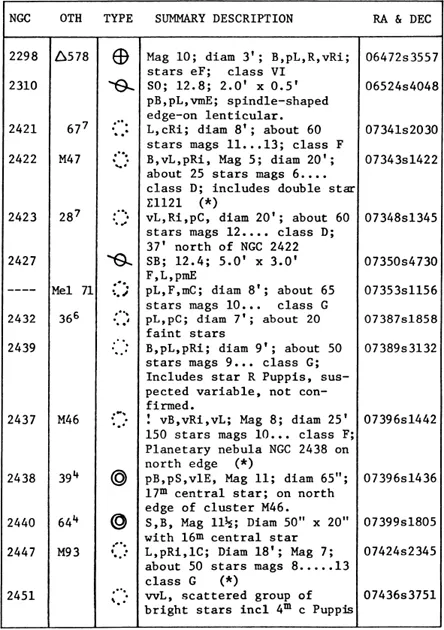
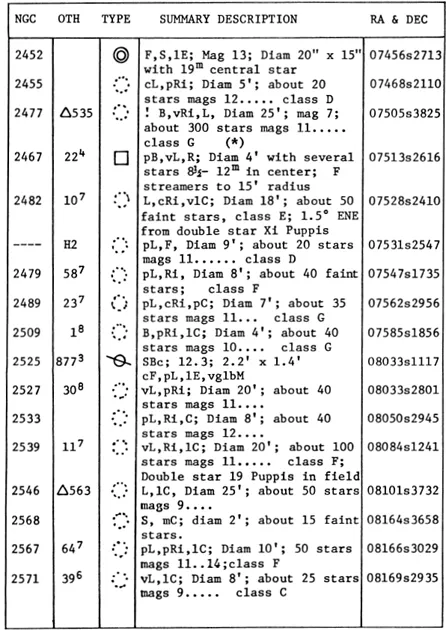
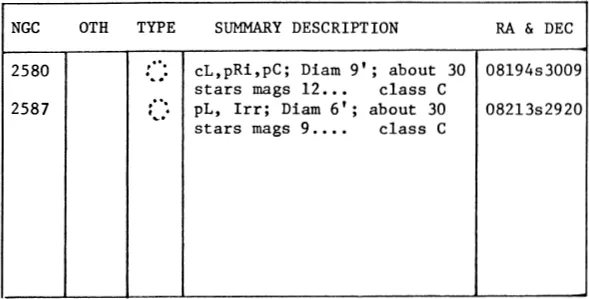
LIST OF STAR CLUSTERS, NEBULAE AND GALAXIES
DESCRIPTIVE NOTES
ZETA
Magnitude 2.25; Spectrum 05; position 08018s 3952. Zeta Puppis is a supergiant star, one of the most luminous stars known in our Galaxy; at a computed distance of about 2400 light years, the actual luminosity is close to 60,000 times that of the Sun, and the derived absolute magnitude is –7.1. The star is comparable to Rigel in energy output; if such a star were as near to us as Vega, it would appear to us about 12 times brighter than Venus at her best! Zeta Puppis shows an annual proper motion of about 0.03″; the radial velocity is 14½ miles per second in approach.
The star is located in a rich region of the winter Milky Way (to Northern Hemisphere observers) and the owner of a good wide–field telescope will find many stunning fields in the surrounding region. Just 2½° to the northwest is the splendid rich star cluster NGC 2477, while 5° NNE is the spot where the brilliant nova CP Puppis flared up in November 1942. The star AP Puppis, shown on the Skalnate Pleso Atlas, about 1° west, is a cepheid with a 5–day period of oscillation.
NU
Magnitude 3.18; Spectrum B7 or B8 III; position 06362s4309, about 10° NNE from the brilliant star Canopus. The computed distance of the star is about 600 light years, giving the true luminosity as 1600 times that of the Sun (absolute magnitude –3.2). The annual proper motion is 0.01″; the radial velocity is 17 miles per second in recession.
XI
Magnitude 3.34; Spectrum G3 Ib; position 07472s2444. Xi Puppis is a yellow supergiant star with a computed actual luminosity of about 5800 suns (absolute magnitude –4.6); the derived distance is about 1200 light years. The annual proper motion is less than 0.01″; the radial velocity is 1.6 miles per second in recession.
The 13th magnitude companion at 4.8″ was first noted by S.W.Burnham with the 36–inch refractor at Lick Observatory in 1889. The projected separation of the pair is 1770 AU, but it is not certain that the two stars are physically related; there has been no definite relative change in the pair since discovery. The faint star, if it is at the same distance as the primary, has an actual luminosity about equal to our Sun.
Xi Puppis lies in a fine region of the Puppis Milky Way, rich in myriads of faint stars. The difficult double star B146 lies 0.5° to the NE, and the attractive cluster M93 is just 1.6° to the NW. Note also the curious diffuse nebula NGC 2467, about 1.7° to the SSE.
PI
Magnitude 2.81; Spectrum K4 or K5 III. Position 07154s3700, about 8° below the stars Eta and Epsilon in Canis Major, which mark the feet of Orion’s Great Dog. Pi Puppis is a moderate sized giant star, probably somewhat over 100 times the solar luminosity (computed absolute magnitude –0.3). It is some 140 light years distant. Slight variability has been suspected; the range of catalogue magnitudes is from 2.70 to about 2.85. The annual proper motion is 0.01″; the radial velocity is 9½ miles per second in recession.
Pi Puppis forms a charming color contrast group with the two components of Upsilon Puppis, which lies 26′ to the NNE. The two stars are magnitudes 4.7 and 5.1, with a separation of about 4′; both spectra are B3 V. These two bluish stars possibly form a true pair, as the measured proper motions, although only 0.01″, agree closely, as do the radial velocities of 12 and 14 miles per second in recession. The western star has an emission line spectrum while the eastern component shows a variable radial velocity and is probably a spectroscopic binary. The bluish pair contrasts beautifully with the bright orange tint of Pi itself. From the lack of any measurable parallax, the two B–stars appear to be at least three times more remote than Pi itself; their distance is probably about 500 light years, and each star has about 100 times the luminosity of the Sun.
RHO
Magnitude 2.80 (slightly variable). Spectrum F6 IIp; Position 08054s2410. Rho Puppis is one of the brightest and best known examples of a “Delta Scuti” type of variable star, a small class of pulsating stars which resemble the RR Lyrae (cluster variables) stars, but have shorter periods and smaller amplitudes. The variability of Rho Puppis was discovered by O.J.Eggen at Mt.Stromlo in Australia, and was independently detected at the Cape Observatory in South Africa. Visually, the star is not a very exciting variable, as the amplitude is only 0.15 magnitude; the range is about 2.72 to 2.87. This star, however, has one of the shortest periods known for any pulsating variable, only 3h 23m, or 0.14088143 day. The star Delta Scuti, often regarded as the standard star of the type, has a slightly longer period (4.65 hours) and a slightly earlier spectral class (F3). The two stars appear to be quite comparable in actual luminosity; the absolute magnitude in each case is about +0.3. In actual luminosity these are among the brightest of the Delta Scuti stars; other examples range from about +1.0 to +2.2. Stars of the class often seem to be somewhat underluminous for their spectral types; a normal F6 II star, for example, should have an absolute magnitude of about –2.0.
Rho Puppis is approximately 100 light years distant, and shows an annual proper motion of 0.10″; the radial velocity is 28 miles per second in recession. (Refer also to Delta Scuti, Epsilon Cephei, and RR Lyrae)
SIGMA
Magnitude 3.28; Spectrum K5 III; Position 07276s4312, about 7½° NW from Gamma Velorum. Sigma Puppis is a common proper motion double star with a fixed separation of 22.4″ in PA 74°; magnitudes 3.3 and 8½. E.J.Hartung (1968) refers to it as “a brilliant orange star with white (by. contrast) companion.…a fine sight in the star sprinkled field.…7.5 cm shows it well.” At a computed distance of 180 light years the actual luminosity of the faint star is about equal to our own Sun; the primary is some 120 times more luminous. The two stars share the proper motion of 0.20″ annually in PA 336°; the spectral types are K5 III and G5 V; and the projected separation of the two stars is about 1200 AU.
The third magnitude primary is itself a spectroscopic binary with a period of 257.8 days and an eccentricity of 0.17; the mean radial velocity is about 54 miles per second in recession.
TAU
Magnitude 2.95; Spectrum K0 III; Position 06487s5033, at the southern edge of the constellation, about 4.3° NE of Canopus. The computed distance of the star is about 125 light years; the resulting actual luminosity is 75 times that of the Sun (absolute magnitude +0.1). Tau Puppis shows an annual proper motion of 0.08″; the radial velocity is 22 miles per second in recession. The star is a spectroscopic binary with a period of 1066 days and an eccentricity of 0.088.
L2
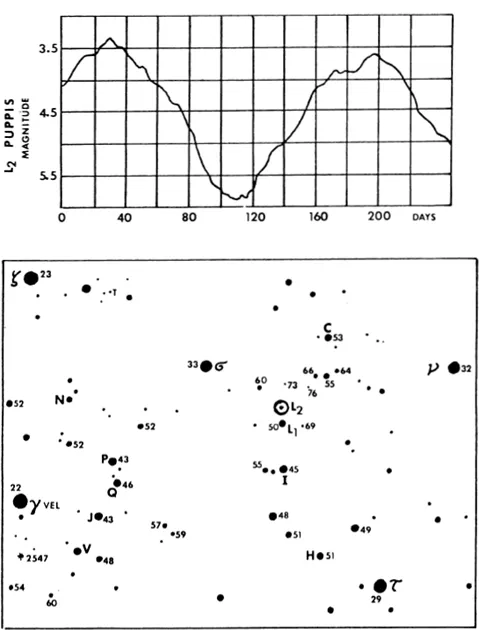
Magnitude 3.0 (variable); Spectrum M5e; Position 07120s4433, about 2.7° SW of Sigma Puppis. The star Is also designated GC 9604 and h3943. One of the brightest of the red variable stars, usually classed as a semi–regular type, occasionally as a member of the Omicron Ceti or LPV type. It was discovered by B.A. Gould in 1872, and the average period of about 141 days was first determined by Isaac Roberts. The star is a naked–eye object throughout much of its cycle, falling to 6th magnitude at minimum, and rising sometimes to brighter than 3rd at maximum. A rather symmetrical light curve is one of the unusual features of the star; the time required to rise from minimum to maximum is almost exactly half of the total period. At maximum the spectral class is gM5e.
L2 Puppis is also the visual double star h3943, the companion being a 9½ magnitude star about 1′ distant in PA 214°; the last measurement reported in the Lick Observatory Index Catalogue of Visual Double Stars was made in 1913, when the separation was 62″. The fairly large proper motion of the primary, however, is carrying it away from the faint star, and the separation is increasing steadily. Hence the star no longer appears in most modem lists of double stars.
From the spectral features, the assumed luminosity of the star is about –3.1, or over 1400 times the light of the Sun; this implies a distance in the range of 600 – 650 light years. Direct parallax measurements, however, lead to a much smaller distance of about 200 light years, and the moderately large proper motion supports the smaller distance estimate. The annual proper motion is 0.34″ in PA 18°; at 650 light years this corresponds to a transverse velocity of about 320 miles per second, an improbably high value. Also, of course, a star at 650 light years would scarcely show a measurable parallax. Evidently this is one star in which the spectroscopic features are not a reliable indicator of luminosity. Tentatively accepting the smaller distance of about 200 light years, the actual luminosity at maximum appears to be about 200 times the Sun, and the absolute magnitude about –1.0. This suggests a luminosity class of II or III. The star shows a radial velocity of 32 miles per second in recession, which varies somewhat during the course of the star’s pulsations. (Refer also to Omicron Ceti)
V
Position 07568s4907. A bright eclipsing variable star of the Beta Lyrae type, discovered by A.S.Williams in 1886. It is located in the extreme SE corner of the constellation, a little more than 8° southeast of L2 Puppis, and 2½° southwest of Gamma Velorum. The star consists of two brilliant B–type giants revolving nearly in contact in a period of 1.4544877 day, or 1d 10h 54m 28s. As the orbit is oriented only 15° from the edge–on position, both components alternately eclipse each other in the course of each revolution. The star never drops below naked–eye visibility during its cycle; the photographic range, according to the Moscow General Catalogue of Variable Stars (1970) is 4.74 to 5.25. A binary of this type shows a continuously varying magnitude; the light curve is a sinusoidal wave with minima of two different depths midway between the maxima. In this case, the primary minimum is only a few hundredths of a magnitude deeper than the secondary one, indicating that the two stars do not differ very greatly in size or brightness. V Puppis is one of those stars which presents us with the “Beta Lyrae problem”; the distortion of the radial velocity measurements by moving gas streams between the stars, making the derived orbital elements unreliable. Thus the masses of about 19 suns each, derived from the direct analysis of the radial velocity curves, are now thought to be in error. In his comprehensive table of eclipsing binary stars, S.Gaposchkin adopted the following dimensions, masses and luminosities for the system, based on studies by H.van Gent and D.M.Popper:
L2 PUPPIS and V PUPPIS FIELD. The chart is about 12° high. Numbers indicate comparison magnitudes according to the AAVSO, with decimal points omitted.
The computed separation of the two stars, center to center, is about 5.3 million miles, which implies that their surfaces are nearly in contact. Both stars are ovoid in shape as a result of rapid rotation and tidal distortion; the amplitude of the radial velocity curve is close to 360 miles per second. No eccentricity can be detected in this system; the orbits seem perfectly circular. Spectroscopic studies show that the gas stream moves from the fainter star to the brighter one, gradually altering the masses of the components, and changing the orbital elements. Like Beta Lyrae, this system is being observed at a critical point in its evolution.
From the derived luminosities, the distance appears to be about 1300 light years. The annual proper motion is 0.02″; the mean radial velocity is about 12 miles per second in recession.
V Puppis is also the visual double star h4025, but it is not certain that the companions are physically associated with the bright star. The closer star is a...