![]()
ORION
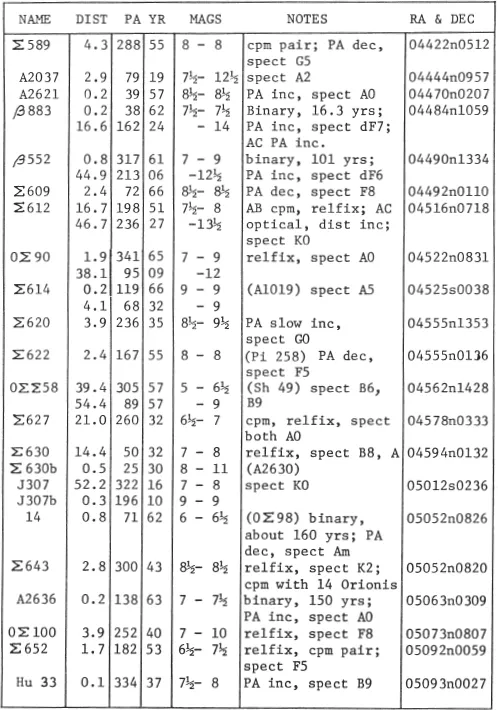
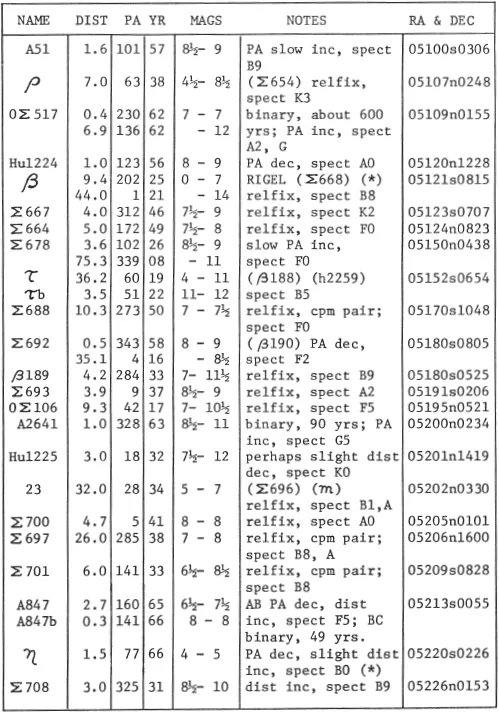
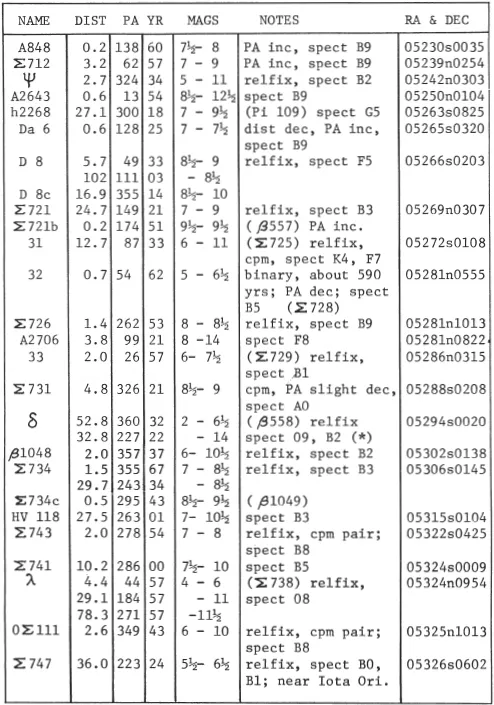
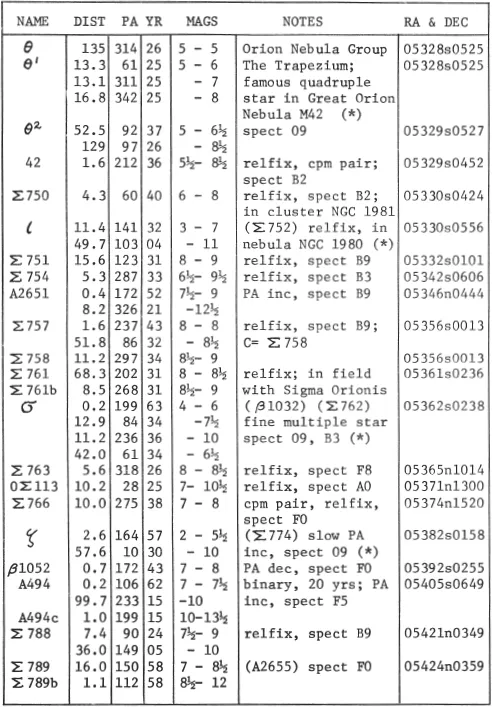
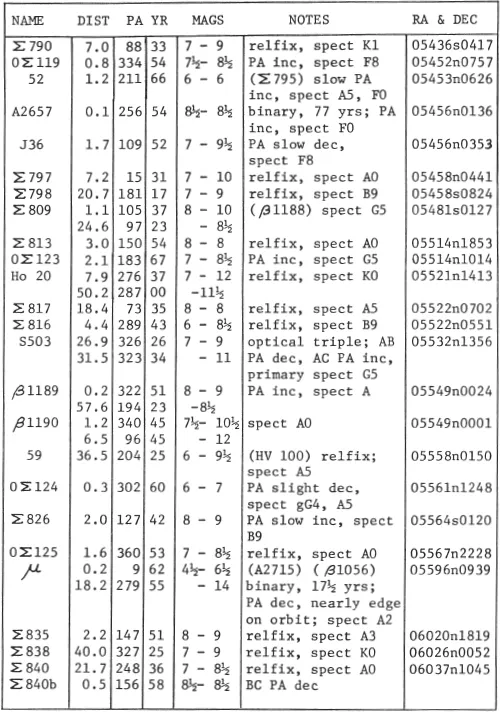
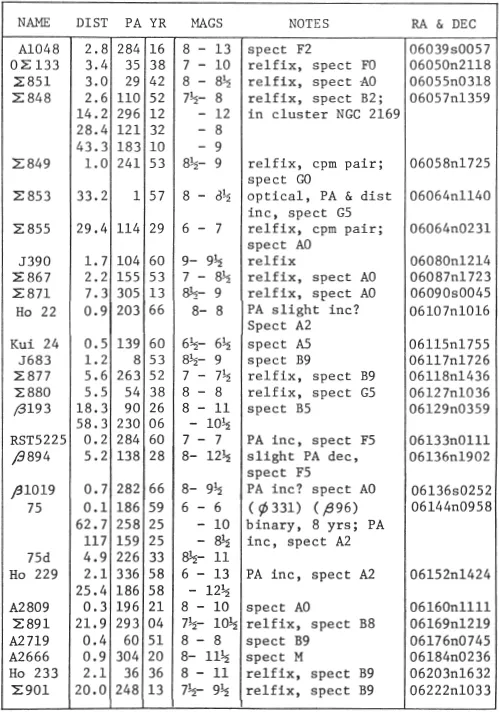
LIST OF DOUBLE AND MULTIPLE STARS
LIST OF STAR CLUSTERS, NEBULAE, AND GALAXIES
DESCRIPTIVE NOTES
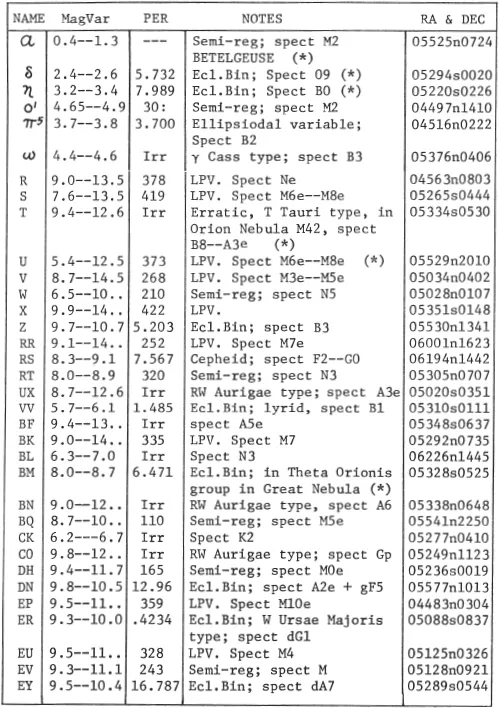
ALPHA Name- BETELGEUSE or BETELGEUX. Magnitude 0.70 (variable); Spectrum M2 Ia; position 05525n 0724. The name of the star is usually translated “The Armpit of the Giant” or the “Arm of the Central One”; it has also been called “The Martial Star”, evidently from its ruddy color. The tint is usually described as golden orange or deep topaz; although this is one of the most famous of the red giant stars, the color is actually more orange than truly “red”. The exotic word padparadasohah, used in India to designate the rare orange sapphire, might be an appropriate name for Betelgeuse; the approximate meaning is something like “The Royal Jewel of the Lotus Blossom”. The star should be compared with the white blaze of Rigel in order to appreciate the color contrast. Betelgeuse is the 11th brightest star in the sky. Opposition date (midnight culmination) coincides closely with the date of the Solstice on December 21.
The “Giant” referred to in the name is of course the Great Hunter or Celestial Warrior
Orion, most brilliant of the constellations, and visible from every inhabited part of the Earth. As is also the case with Hercules, the figure of Orion has been associated in virtually all ancient cultures with great national heroes, warriors, or demigods. The origin of the name Orion is obscure, though some classical scholars have suggested a connection with the Greek
Arion, or more probably the Greek word
which means simply “warrior”. Pindar calls the constellation
Oarion. The British orientalist Robert Brown, Jr., thought to find its origin in the Akkadian
Uru-Anna, the “Light of Heaven”, though the title is also used in early Babylonian writings as a name of the Sun-god. According to R.H.Allen, the constellation was the “Armed King”
Caomai to the early Irish,
Orwandil to the Norsemen, and
Ebuorung to the ancient Saxon tribes. Ovid and Hyginus refer to it as
Urion which might suggest that the mighty Hunter was regarded also as some variety of star-god. That foremost authority on Hobbit-lore, J.R.R.Tolkien, tells us that the constellation was known in the Third Age of Middle-earth as
Menelvagor, “The Swordsman of the Sky”.
In contrast to Hercules, who has a very definite personality and is credited with a detailed series of exploits, Orion seems to us a vague and shadowy figure. In Greek myth he was simply a great and powerful hunter, a son of Neptune, and possibly of a somewhat boastful disposition, as he is said to have claimed dominion over every living creature. Homer refers to him as the tallest and most beautiful of men. He had come to love the divine huntress Diana, but was unintentionally slain by an arrow from her bow, at the instigation of her brother Apollo. In another version of the story, Orion was killed by the sting of the deadly scorpion sent by Juno to punish him for his arrogant pride, nevertheless he was honored by a place in the heavens, and the fatal scorpion was placed in the exact opposite part of the sky so that it could never threaten him again. Orion is the giant who is said to have pursued the Pleiades, particularly Merope, and was consequently blinded by the angry Oenopion, King of Chios. On the advice of Vulcan, however, Orion climbed to the top of a great mountain on or near the isle of Lemnos, where, as he faced the rising sun, his sight was restored. The Greek historian Diodorus, writing in the days of Julius Caesar, tells us that Orion was credited with having built the great harbor-dam at Messana, and the Promontory of Pelorum, in Sicily.
According to Thomas Hyde in the 17th century, a very popular Arabian name for Orion was Al Bahadur, “The Strong One”; better known is the Arabian name Al Jabbar, “The Giant”, obviously derived from the older Syriac Gabbara, the Jewish Gibbor. These names, in turn, are the source of another name, which appears in Longfellow’s “Occultation of Orion”:
Equally well known is Tennyson’s allusion to the glittering constellation in the opening passages of the prophetic Locksley Hall, a poem famous also for containing one of the most exquisite tributes to the Pleiades to be found in English literature:
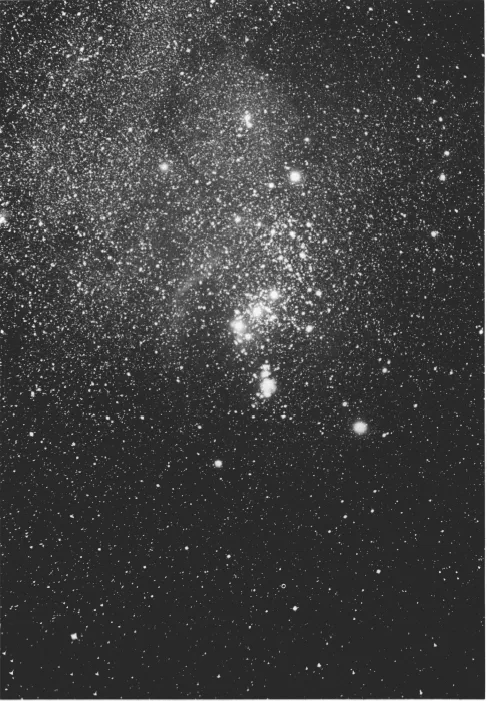
THE CONSTELLATION OF ORION as photographed with a wide- angle Tessar lens of 10-inch focus. Rigel and the stars of the Belt appear prominently.
Mt.Wilson Observatory.
“Many a night from yonder ivied casement, ere I went to rest,
Did I look on great Orion, sloping slowly to the west.
Many a night I saw the Pleiads, rising thro’ the mellow shade,
Glitter like a swarm of fireflies tangled in a silver braid.”
Orion in classical times was associated with wintry storms, a tradition mentioned in Babylonian myths, and in still older Hindu legend. Polybius, in the 2nd century BC, attributes the destruction of the Roman squadron during the First Punic War to the fact that the fleet unwisely sailed with the rising of Orion. Hesiod, in the same vein, speaks of the appearance of the Great Hunter as a turbulent time when the winds battle with thunderous sound.... and the sullen sea lies hidden in sable cloud... Virgil, Pliny, and Horace all speak of Orion with adjectives that may be translated “The Bringer of Clouds”, the “Stormy One”, or “He Who Brings Peril to the Seas”. Even Milton, in the 17th century, continues the ancient tradition when he writes in Paradise Lost of the time
The familiar reference to Orion and the Pleiades in the Book of Job (Ch. XXXVIII) has generated much debate, and it is not at all certain that the popular King James translation is the correct one:
31. Canst thou bind the sweet influence of the Pleiades, or loose the bands of Orion?
32. Canst thou bring forth Mazzaroth in his season? Or canst thou guide Arcturus with his sons?
In the New English Bible, the “Bands of Orion” appear simply as “Orion’s Belt”, the enigmatic Mazzaroth is now interpretated as a reference to the whole cycle of the Zodiac, while the translation “Arcturus with his sons” may be an outright error, and is replaced by “Aldebaran and its train”. Other authorities have suggested that the passage actually refers to the Great Bear, which in some ancient writings is regarded as being under the guardianship of Arcturus.
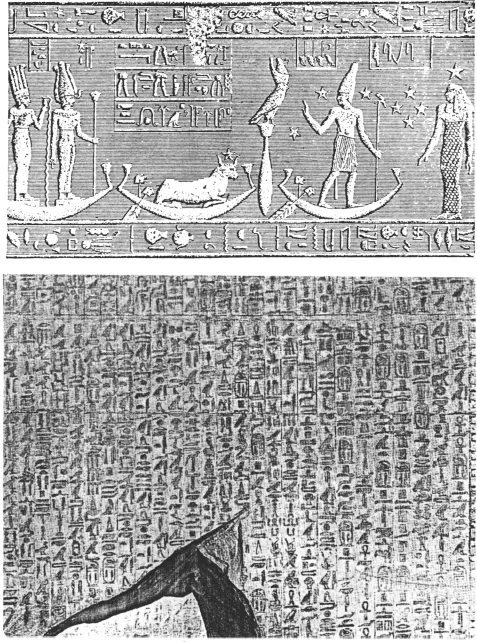
Orion, under the name of Sahu, was one of the most important sky figures to the ancient Egyptians, and was regarded as the soul or incarnation of the great god of the afterworld, Osiris. On wall reliefs at the Temple of Denderah, he is shown journeying through the heavens in his celestial boat, followed by Sothis (Sirius) who is identified as the Soul of Isis, and is shown as a kneeling cow with a star between her horns. In some of the oldest writings which have come down to us from ancient Egypt, the Pyramid Texts of the late 5th Dynasty, the King is promised a celestial journey to the realms of Orion:
“The Great One has fallen.... His head is taken by Re, his head is lifted up.... Behold, he has come as Orion..... Behold, Osiris has come as Orion, Lord of Wine in the festival.... he who the sky conceived and the dawn-light bore. 0 king, the sky conceives you with Orion; the dawn-light bears you with Orion.... by the command of the gods do you live.... with Orion you shall ascend from the eastern regioni of the sky; with Orion you shall descend into the western \region of the sky.....Sothis, pure of thrones, shall guide you on the goodly roads which are in the sky in the Field of Rushes.....”
References to Orion occur also in the famous Book of the Coming Forth by Day, or Book of the Dead, which dates back to the very earliest period of Egyptian history. In a late version, the Papyrus of Ani, which is at least 3000 years old, the text promises the scribe Ani that he shall enter the heavenly regions, and become one with Orion. Sir W.M.Flinders Petrie, in his contribution to that monumental archeological compendium Wonders of the Past, refers to Orion (or Sahu) as “a star god of the myth-strewn firmament”; the accompanying photograph shows Orion as a tall and stately figure whose headdress features a five-pointed star. In the Denderah reliefs, Orion more closely resembles the traditional portrayals of Osiris.
In the sky, Orion appears as the legendary Warrior or Hunter, with his shoulders marked by Alpha and Gamma, his knees by Beta (Rigel) and Kappa, and his great jeweled Belt by the striking row of three bright stars Delta, Epsilon, and Zeta. Below the Belt, the nebulous gleam of Theta and Iota Orionis outline the great Sword of Orion. Beneath his feet crouches Lepus, the Hare; following him are his two dogs, Canis Major and Canis Minor. Orion, like Hercules, is usually depicted with a lion-skin shield, held high on one arm as Orion faces the thundering charge of Taurus, the Bull, whose baleful red eye, Aldebaran, glares down from the V-shaped Hyades group, the Bull’s Head. The significance of the Orion-Taurus combat does not appear to be made clear in any ancient legend; the purely symbolic interpretation is the obvious one, that the two constellations represent the eternal conflict of good and evil. But this interpretation, aside from its triteness, does not seem supported by any of the ancient myths; the Bull was never regarded as a symbol of evil anywhere in the classical world; on the contrary it was venerated as the embodiment of strength, power, and virility, and was an object of worship in more than one ancient cult. Picasso uses the figure of the Bull in a painting which has become perhaps one of the best known classics of modern art, Guernica, but even here the Bull appears as the incarnation of blind, destructive, crushing force, rather than deliberate evil.
ORION and SIRIUS appear (top) on the ancient Egyptian wall reliefs at Denderah. Below: A section of the Vth Dynasty I Pyramid Texts from the tomb of King Unas at Sakkara.
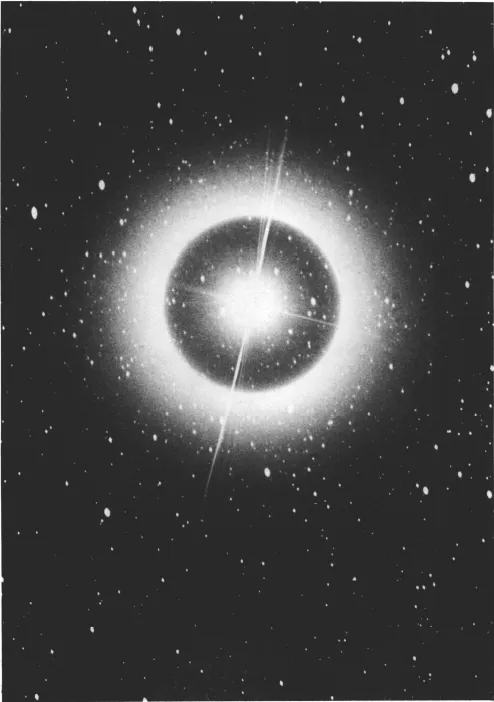
BETELGEUSE. A “close-up” photograph of one of the largest known stars. The original plate, in red light, was made with the 13-inch camera at Lowell Observatory.
The name Betelgeuse is from the Arabic Beit Algueze or Bed Elgueze, very corrupted forms of Ibt al Jauzah, the “Armpit of the Giant” or “Arm of the Central One”. R.H. Allen lists a variety of other Arabic names as Al Mankib, “The Shoulder”, Al Dhira, the “Arm”, and Al Yad al Yamna, “The Right Hand”. Students of Arabic, however, believe that the original name, Al Jauzah, or Yad al Jawza, did not refer to a “giant” but was a term used for a sheep marked with a central spot or belt; a fair translation might then be “The Front Leg of the White-belted Sheep”. The present author believes, however, that star-watchers will continue to see a celestial giant in the great figure of Orion; the sheep unfortunately lacks heroic grandeur. The Alfonsine Tables call the star Beldengenze, while Riccioli has it labeled Bectelgeuze. The Sanskrit name, Bahu,simply means “The Arm”, and the Coptic Klaria signifies “The Armlet”. The Hobbits of Middle-earth, according to Tolkien, knew it as “Borgil” ...