![]()
HARMONY.
§ 1. Musical tones are combined in two different ways: first by allowing them to sound separately one after the other, then again by subjecting them to a simultaneous concordance. The first combination is named „Melody“, the second „Harmony“.
These two elements, together with the element of rythm, (which regulates them in their relation to the time or measure) constitute the Material of the art of music. The subject of this treatise shall be the simultaneous concordance of tones: Harmony.
First Part.
§ 2. The simultaneous sounding of three, four or five tones, separated from one another by the interval of a third, is called a chord. The simplest and at the same time most important chord is the Triad, which, as its name indicates, consists of three tones. Being composed of two consonant intervals (Third and Fifth) its effect on the musical ear is satisfying, in contrast to that of chords consisting of four or five tones, which contain dissonant intervals and hence cannot appear independently, but must be supported by or resolved into a consonating chord or triad.
___________
First Section.
Consonant chords.—Triads.
§ 3. The triad, or common chord consists of three tones, separated each from the other by the interval of a Third.
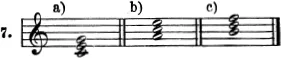
The lowest tone is called: Fundamental tone, or Base—the intermediate tone: the Third—and the highest tone: the Fifth of the triad. Triads are divided, according to the kinds of Thirds and Fifths that compose them. A large or major triad is a chord composed of a major Third and a perfect Fifth (a). Minor Third and perfect Fifth constitute a minor triad (b); minor Third and diminished Fifth a diminished triad (c).
CHAPTER I.
The Triads of the Major Scale.
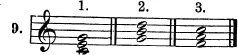
§ 4. If we construct a triad on each successive degree of the diatonic major scale, we obtain the following chords:
On the 1-st, 4-th and 5-th degree we find major triads:
These triads, representing the most essential constituents of the major scale, bear the names of those degrees of the scale, on which they are based.
§ 5. It has just been said that these three major triads form the most essential constituents of the major scale. Verily they contain all the diatonic degrees of the scale; and, being most closely related to one another, they indicate clearly and unmistakeably the key and further suffice for the harmonic accompaniment of any melody that does not surpass the limits of the key in question. Their mutual affinity is easily demonstrated by the degree of relation existing between the several scales to which they belong. The triads on the 4-th and 5-th degrees, while they are respectively the Subdominant and Dominant in the harmony of the given key, are at the same time the tonic triads of those keys, which, in the so-called „Circle of Fifths“ are nearest to the given key. So that the inner relationship of the three major triads in the harmony of the major scale is in direct proportion to the degree of relationship of the three successive keys in the Circle of Fifths (their Tetrachords being common).
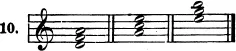
§ 6. In the major scale minor triads are also found, namely on the 2-nd, 3-rd and 6-th degrees. The minor Third imparts to these triads a soft, weakened character, hence they cannot command the importance possessed by the major triads. However, they furnish us with a beautiful contrast to the latter, emphasizing their strength! Their mutual affinity is the same as that of the major triads, as they possess the same proximity in the Circle of Fifths.
Of the degree of their relationship to the major triads we may say it is the same as that existing between parallel keys; for the chords on the 1-st and 6-th degrees, the 5-th and 3-rd degree and the 4-th and 2-nd degree respectively are separated by a minor third.
The whole mass of major and minor triads may be grouped into three sets of two triads each:
a) The tonic group viz: the triads on the 1-st and 6-th degrees.
b) The dominant group viz: the triads on the 5-th and 3-rd degrees and
c) The subdominant group viz: the triads on the 4-th and 2-nd degrees.
§ 7. In marked contrast to the other triads stands the diminished triad on the 7-th degree, because of its dissonant character. We shall return to this chord later on, having first entirely mastered the connection of the other six triads.
CHAPTER II.
The Connection of the Triads of the major scale.
§ 8. In music chords are either used in masses, that is with manifold repetitions of one and the same interval—as is the case in compositions for orchestra and Pianoforte—or they are set for several, single, distinct voices. „Four-voiced-writing“ is the commonest and most normal form, as it denotes the four different human voices—namely: Soprano, Alto, Tenor and Bass. So, in our study of Harmony we shall keep...