This comprehensive reference will be invaluable to anyone requiring accurate data on the Civil War period. Indispensable for identifying, describing, and understanding the use of more than 800 items, the text is arranged alphabetically by topic, with subjects ranging from artillery accouterments, heavy cannon, boats, and barracks equipment to bridge materials, a charcoal water filter, brass name stencils (to label personal equipment), and an enormous variety of weapons. Material is cross-referenced for quick location of individual entries. "Everything an interested reader would want to know . . . A must-have book." — Antiques & Auction News. Over 350 rare illustrations.
eBook - ePub
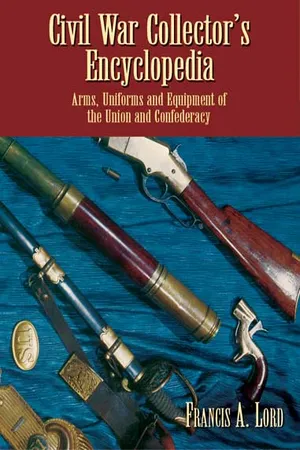
Civil War Collector's Encyclopedia
Arms, Uniforms and Equipment of the Union and Confederacy
- 376 pages
- English
- ePUB (mobile friendly)
- Available on iOS & Android
eBook - ePub
Civil War Collector's Encyclopedia
Arms, Uniforms and Equipment of the Union and Confederacy
About this book
Information
ACCOUTERMENTS. This term includes items of equipment, other than weapons and clothing, carried by the soldier, sailor, or Marine. (In the Civil War the common spelling was “accoutrements.”) Generally the term applied to the articles carried on or by the belt, and included the belt, cartridge box, cap box, and bayonet scabbard. Accouterments differed for the three combat branches of the Army–infantry, cavalry, and artillery. Details are given under appropriate headings. The canteen, haversack, and knapsack were usually excluded from the term “accouterments.” For component items see: Belt, Cartridge-Box; Belt, Waist; Belt, Sword, Shoulder; Box,
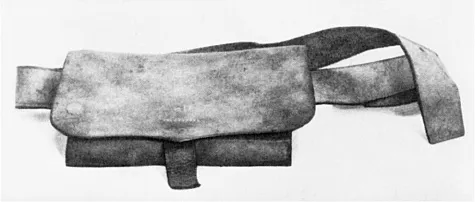
Artillery belt and fuze pouch.
Cap; Box, Cartridge; Scabbard, Bayonet; Sling, Cartridge-Box; and Sling, Gun.
ACCOUTERMENTS, ARTILLERY. (See also ARTILLERY). For items common to all arms, see ACCOUTERMENTS, INFANTRY. Artillery accouterments were much more varied than in either the infantry or cavalry since artillerymen had to carry special items for servicing their cannon. Most artillerymen wore a leather waist belt on which were carried a short sword or artillery saber, pistol and holster, cap box, and a fuze pouch. An artilleryman also carried a pendulum hausse and wore a gunner’s haversack over his shoulder.
ACCOUTERMENTS, CAVALRY. Cavalry accouterments consisted of two belts and the articles (excluding weapons) attached to them. To the waist belt (saber belt) was attached a cartridge box for carbine ammunition, a pistol box for revolver ammunition, and a cap box; also the saber in its scabbard and the revolver in its holster. To the carbine sling (or belt) was attached, by a swivel, the carbine.
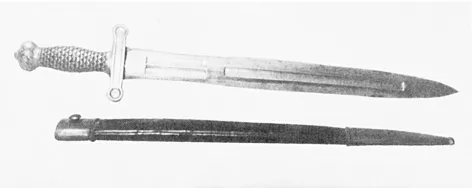
Artillery short sword.
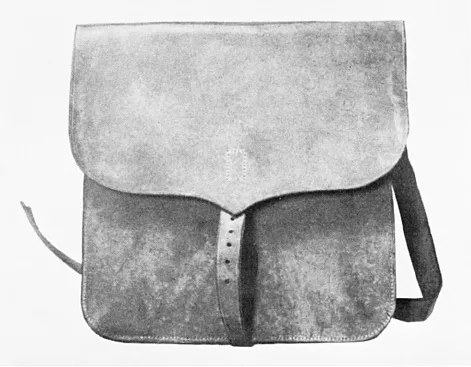
Artillery gunner’s haversack.
CARTRIDGE BOX. Some cavalry used the Blakeslee Cartridge Box (Patent No. 45,469), patented December 20, 1864, by Erastus Blakeslee, Plymouth, Conn. This box contained one or more removable tubes filled with fixed ammunition, by which a magazine arm like Spencer’s could be replenished or the cartridges could be gotten out singly. A side pouch was attached for other ammunition.
MANN’S ACCOUTERMENTS. These were designed to replace the earlier cavalry accouterments, but only came into limited use late in the war. This new equipment combined the cartridge box, pistol box, and cap box in one unit, and enabled the trooper to carry more than double the amount of ammunition held by the old boxes. It transferred, by two broad belts, the weight from the man’s waist to his shoulders. Unfortunately this improved type of equipment was never generally adopted; therefore many cavalrymen, using the old equipment, suffered rupture, hemorrhoids, weak back, and diarrhea from the weight of the ammunition and heavy arms attached to the waist.
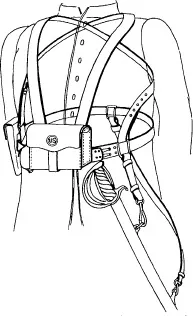
Mann’s accouterments. (National Archives)
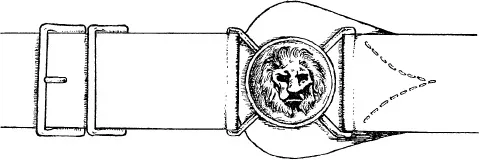
Confederate belt and buckle. Imported through the blockade. (Drawing by Mike McAfee)
ACCOUTERMENTS, CONFEDERATE. Since the Confederacy was short of leather it was necessary to import leather equipments and also to find substitute material. One of the substitutes was prepared cotton cloth, stitched together in three or four thicknessess. Instead of brass, lead and wood were used. (See Confederate Makers)
BELTS. Two types of Confederate belts are illustrated, one of them being imported from England.
CAP BOX. Confederate cap boxes are very rare, especially those marked CS, like that shown in the accompanying photograph. Made similar to the U.S. cap box, it shows high-quality craftsmanship, may possibly have been manufactured in England but more likely was made in the South. Has an impressed CS in an oval cartouche. Cap boxes of this type are susceptible of being forged, but such fakes are easily distinguishable. Note the squarish appearance of the flap on the authentic one illustrated. Almost identical to the US type, but has a different design bearing the CS.
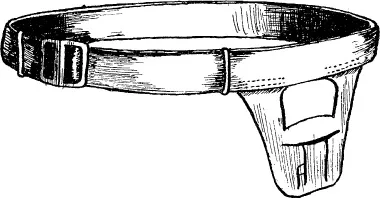
Confederate artillery belt. (Drawing by Mike McAfee)
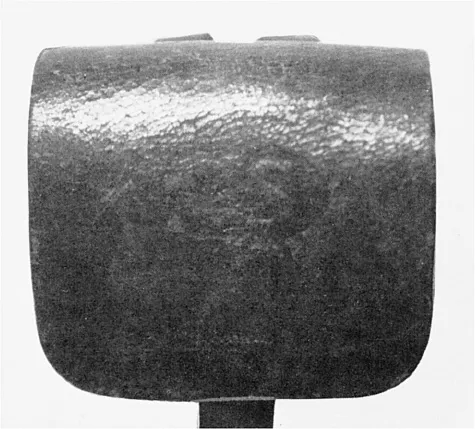
Confederate cap box or pouch, made similar to U.S. Shows high quality craftsmanship, may possibly have been manufactured in England but more likely in the South. Impressed design “CS” in oval cartouche.
CARTRIDGE BOX. Many cartridge boxes used by Confederates were imported from England as part of the equipments used with Enfield muskets and rifles. Shown here is such a box. There is also illustrated an original Confederate-manufactured pouch for infantry, with the original cross shoulder strap. It has generally the same proportions as the U.S. issue but the leather is of different quality and it is extremely rough.on the inside. The outside is smooth black leather with the original impressed oval design CS. The letters themselves are impressed in the leather as differentiated from the U.S. model, in which the U.S. seems to stand out slightly. This Confederate box also has a lead fastening button. The original wide-stitched, black waterproofed-linen cross shoulder-strap is still affixed. It shows a spot where once there was a circular plate, now missing.
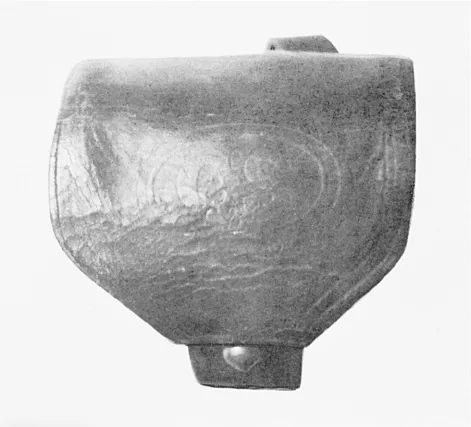
Confederate cap pouch with different impressed design but also bears “CS” lettering. Almost identical to U.S. type. (Norm Flayderman)
ACCOUTERMENTS, INFANTRY. Consisted of a cartridge-box belt, to which were attached the following; cartridge-box sling, cartridge box, cap box, bayonet scabbard, and canteen (not an accouterment). Sergeants and musicians wore a waist belt. Noncommissioned officers wore a sword shoulder belt.
BAYONET SCABBARD. There were two infantry bayonet scabbards:
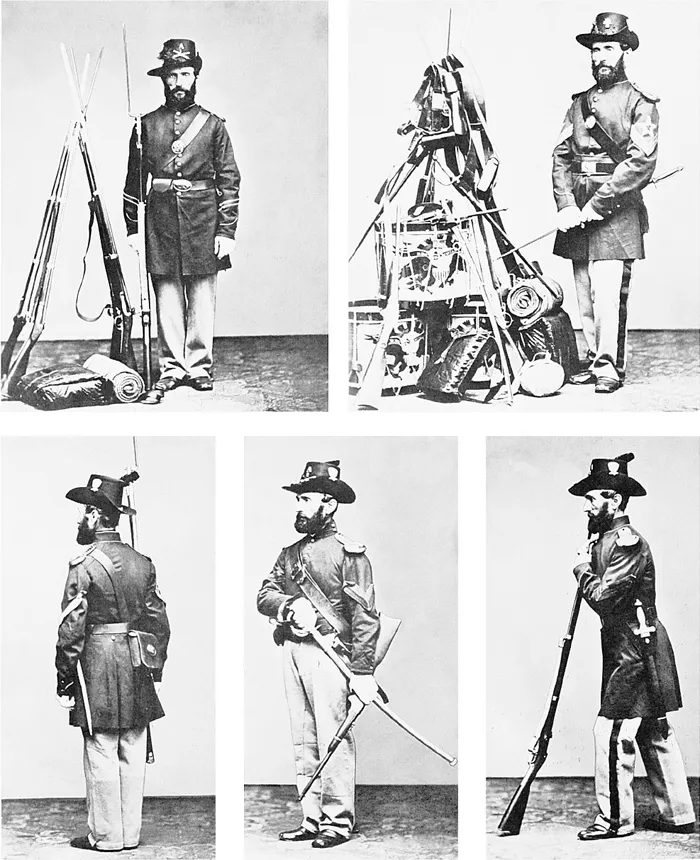
Above are five of a series of photos made for the Quartermaster, U.S. Army to illustrate clothing and equipment of the Civil War and postwar period. Upper left, artillery private with infantry equipment; upper right, Ordnance sergeant with miscellaneous arms and equipment; lower left, infantry corporal with infantry equipment; center, cavalry accouterments, Spencer carbine, and sling; lower right, artillery short sword worn by artillery sergeant. (Smithsonian Institution)
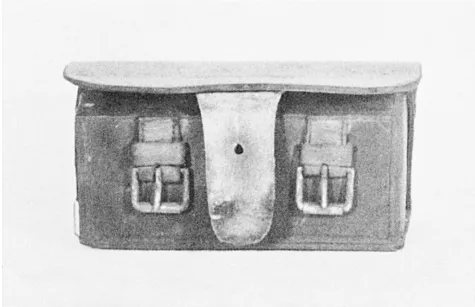
Enfield cartridge box, dated 1861.
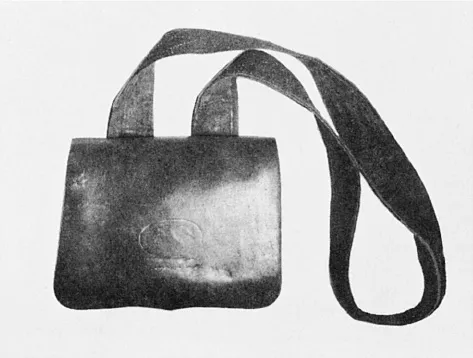
Rare Confederate cartridge box, for infantry. (Norm Flayderman)
Emerson Bayonet Scabbard (Patent No. 36,209). Patented August 19, 1862 by J. E. Emerson, Trenton, N. J. “As a new article of manufacture (Emerson patented) an angular bayonet scabbard, constructed of steel.”
Gaylord Bayonet Scabbard (Patent No. 28,269). Patented May, 1860 by Emerson Gaylord, Chicopee, Mass.
CAP BOX. Four types of containers or holders for percussion caps were in use by the infantry:
Harvey Cap Box (Patent No. 43,497). Patented July 12, 1864 by Thomas Harvey, Baltimore, Md. This cap box involved the use of an annular cap holder freely movable within a circular or cylindrical case, with teeth on its interior surface, thus permitting the caps to come in succession opposite the ejection opening in the case.
Lamb Cap Box (Patent No. 40,487). Patented November 3, 1863 by Thomas Lamb, Hamilton, Mich. A “cap holder,” consisting of two notched revolving plates joined at their centers, with the portions of plate between the notches being flexible and forming studs on which the caps were placed.
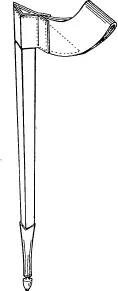
Gaylord bayonet scabbard. (National Archives)
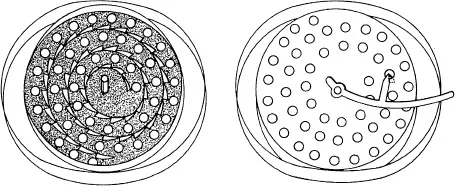
Warren’s cap box.
Pickett Percussion Cap Holder (Patent No. 47,127). Patented April 4, 1865 by Rufus S. Pickett, New Haven, Conn. The caps were arranged in a row around the interior of an oblong box upon an endless belt extended between a small pulley and a ratchet wheel. The ratchet wheel was revolved by means of a thumb dog passing through the back of the box, so as to drive forward one cap at every movement of the dog.
Warren Cap Box (Patent No. 41,655). Patented February 16,1864 by J. T. Warren, Stafford, N. Y. This invention involved a spirally revolving disc within a case operated by a small lever, which by a ratchet movement brought the percussion caps in succession opposite an opening ...
Table of contents
- Cover
- Title Page
- Copyright Page
- Dedication
- Contents
- Foreword
- About The Author
- Acknowledgements
- Topic Arrangement
- Accouterments
- Schuyler, Hartley & Graham. New-York.
- Appendix
- Bibliography
- Index
Trusted by 375,005 students
Access to over 1.5 million titles for a fair monthly price.
Study more efficiently using our study tools.
Frequently asked questions
Yes, you can cancel anytime from the Subscription tab in your account settings on the Perlego website. Your subscription will stay active until the end of your current billing period. Learn how to cancel your subscription
No, books cannot be downloaded as external files, such as PDFs, for use outside of Perlego. However, you can download books within the Perlego app for offline reading on mobile or tablet. Learn how to download books offline
Perlego offers two plans: Essential and Complete
- Essential is ideal for learners and professionals who enjoy exploring a wide range of subjects. Access the Essential Library with 800,000+ trusted titles and best-sellers across business, personal growth, and the humanities. Includes unlimited reading time and Standard Read Aloud voice.
- Complete: Perfect for advanced learners and researchers needing full, unrestricted access. Unlock 1.5M+ books across hundreds of subjects, including academic and specialized titles. The Complete Plan also includes advanced features like Premium Read Aloud and Research Assistant.
We are an online textbook subscription service, where you can get access to an entire online library for less than the price of a single book per month. With over 1.5 million books across 990+ topics, we’ve got you covered! Learn about our mission
Look out for the read-aloud symbol on your next book to see if you can listen to it. The read-aloud tool reads text aloud for you, highlighting the text as it is being read. You can pause it, speed it up and slow it down. Learn more about Read Aloud
Yes! You can use the Perlego app on both iOS and Android devices to read anytime, anywhere — even offline. Perfect for commutes or when you’re on the go.
Please note we cannot support devices running on iOS 13 and Android 7 or earlier. Learn more about using the app
Please note we cannot support devices running on iOS 13 and Android 7 or earlier. Learn more about using the app
Yes, you can access Civil War Collector's Encyclopedia by Francis A. Lord in PDF and/or ePUB format, as well as other popular books in History & American Civil War History. We have over 1.5 million books available in our catalogue for you to explore.