Ludwig van Beethoven (1770–1827), the protagonist of freedom for music, disentangled music from the control of the ruling class. In publishing his music and writing for the rising classes, Beethoven claimed freedom and expressed the emotions of the new rulers, the artists. The Eroica, Fidelio, and the piano works express the emotions of the new rulers — the intense love, the need for companionship of people, the forces that conspired to defeat the artist, and the strength and superiority of the artist in overcoming the weaknesses. The letters of Beethoven are the principal nonmusical expression of his personality in its relationship with the world of his time.
In what he called the "dry letters of the alphabet," Beethoven depicted his fears, his loves, and his friendly relations: his fears of deafness and of corrupted texts by pirating printers; his loves, Bettina Brentano and Giulietta Guicciardi; and his friendly relations with Baron Zmeskall, Frau Nannette Streicher, and the music publishers Steiner and Company. He praises the poetry of Goethe and Schiller but condemns Goethe for his obeisance toward royalty. He solicits help during his perpetual trouble with his health and with his servants. He castigates publishers, sets prices for his works, and calculates letters of dedication. He expresses his love for his nephew, Carl, but documents the trouble that Carl was causing him by taking up his precious time. And although Beethoven liked to decorate the letters with musical openings and closings and an occasional song to the receiver, he increasingly signed his letters, "In haste."
The 457 letters collected here are the most important of the letters of the spirit that was to shape and move a century. Explanatory notes comment upon works, on persons mentioned, and on the puns of which Beethoven was fond. The letters chronicle his business, his needs, his humor and bitterness, and his philosophy. They will give many insights into Beethoven's methods, his influences, his moods, and the conditions under which the master worked.
- 448 pages
- English
- ePUB (mobile friendly)
- Available on iOS & Android
eBook - ePub
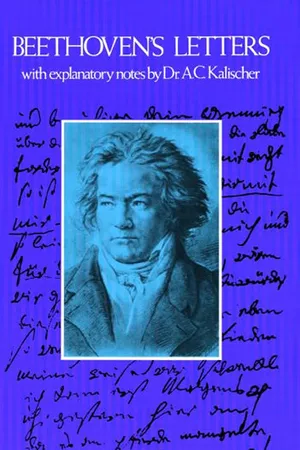
Beethoven's Letters
About this book
Trusted by 375,005 students
Access to over 1 million titles for a fair monthly price.
Study more efficiently using our study tools.
Information
Subtopic
Music BiographiesBEETHOVEN’S LETTERS
1. DEDICATION LETTER TO THE PRINCE ELECTOR,
MAX FRIEDRICH OF COLOGNE
MAX FRIEDRICH OF COLOGNE
Most illustrious!
Music from my fourth year began to be the first of my youthful occupations. Thus early acquainted with the gracious muse who tuned my soul to pure harmonies, I became fond of her, and, as it often seemed to me, she of me. I have already reached my eleventh year; and since then often has my muse whispered to me in inspired hours: “Try for once and write down the harmonies of thy soul!” Eleven years old—methought—and how would an author’s air become me? And what would masters of the art probably say to it? I almost became diffident. Yet my muse so willed—I obeyed, and wrote.
May I now venture, most illustrious Prince, to place at the foot of your throne the first-fruits of my youthful works? And may I venture to hope that you will bestow on them the benevolent paternal look of your encouraging approval? Oh yes! the arts and sciences have always found in you a wise protector, a generous patron, and budding talent has prospered under your noble, paternal care.—
Full of this encouraging assurance, I venture to approach Your most serene Highness with these youthful attempts. Accept them as a pure offering of childlike homage, and look graciously on them, and on their young author.
The above appears on the reverse side of the title-page of the first publication. The title is as follows :
“Three Sonatas for pianoforte dedicated to the Most worthy Archbishop and Prince Elector of Cologne, Maximilian Friedrich, my most gracious Lord.
“Dedicated and composed by LUDWIG VAN BEETHOVEN,
“Aged eleven.”
Published by Councillor Bossler, Spires.
No. 21.
Price 1 fl. 30 kr.
[According to the original edition of the three pianoforte sonatas in E flat, F minor, and D, published in 1783. In that year Beethoven was not eleven, but thirteen years old. Not only the composer, but many of his friends, maintained for a long time that he was born in 1772. Even Joh. Aloys Schlosser, in the first small Beethoven Biography, which appeared in 1828, wrote: “ Ludwig van Beethoven was born in the year 1772.”]
2. TO COUNCILLOR DR. VON SCHADEN, AUGSBURG
September 15th,
BONN, 1787.
WELL AND NOBLY BORN AND SPECIALLY WORTHY FRIEND,
I can easily imagine what you think of me; and I cannot deny that you have good cause for not entertaining a good opinion of me. In spite of that, I will not offer any excuse until I have shown the causes, whereby I venture to hope that my excuses will be accepted. I must acknowledge that since I left Augsburg, my happiness, and with it my health, began to fail; the nearer I approached my native city, the more frequent were my father’s letters urging me to travel faster than I should have done under ordinary circumstances, as my mother’s state of health was far from satisfactory. I hurried as fast as I could, for I myself, indeed, became unwell. The longing once more to see my sick mother caused me to make light of all obstacles, and helped me to overcome the greatest difficulties. I found my mother still alive, but in the weakest possible state; she was dying of consumption, and the end came about seven weeks ago, after she had endured much pain and suffering. She was to me such a good, lovable mother, my best friend. Oh! who was happier than I, when I could still utter the sweet name of mother, and heed was paid to it; and to whom can I say it now? —to the dumb pictures resembling her, the creations of my imagination? Since I have been here, I have enjoyed only a few pleasant hours; during the whole time I have been troubled with asthma, and I much fear that it will lead to consumption. I also suffer from melancholy which for me is almost as great an evil as my illness itself. Imagine yourself now in my place, and I hope that you will forgive my long silence. As you showed extraordinary kindness and friendship at Augsburg in lending me three carolins, I must beg of you to be still patient with me. My journey was expensive, and here I have not the slightest hope of earning anything; the fates have not been favourable to me here in Bonn.
Please excuse my having detained you so long with my prattling, but was it absolutely necessary to vindicate myself. I hope you will not refuse still to extend to me your honoured friendship; I have no greater desire than to prove myself to some degree worthy of it.
I am, with all respect,
Your most obedient servant and friend,
L. V. BEETHOVEN,
Organist to the Prince Elector of Cologne.
A MONSIEUR,
MONSIEUR DE SCHADEN
Conseilièr d’augspurg
à augspurg.
[This, the first real letter by Beethoven which we possess, first appeared in the Vossische Zeitung, 21 August, 1845, at the time of the inauguration of the Beethoven monument at Bonn.]
3. TO FRL. ELEONORE VON BREUNING
[BONN, about 1791]
Fragment.
Fragment.
. . The neckcloth worked with your own hand came to me as a great surprise. It awoke in me feelings of sadness, however pleasant the thing in itself. It reminded me of former times; also your magnanimous behaviour filled me with shame. In truth, I did not think that you still considered me worthy of your remembrance. Oh! if only you could have seen how this incident affected me yesterday, you certainly would not accuse me of exaggeration, if I now say to you, that your token of remembrance caused me to weep and feel very sad. I entreat you, however little I deserve faith in your eyes, to believe, my friend (let me still ever call you thus), that I have deeply suffered, and still suffer, through the loss of your friendship. Never shall I forget you and your dear mother. Your kindness was so great that it will be long ere I can make good my loss. I know what I have forfeited, and what you were to me, but—to fill up this blank I should have to recall scenes unpleasant for you to hear, and for me to describe. As a small return for your kind remembrance of me, I take the liberty of sending you herewith these Variations and the Rondo with violin. I am very busy, otherwise I would have copied for you the long-promised Sonata. In my manuscript it is little more than a sketch, and it would have been difficult even for Paraquin, clever as he is, to copy it out. You can have the Rondo copied and then the score returned to me. I am sending you the only one of my compositions of which you could probably make any use; and as, besides, you are going away to Kerpen, I thought this trifle might give you some pleasure.
Farewell, my friend. It is impossible for me to call you otherwise; and however indifferent I may be to you, pray believe that I honour you and your mother just as much as formerly. Moreover, if it be in my power to please you in any way, I beg you not to ignore me; it is the only means left for me to show gratitude for the friendship which I have enjoyed.
A pleasant journey, and bring your dear mother back fully restored to health. And think sometimes of one who still always esteems you.
Your friend,
BEETHOVEN.
4. TO THE PRINCE ELECTOR, MAX FRANZ, COLOGNE
[VIENNA, end of April or beginning of May, 1793.]
MOST REVEREND AND ILLUSTRIOUS PRINCE ELECTOR, MOST GRACIOUS SOVEREIGN,
A few years ago it pleased your Highness to pension off my father, the court tenor singer, van Beethoven; also, by a most gracious decree, to assign to me 100 rix-thalers of that pension, so that I might be able to clothe, feed, and educate my two younger brothers, also to discharge our father’s debts.
I wished to place this decree before your chief land-steward, but my father earnestly begged me not to do it, so that it might not publicly appear as if he himself were incapable of providing for his family. And he added that he himself would hand over to me twenty-five rix-thalers every quarter, and that promise was always duly kept.
Now after his death (which followed last year in December) I wished to make use of your most gracious kindness by presenting the above-named decree, when I was startled to find that my father had made away with it.
With highest respect, I therefore beg your Serene Highness most graciously to renew this decree, and to instruct your land-steward to hand over to me the gracious salary for the quarter just elapsed (due at the beginning of February).
Your Serene Highness’s most dutiful and faithful
LUD. v. BEETHOVEN
(Court Organist).
[Both writers consulted the Rhenish archives at Düsseldorf. This petition, circumspect as it is, gives a clear insight into the sad relationship between Beethoven and his unfortunate father, who died suddenly on 18 December, 1792—very soon, therefore, after his son’s arrival in Vienna. The petition was answered. According to Deiters, Beethoven received fifty thalers every quarter up to March 1794. With that, all connection between Beethoven and the Electorate ceased.]
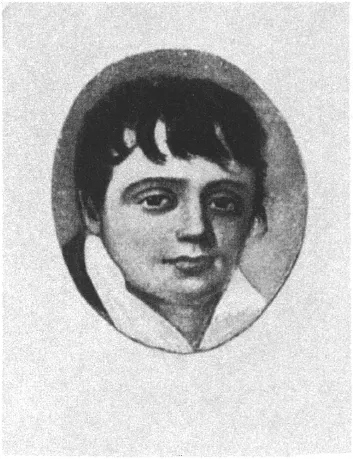
Beethoven at the age of twenty-one (1791)
From a miniature by Gerhard von Kügelgen, in the possession of Sir George Henschel
From a miniature by Gerhard von Kügelgen, in the possession of Sir George Henschel
5. TO FRL. ELEONORE VON BREUNING, BONN
VIENNA, November 2, 1793.
HONOURED ELEONORE, MY DEAREST FRIEND,
I shall soon have been in this capital a whole year, yet only now do you receive a letter from me, but you were certainly constantly in my thoughts. Frequently, indeed, did I hold converse with you and your dear family, but, for the most part, not with the tranquillity of mind which I should have liked. Then it was that the fatal quarrel hovered before me, and my former behaviour appeared to me so abominable. But the past cannot be undone, and what would I not give if I could blot out of my life my former conduct so dishonouring to me, so contrary to my character. Many circumstances, indeed, kept us at a distance from each other, and, as I presume, it was especially the insinuations resulting from conversations on either side which prevented all reconciliation. Each of us believed that he was convinced of the truth of what he said, and yet it was mere anger, and we were both deceived. Your good and noble character is indeed a guarantee t...
Table of contents
- Cover
- Title Page
- Copyright Page
- Contents
- Introduction
- Preface
- List of Illustrations
- Beethoven’s Letters
- Beethoven Autograph
- List of Letters
- Index of Persons
- Index of Works
Frequently asked questions
Yes, you can cancel anytime from the Subscription tab in your account settings on the Perlego website. Your subscription will stay active until the end of your current billing period. Learn how to cancel your subscription
No, books cannot be downloaded as external files, such as PDFs, for use outside of Perlego. However, you can download books within the Perlego app for offline reading on mobile or tablet. Learn how to download books offline
Perlego offers two plans: Essential and Complete
- Essential is ideal for learners and professionals who enjoy exploring a wide range of subjects. Access the Essential Library with 800,000+ trusted titles and best-sellers across business, personal growth, and the humanities. Includes unlimited reading time and Standard Read Aloud voice.
- Complete: Perfect for advanced learners and researchers needing full, unrestricted access. Unlock 1.4M+ books across hundreds of subjects, including academic and specialized titles. The Complete Plan also includes advanced features like Premium Read Aloud and Research Assistant.
We are an online textbook subscription service, where you can get access to an entire online library for less than the price of a single book per month. With over 1 million books across 990+ topics, we’ve got you covered! Learn about our mission
Look out for the read-aloud symbol on your next book to see if you can listen to it. The read-aloud tool reads text aloud for you, highlighting the text as it is being read. You can pause it, speed it up and slow it down. Learn more about Read Aloud
Yes! You can use the Perlego app on both iOS and Android devices to read anytime, anywhere — even offline. Perfect for commutes or when you’re on the go.
Please note we cannot support devices running on iOS 13 and Android 7 or earlier. Learn more about using the app
Please note we cannot support devices running on iOS 13 and Android 7 or earlier. Learn more about using the app
Yes, you can access Beethoven's Letters by Ludwig van Beethoven in PDF and/or ePUB format, as well as other popular books in Media & Performing Arts & Music Biographies. We have over one million books available in our catalogue for you to explore.