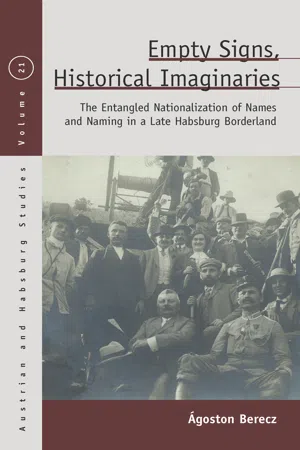
Set in a multiethnic region of the nineteenth-century Habsburg Empire, this thoroughly interdisciplinary study maps out how the competing Romanian, Hungarian and German nationalization projects dealt with proper names. With particular attention to their function as symbols of national histories, Berecz makes a case for names as ideal guides for understanding historical imaginaries and how they operate socially. In tracing the changing fortunes of nationalization movements and the ways in which their efforts were received by mass constituencies, he provides an innovative and compelling account of the historical utilization, manipulation, and contestation of names.
Trusted by 375,005 students
Access to over 1.5 million titles for a fair monthly price.
Given names have several characteristics that make them eminently suitable for disseminating and naturalizing historical visions. They typically tolerate a great deal more referents (bearers) than family, let alone place names. Their body also changes more rapidly, as people are born and die. They do not develop spontaneously but are bestowed by small groups of persons of authority – parents and godparents. Whilst choices are not limited by the newborn baby’s personal traits, they are regulated on the social level by a distinct and finite set of possible names, traditionally embodied in the calendar, the first and for a long time the most widespread printed matter in the rural world.1 Note that the authority of this name inventory was not invested with actual, face-to-face communities, but it derived from wider metaphysical, and thus potentially ethnic, centres of power. This combination of otherworldly sanction and social recognition of a choice made by others while still an infant revealed the potential to root the political deep within the personal.
Baby naming underwent radical change in nineteenth- and twentieth-century Europe, as naming patterns structurally rearranged to leave more space for individuation. The basic process, if not its pace, was similar in the various European nations, and it seems to lend support to cultural modernization theories.2 In early modern times, and in particular in the lower classes, three major factors influenced the choice of baby names: the calendar (the popular saint whose feast day fell closest to the baby’s birth), geography (local preferences for certain names) and name inheritance.3 Individual names waxed and waned in popularity, but at a slow rate and with great regional differences.4 Then, within a few generations, fashion took the place of custom, and choosing a name for one’s baby became a matter of taste. The average popularity curve of names shortened enormously, the range of available choices widened both for boys and girls, and the gender gap in diversity got reversed in favour of girls. Variants of the same names were unified on the national level, while local and regional preferences for baby names converged into national patterns.
The Reformation already reshuffled the given name corpus of Protestant communities by introducing more Old Testament names, and French revolutionary republicanism was arguably the first secular ideology to affect naming trends.5 It launched new names inspired in classical antiquity (Brutus, Ulysse, Achille) and brought others into fashion (Alexandre, Camille, Émilie, Julie).6 In the newly independent United States, there was a surge of such names as Jefferson and Washington. In post-Risorgimento Italy, urban people committed to democratic-republican ideas would give classical names to their children (Bruto, Aristotele, Ercole and probably Ettore), and some of them went one step further to choose more overtly ideological ones taken from recent national history. The popularity of such republican names reached a high-water mark between 1895 and 1915.7
While the shift to the modern paradigm of baby naming was, on the whole, a more piecemeal process in the core West European lands, the diffusion of what I will call national names brought a more abrupt shift on the peripheries of the continent. What was unprecedented about these new sets of names was that nationalist intelligentsias consciously adopted them to assert group belongings. As later discussion will demonstrate, the popularity of national names expanded top-down through class imitation and propaganda.8 In an initial period encompassing at least two generations, they functioned as sandwich boards that their early bearers wore day and night, gently but efficiently advertising a nationalist canon of history. Much of this power, inherited from the Christian rite of baptism, later faded away as name-giving was caught up in the by and large internally motivated logic of fashion.
National names were usually drawn from putative national history, myths and Romantic literary works, but late-coming nationalisms sometimes showed idiosyncratic variations. Thus Turkish and Estonian national names were created from adjectives for personal traits, and from common nouns designating natural phenomena; some Estonian ones were even borrowed from the cognate Finnish language.9 Sabin(o) Arana, the father of Basque nationalism, single-handedly invented an entire new Basque name inventory, applying to Latin names the rules of phonological integration distilled from vernacular loanwords of Latin origin. Although his male names in -a completely went against tradition, they nevertheless gained currency after his onomastic work was published to great success in 1910.10
Probably all successful nineteenth-century, catching-up national movements reshuffled the corpus of first names to some degree. If national names never even came close to completely replacing the traditional and mostly ‘international’ Christian ones, that was partly because native forms of these Christian names could also be perceived as singularly national. Simultaneously, increased social communication also nationalized name-giving by levelling out regional differences, but the shared cultural space of the nation has never wiped out social divergence in naming patterns. On the contrary, these patterns have constituted an important aspect of the way fashion works.
The calendar, geography and name inheritance were also the factors traditionally governing name-giving in the territory under study. The calendar was the most important factor of the three, not only among Orthodox Romanians and Roman Catholics but among Calvinist Magyars as well.11 The traditional first names of Romanians, Magyars and German-speakers were overwhelmingly hagiographical and biblical in their origins; Romanian ones were based on a Byzantine, Greek-Slavic tradition, while Hungarian and German ones on Latin, Greek and Old Testament sources. Even though the pool of patron saints greatly overlapped, the forms differed between them and were apparently used as ethnic markers in the villages, although the purchase of marking typically remained local and did not add up to national patterns.12
On a related note, let me point out that the interchangeability between what today’s observer would see as variants of the same name was limited in the world of the village. Two sisters could be called Ilona and Elena (‘Helen’) or Maria and Marișca.13Ionuț, Ionel, Ioniță, Nuț, Onișcă and Ianăș, all hypocoristics of Romanian Ioan/Iuon/Ion (‘John’) could behave as functionally unique, individuating their bearers within a given community.14 It also attests to this trend that after the establishment of the civil registry, parents often tried to give hypocoristic forms to their children in front of registrars. Romanian priests, who kept the official registers until 1894, commanded the expertise necessary to introduce more normative forms. As they had not recorded births and marriages with any consistency before the end of the eighteenth century, Romanian priests’ onomastic control was neither well established nor well coordinated. There is no evidence that their flock resented it, not only because it was less coercive, but also because Romanian peasants felt their ethnic churches incomparably closer culturally than the state. Some Romanian priests in Szatmár County grumbled when their parishioners chose what they understood as ‘Hungarian’ name variants for their children, but this only raised serious concerns if the parents insisted that these rather than their ‘proper Romanian’ equivalents should be entered into the books.15
Can the penetration of the national paradigm be measured by the spread of national given names? In general, the idea of quantifying nationalization seems awkward, since it is hard to think of any feature that can be boiled down into a binary variable and that can adequately capture the range of the process. Whilst nationalism integrated ethnic and ethnicized non-ethnic segments of folk culture, peasants with a still essentially prenational mindset could also pick up new national symbols (such as the tricoloured) and adjust them to their needs. If anything, however, choices of national names probably stand closest to an ideal proxy for the spread of national ways of thinking among the peasantry. In the three ethnic first-name inventories studied, national names were certainly new additions and clearly did not fit well there. They originated in distinctly nationalist imaginaries, which made their cultural references unintelligible for the uninitiated. Even more to the point, the seriousness of the act of naming a child enhanced the cultural leap and the emotional investment that the choice of national names entailed, at least in an early phase.
Certainly, national names cannot be used for drawing comparisons across national lines. There is no reason why their popularity would reach similar proportions in different national movements. Social and regional asynchronies in the spread of a particular set of national names, however, can point to different levels of openness to the nationalist ideology within a nation’s claimed constituency. Of course, not everyone from the rural nationalist vanguard gave national names to their children. But given the high rates of popularity that these names enjoyed among the three elites, and the uniform cultural patterns within the respective national movements, statistically significant regional differences should be put down to the reception of the nationalist message rather than to its varying regional understandings.
Latinate Names among Romanians
The so-called Latinist paradigm, endorsed by the first generations of Romanian nationalists, fancied Romanians to be unmixed descendants of Emperor Trajan’s Roman colonists in Ancient Dacia, and it plotted out a course of national rebirth, including a radically puristic language-planning programme not unlike the ideal of Katharevousa designed for contemporary Greek. Romanian was to be brought closer to Latin on multiple levels. The shift from Cyrillic to Latin already served this purpose at mid century, and the so-called etymological...
Table of contents
Cover
Title Page
Copyright Page
Dedication
Contents
List of Illustrations
Acknowledgements
Notes on Text
Introduction
Part I. Peasants
Part II. Nationalisms
Part III. The State
Conclusions
Appendix A. Tables
Appendix B. Place-Name Index
Bibliography
Index
Frequently asked questions
Yes, you can cancel anytime from the Subscription tab in your account settings on the Perlego website. Your subscription will stay active until the end of your current billing period. Learn how to cancel your subscription
No, books cannot be downloaded as external files, such as PDFs, for use outside of Perlego. However, you can download books within the Perlego app for offline reading on mobile or tablet. Learn how to download books offline
Perlego offers two plans: Essential and Complete
Essential is ideal for learners and professionals who enjoy exploring a wide range of subjects. Access the Essential Library with 800,000+ trusted titles and best-sellers across business, personal growth, and the humanities. Includes unlimited reading time and Standard Read Aloud voice.
Complete: Perfect for advanced learners and researchers needing full, unrestricted access. Unlock 1.5M+ books across hundreds of subjects, including academic and specialized titles. The Complete Plan also includes advanced features like Premium Read Aloud and Research Assistant.
Both plans are available with monthly, semester, or annual billing cycles.
We are an online textbook subscription service, where you can get access to an entire online library for less than the price of a single book per month. With over 1.5 million books across 990+ topics, we’ve got you covered! Learn about our mission
Look out for the read-aloud symbol on your next book to see if you can listen to it. The read-aloud tool reads text aloud for you, highlighting the text as it is being read. You can pause it, speed it up and slow it down. Learn more about Read Aloud
Yes! You can use the Perlego app on both iOS and Android devices to read anytime, anywhere — even offline. Perfect for commutes or when you’re on the go. Please note we cannot support devices running on iOS 13 and Android 7 or earlier. Learn more about using the app
Yes, you can access Empty Signs, Historical Imaginaries by Ágoston Berecz in PDF and/or ePUB format, as well as other popular books in Histoire & Histoire de l'Europe. We have over 1.5 million books available in our catalogue for you to explore.