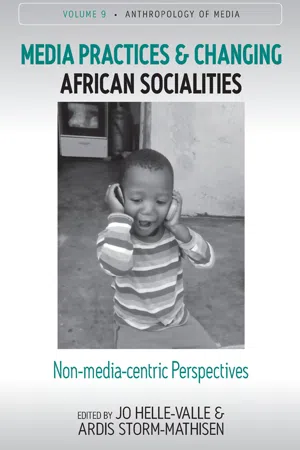
Deriving from innovative new work by six researchers, this book questions what the new media's role is in contemporary Africa. The chapters are diverse - covering different areas of sociality in different countries - but they unite in their methodological and analytical foundation. The focus is on media-related practices, which require engagement with different perspectives and concerns while situating these in a wider analytical context. The contributions to this collection provide fresh ethnographic descriptions of how new media practices can affect socialities in significant but unpredictable ways.
eBook - ePub
Media Practices and Changing African Socialities
Non-media-centric Perspectives
- 256 pages
- English
- ePUB (mobile friendly)
- Available on iOS & Android
eBook - ePub
Media Practices and Changing African Socialities
Non-media-centric Perspectives
About this book
Trusted by 375,005 students
Access to over 1.5 million titles for a fair monthly price.
Study more efficiently using our study tools.
Information
Economy
CHAPTER 1
Digital Development Imaginaries, Informal Business Practices and the Platformisation of Digital Technology in Zambia
Wendy Willems
While Zambia was declared a middle-income country by the World Bank in 2011, the country’s economic performance has slowed down in recent years, exacerbated by the low copper price (caused by decreasing demand from China) and frequent electricity cuts. Coinciding with these changes, hopes are being vested in the ability of digital technology to contribute to economic growth. The Government of Zambia’s Sixth National Development Plan, 2011–2015 (2011, p. 153) and the Seventh National Development Plan, 2017–2021 (2017, p. 75) both identify information and communications technology (ICT) as crucial in the country’s socio-economic development, and consider the improvement of ICT infrastructure as a key policy priority. This echoes a wider belief in the ability of digital technology to transform economies in the Global South, as reiterated for example by the World Bank’s 2016 World Development Report Digital Dividends and by scholars in the subfields of ICT4D, Mobile for Development (M4D) or Social Media for Development (SM4D). Tech hubs and start-ups are considered key to promoting innovation, investment and wider economic growth on the African continent, reflected by terms such as Kenya’s ‘Silicon Savannah’, Nigeria’s ‘Silicon Lagoon’ and Cameroon’s ‘Silicon Mountain’. Similarly, Zambia’s capital Lusaka has in recent years seen a growth in start-up initiatives, network events and ICT hubs, which have received increasing government support. For example, the Zambia Information and Communications Technology Authority (ZICTA) intends to launch a programme aimed at ‘unlocking the potential of ICT-related innovators, entrepreneurs, Micro, Small and Medium Enterprises (MSMEs) and start-ups in contributing to the growth and development of the ICT sector’ (ZICTA, 2015, p. 2).
Digital technology is not only treated as a crucial growth sector in its own right but is also seen as a means to transform existing businesses, entrepreneurs and economic practices (Aker and Mbiti, 2010; Obijiofor, 2009; Porter, 2012; World Bank, 2016). Mobile phones are considered to be vital in the business practices of farmers, small-scale traders and market vendors. For some, they have enabled small businesses to communicate more effectively with customers or suppliers or made it possible for farmers to access market price information on livestock or agricultural commodities. However, in focusing attention on the contribution of digital technology to economic change, scholars – and particularly those associated with the ICT4D field – often fail to examine the way in which the internet itself is changing, slowly giving way to a space that is largely controlled by global social media platforms and marginalising local technology firms in the process. Hence, it is crucial to analytically situate digital media practices within the ‘platformisation’ of the global mobile internet which not only violates net neutrality but also raises concerns about the growing datafication of the Global South and threats to privacy (Helmond, 2015; Sambuli, 2016; Taylor and Broeders, 2015).
Against this background of global power relations which increasingly shape the nature of the internet, this chapter examines how informal traders and vendors in New Soweto Market in Lusaka, Zambia make use of digital technology in their working lives and the extent to which smartphones have transformed their business practices. Informal employment constitutes a substantial part of the labour force in Zambia, with a small minority of people employed in formal jobs (primarily in the mines in the northern part of the country and in the public sector). Only 28 per cent of those employed in Lusaka in 2014 held formal employment, and the majority (72 per cent) had informal jobs (Ministry of Labour, 2014, p. 53). Drawing on semi-structured interviews with informal traders and vendors, the chapter argues that smartphones, mobile internet and social media offer a number of opportunities to small-scale informal businesses, such as the ability to efficiently communicate with customers, to cheaply and instantly share information (e.g. images of goods) with traders in neighbouring countries, or to quickly transfer money to suppliers. However, technology does not radically transform informal businesses as face-to-face contact as well as building trust remain important preconditions for the scaling up of informal business networks. Furthermore, the growing ‘platformisation’ of Zambia’s mobile internet marginalises local technology firms, is likely to reinforce user dependency on global corporate platforms and poses risks to traders’ and vendors’ privacy.
The first section of this chapter examines the way in which policy documents, media discourses and academic accounts have imagined the role of digital technology in economic development. This is followed by a discussion of four critical approaches to digital development imaginaries: (1) technological solutionism; (2) technological determinism; (3) dependency between Global North and South; and (4) ethical concerns around data extraction. The third and fourth sections offer background and context on digital technology, economic development and informal trading in Zambia. The final section discusses how informal traders and vendors in New Soweto Market in Lusaka, Zambia make use of digital technology in their working lives and examines the extent to which smartphones have transformed their business practices.
Digital Imaginaries and Economic Development
A social imaginary refers to a ‘common understanding that makes possible common practices and a widely shared sense of legitimacy’ (Taylor, 2004, p. 23). Contemporary social imaginaries on economic development often revolve around digital technology. Government policy documents, reports of international financial institutions, news articles and academic research are all involved in ‘doing’ this imagining. In the process, they construct narratives and discourses about the way in which digital technology transforms the economy. Hence, development imaginaries are increasingly also digital imaginaries which participate in reflecting on how digital tools and technologies such as mobile phones, mobile internet and social media platforms can potentially contribute to economic development. This is demonstrated by the following quotation from a November 2017 article in The Economist:
As mobile phones spread, they speed economic growth and help boost productivity. Fast cable internet may be even better at creating well-paid jobs, boosting the number of startups and stimulating exports. Although data are still scarce, there is every reason to think that phones, the internet and the technologies that they enable may together provide Africa with the most powerful tools yet to alleviate poverty, boost growth and ultimately catch up with the rich world.1
Similarly, the World Bank’s Digital Dividends report highlights that the internet has lowered the costs of ‘acquiring and using information, which in turn has lowered transaction costs – and often as a consequence, production costs’ (World Bank, 2016, p. 42). According to the report, digital technology has created new markets for small producers and has made transactions faster and cheaper, thereby increasing economic productivity. Similarly optimistic narratives can be found in other policy documents and reports on the role of information and communication technologies on the African continent which often ‘propose Grand Visions of connectivity, attributing a self-evident positive, widespread, and transformational impact to the Internet’ (Friederici et al., 2017, p. 1).
In examining the impact of technology on economic development, academic accounts often make a distinction between benefits at the macro-economic and micro-economic levels. At the level of nations, digital technology is considered to contribute to development ‘by improving communication, opening new investment opportunities, incorporating the African diaspora in development, and integrating the continent into the global economy’ (Otiso and Moseley, 2009, p. 99). Hopes are vested in the ability of technology to promote economic growth, and for some, ‘there is a strong link between uptake of new technologies and the socioeconomic growth and development of different countries and communities’ (Obijiofor, 2009, p. 32). At the level of individuals and households, the focus is frequently on the economic benefits of mobile phones, whose rapid growth on the African continent has been described as a ‘revolution’ (Etzo and Collender, 2010). For some, there is evidence that mobile phones ‘can enable the poor to build livelihood assets and take up employment opportunities, not only through direct employment or job-search benefits, but also through the critical support they can bring to small businesses in terms of expanded profit margins’ (Porter, 2012, p. 253). Studies often focus on the way in which micro-enterprises, market traders, street vendors or small-scale farmers have managed to reduce their communication costs and facilitated their search for information through mobile phones, which ultimately is also considered to translate into growth and benefits at the macro-economic level (Aker and Mbiti, 2010).
Mobile phones have been central in digital imaginaries of economic development. For example, basic phones were assumed to enable small-scale enterprises and farmers to improve the efficiency of their communication with both customers and suppliers, to assist them in accessing market prices of key commodities via short-message service market information systems, and to carry out money transfers through, for example, M-Pesa. With the emergence of smartphones, mobile technology gained additional functionalities, including the capacity to access the internet. As compared to fixed line internet access, mobile internet required ‘fewer ICT skills, less financial resources and does not rely on electricity at home, compared to computers or laptops’ (Stork et al., 2013, p. 34). Because of the relatively low costs of smartphones, the mobile internet is considered to have the potential to close the digital divide. The emergence of the mobile internet has coincided with the rise of social media, which are increasingly dominating smartphone use and for many users equal their experience of the internet. In the context of the so-called ‘Arab Spring’, social media were considered crucial in mobilising resistance and democratising authoritarian contexts. Following the protests, a number of development agencies similarly began to put their faith in the ability of social media to provoke social change and to promote good governance by providing aid packages to digital activists (Christensen, 2011). However, apart from vesting hope in the political transformation that social media could bring about, the development sector is also increasingly recognising the potential of social media in economic development. For example, several reports and handbooks emphasise the opportunities offered by social media in agricultural development, enabling farmers to extend their networks and market their products more effectively (Andres and Woodard, 2013; Pedrick, 2015).
The focus on technology in contemporary development policy, discourses and practices is inextricably linked to the idea that business and entrepreneurship are key to Africa’s development and to ‘bottom-of-the-pyramid’ (BoP) approaches which are gaining ground on the continent. These approaches encourage large multinational corporations to take advantage of the vast, underserved potential consumer base represented by ‘the global poor’ (Prahalad, 2004). Instead of treating them as victims in need of development aid, the ‘bottom-of-the-pyramid’ argument considers the poor as a crucial, profitable market. Furthermore, connecting the poor with multinational corporations (MNCs) via the internet is expected to enable them to develop business opportunities. As Dolan and Rajak (2016, p. 515) argue, ‘from national governments to international financial institutions, donor agencies and NGOs, from big business to start-ups, diverse actors with varying interests are rallying behind the potential of BoP enterprise to discipline, and at the same time unleash, a new generation of African microentrepreneurs’.
For example, under the developmental banner of ‘connecting the unconnected’, corporate social media platforms such as Facebook have increasingly shifted their attention to emerging economies in the Global South in the face of saturating Global North markets. Since 2009, Facebook has developed a number of products and projects to target mobile internet users in low-income or low-bandwidth contexts such as Facebook Lite, Facebook Zero, Internet.org and Free Basics (Goggin, 2014, pp. 1071–72). By July 2017, Facebook’s Free Basics app had been launched in twenty-four African countries. The app enables mobile phone users to access a text-based version of Facebook free of charge while Facebook Lite allows users to run the application with less consumption of mobile data.2 These strategies have enabled Facebook to increase the number of African users to 170 million in 2017, representing significant growth of 42 per cent since 2015 (Shapshak, 2017).
Critical Approaches to Digital Development Imaginaries
Large social media corporations such as Facebook are thus increasingly part of an economic development paradigm that places technology at the heart of economic growth. However, critics have raised a number of concerns about the optimistic utopianism that is often part of these digital imaginaries on development (Friederici et al., 2017; Kleine and Unwin, 2009; Murphy and Carmody, 2015). First of all, they could be seen to reproduce a form of ‘technological solutionism’ (Morozov, 2013). Echoing modernisation theory of the 1950s and 1960s, economic development here continues to be framed as a problem that can be solved with technology, thereby ignoring or neglecting other key structural inequalities between Global North and South. For example, the focus on the role of ICTs in economic development can ‘distort development priorities away from core issues like debt and poverty alleviation towards the pursuit of a “virtual panacea” for Africa’s deep-rooted problems’ (Alden, 2003, p. 457), or it can present ‘the mobile phone as a technical fix for what are primarily problems of power maldistribution’ (Carmody, 2012, p. 1).
Secondly, utopian digital imaginaries convey a sense of technological determinism which presupposes that technology has the potential to transform economic practices and ‘accords no importance to existing social conditions, assuming that equipping people with computers will suffice to leapfrog them into the technological world of economic opportunities’ (Alzouma, 2005, p. 228). Technology is not always used in the way it is intended by those designing it, and its use is strongly shaped by a range of social factors, including class, gender, race, ethnicity, age and so on, as social constructivists have reminded us (Bijker et al., 1987). Some scholars have emphasised the ‘othering’ of Global South digital media users in ICT4D discourses, who are often presented as using digital media purely for instrumental or utilitarian purposes, while much of their digital media use is in fact leisure-oriented (Arora, 2012; Arora and Rangaswamy, 2014).
A third critique reiterates the structuralist position of 1970s dependency theorists such as Andre Gunder Frank and Immanuel Wallerstein, who argued that the transfer of technology from the Global North to the Global South perpetuates dependencies and hampers the advancement of home-grown technology in developing countries. For example, Murphy et al. (2014, p. 264) have argued that ‘ICTs are enabling new forms of outside intervention and intermediation into African markets, often further marginalising local firms and industries’. They contend that information and communication technologies on the continent are primarily used for the purpose of communication rather than more intensive uses such as information processing and management. This is echoed by Carmody (2013, p. 24), who points out that, ‘while Africa may be an information society, it is not, as yet, developing a knowledge econo...
Table of contents
- Cover
- Title Page
- Copyright Page
- Contents
- Acknowledgements
- Introduction. A Social Science Perspective on Media Practices in Africa: Social Mechanisms, Dynamics and Processes
- Part I. Economy
- Part II. Gender and Social Relations
- Part III. Localities and New Media
- Afterword. The Electronic Media in Africa, with an Addendum from Mauritius
- Index
Frequently asked questions
Yes, you can cancel anytime from the Subscription tab in your account settings on the Perlego website. Your subscription will stay active until the end of your current billing period. Learn how to cancel your subscription
No, books cannot be downloaded as external files, such as PDFs, for use outside of Perlego. However, you can download books within the Perlego app for offline reading on mobile or tablet. Learn how to download books offline
We are an online textbook subscription service, where you can get access to an entire online library for less than the price of a single book per month. With over 1.5 million books across 990+ topics, we’ve got you covered! Learn about our mission
Look out for the read-aloud symbol on your next book to see if you can listen to it. The read-aloud tool reads text aloud for you, highlighting the text as it is being read. You can pause it, speed it up and slow it down. Learn more about Read Aloud
Yes! You can use the Perlego app on both iOS and Android devices to read anytime, anywhere — even offline. Perfect for commutes or when you’re on the go.
Please note we cannot support devices running on iOS 13 and Android 7 or earlier. Learn more about using the app
Please note we cannot support devices running on iOS 13 and Android 7 or earlier. Learn more about using the app
Yes, you can access Media Practices and Changing African Socialities by Jo Helle-Valle, Ardis Storm-Mathisen, Jo Helle-Valle,Ardis Storm-Mathisen in PDF and/or ePUB format, as well as other popular books in Social Sciences & Cultural & Social Anthropology. We have over 1.5 million books available in our catalogue for you to explore.