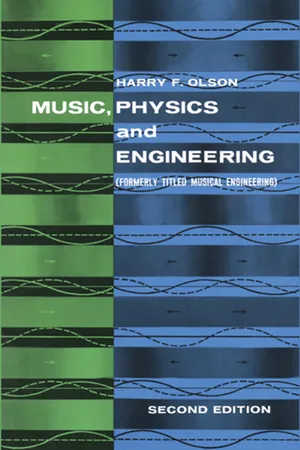
Now thoroughly revised and enlarged, this book offers the most comprehensive coverage available of all aspects of the production, reception, and reproduction of sound. Written clearly and concisely, all its chapters can be understood without specialized training in music, physics, engineering, or mathematics.
Dr. Olson discusses the nature of sound waves; explains the division of sound into scale patterns and the traditional method of notating them; describes the individual characteristics of all musical instruments currently in use (including the human voice); shows how the ears hear; discusses concert hall and recording studio acoustics, amplification systems, etc; describes the elements of sound reproduction systems from the telephone to the stereo record player; and concludes with a new chapter on the production, development, and potentialities of electronic music.
Under these broad headings, readers will find a close analysis of the way in which a violin produces sound; descriptions of carbon, crystal, dynamic, velocity, and unidirectional microphones; a comparison of the relative absorbency of 22 acoustic materials, building materials, and objects; a description of how music can be produced by a digital computer; and much, much more. Conductors will find suggestions on positioning their orchestras; performers will understand the dynamics of their instruments; recording engineers and acousticians will discover a remarkably comprehensive reference work; and music teachers, students, physicists, and enthusiasts in general will find easy access to a vast wealth of information.
- 480 pages
- English
- ePUB (mobile friendly)
- Available on iOS & Android
eBook - ePub
Music, Physics and Engineering
About this book
Information
Subtopic
Music Theory & AppreciationCHAPTER ONE
Sound Waves
1.1 INTRODUCTION
Music is the art of producing pleasing, expressive, or intelligible combinations of tones. The sounds of original music are produced by the human voice or instruments actuated by musicians. Most music is recorded and translated into sound from a symbolic notation on paper. The ultimate objective destination of all music is the human hearing mechanism. Thus the production of music consists of the following processes: the symbolic notation on paper by the composer, the translation of the notation into musical sounds by a musician employing his own voice or an instrument or both, and the actuation of the human hearing mechanism by the musical sounds.
The evolution and production of combinations of tones by composers and musicians, which have been accepted by the listeners as pleasant and expressive, have gone on through all the ages of man. Some of the musical developments have withstood the rigors of time and are in evidence at the present time. Others enjoyed a short-lived popularity and, as a consequence, were lost in the oblivion of the past. The evolution, development, and production of music through all the past epochs has been a very slow process, because the number of persons that could listen first hand to music as it was rendered was obviously limited. The advent of sound reproduction changed all this and made it possible for people in the millions to hear famous actors, artists, and musical aggregations where only the order of a thousand had been able to hear them first hand. As a result of sound reproduction, music entered upon a new era which made the musical past seem rather insignificant in comparison.
The reproduction of sound is the process of picking up sound at one point and reproducing it either at the same point or at some other point either at the same time or at some subsequent time. The most common sound-reproducing systems are the telephone, the phonograph, the radio, the sound motion picture, and television.
The telephone is the oldest sound-reproducing system. There is an average of more than one telephone instrument for each family in this country. This means that any person can talk to any other person in the matter of seconds.
The phonograph was the first sound-reproducing system which made it possible for all the people of the world to hear statesmen, orators, actors, orchestras, and bands when, previously, only a relatively few could hear them at first hand. The phonograph is used in every country and clime. There is an average of at least one phonograph per family in this country. For the past decade the sale of records has averaged three per year for every man, woman and child. The popularity of the phonograph is due to the fact that the individual can select any type of information or entertainment and reproduce it whenever he wants it.
The radio, like the phonograph, is a consumer-type instrument. Practically every family owns several radio receivers from the personal to the high-quality types. More than half of the automobiles are equipped with radio receivers. As a result, practically every person can select almost any desired program for listening.
The addition of sound to motion pictures made this type of expression complete. This was the first system in which picture and sound were synchronized and reproduced at the same time. Practically one-half of the population sees a motion picture once a week.
Television is the latest system in which picture and sound are reproduced at the same time. Sound is, of course, important to television because without it the result would be the same as the silent motion picture. On the average, every family owns a television receiver and has the opportunity to select from a myriad of varied programs.
The radio, phonograph, sound motion picture, and television have made it possible for all the people of the world to hear famous statesmen, artists, actors, and musical aggregations where only a relatively small number had been able to hear them at first hand. It is evident that the reproduction of sound has produced in a relatively short time a great change in the education and entertainment of this and other countries. The impact of the telephone, phonograph, radio broadcasting, sound motion pictures, and television upon the dissemination of information, art, and culture has been tremendous. The reproduction of sound in these fields has been as important to the advancement of knowledge as the invention of the printing press.
The science of music has been advanced along with acoustics, mathematics, electrical engineering, electronics, psychology, and physiology. The findings in these fields have made it possible to use a scientific approach in the study of speech and music. As a result, great advances have been made in reducing speech and music to a scientific basis. These advances have been hastened by the advent of the reproduction of sound, because the maximum exploitation of this medium requires a scientific understanding of speech and music. The studies in speech, music, hearing, and sound reproduction have advanced to the point where the fundamental aspects dealing with speech, music, musical instruments, hearing, and sound reproduction are reasonably well established. This implies that the science of music and the related subjects have advanced to the stage where they can be classed as engineering. In view of the importance and status of the science of speech, music, and the related subjects, it seems logical and timely to devote a book to the exposition of the scientific aspects of these subjects. Accordingly, the book presented herewith was written. In keeping with the treatment outlined above, the book is given the title Musical Engineering. Musical engineering is the theory and practice of the subjects of speech, music, hearing, acoustics, and electronics in the applied-science domain. More specifically, musical engineering involves the following subjects: the nature of an audio sound wave; the fundamental generators for the production of sound waves; musical terminology; musical scales; resonating and radiating systems used in musical instruments; string, wind, percussion, and electrical musical instruments and the human voice; the frequency spectrums, power output, directivity patterns, growth and decay and duration characteristics of musical instruments; the fundamental properties of speech and music; the human hearing mechanism; the acoustics of rooms; and sound-reproducing systems. It is the purpose of this book to present the subject of musical engineering.
1.2 SOUND
Sound is an alteration in pressure, particle displacement, or particle velocity which is propagated in an elastic medium, or the superposition of such propagated alterations.
Sound is also the auditory sensation produced through the ear by the alterations described above.
From these definitions it will be seen that sound is produced when the air or other medium is set into motion by any means whatsoever. Sound may be produced by a vibrating body as, for example, the sounding board of a piano, the body of a violin, or the diaphragm of a loudspeaker. Sound may be produced by the intermittent throttling of an air stream as, for example, the siren, the human voice, the trumpet and other lip-reed instruments, and the clarinet and other reed instruments. Sound may also be produced by the explosion of an inflammable-gas mixture or by the sudden release of a compressed gas from bursting tanks or balloons. Sound may be produced by the impact of the wind against certain objects in which the nonlinear properties of the medium convert a steady air stream into a pulsating one.
The properties of sound waves and the most common ways of producing sound waves will be described in this chapter in the sections which follow.
1.3 NATURE OF A SOUND WAVE
An explosion of a small balloon of compressed air produces one of the simplest forms of sound wave. A small balloon filled with compressed air is shown in Fig. 1.1 A. The air surrounding the balloon is in repose. In Fig. 1.1 B, the balloon has burst and the air which has been confined under pressure is transmitted outward in all directions as a pulse of pressure. In equalization, the pressure or condensation pulse is followed by a rarefaction pulse. In the rarefaction pulse the pressure is below the normal undisturbed atmospheric pressure, and in the condensation pulse the pressure is above the normal undisturbed atmospheric pressure, as shown in C, D, and E of Fig. 1.1. Following the definition of a sound wave, given in Sec. 1.2, it will be seen from the foregoing description that the disturbance produced by the bursting balloon constitutes a sound wave, consisting of a condensation or high-pressure pulse followed by a rarefaction or low-pressure pulse. The sound wave travels outward in all directions at the velocity of sound, that is, 1,100 feet per second. The magnitude of the condensation and corresponding rarefaction falls off inversely as the distance from the point of explosion of the balloon. The sound wave depicted in Fig. 1.1 is one of the simplest types. More complex sound waves consist of more than one condensation and rarefaction, usually of different values. These sound waves are produced by a vibrating body or a throttled air stream....
Table of contents
- Cover
- Title Page
- Copyright Page
- Contents
- 1 Sound Waves
- 2 Musical Terminology
- 3 Musical Scales
- 4 Resonators and Radiators
- 5 Musical Instruments
- 6 Characteristics of Musical Instruments
- 7 Properties of Music
- 8 Theater, Studio, and Room Acoustics
- 9 Sound-Reproducing Systems
- 10 Electronic Music
- Index
Trusted by 375,005 students
Access to over 1.5 million titles for a fair monthly price.
Study more efficiently using our study tools.
Frequently asked questions
Yes, you can cancel anytime from the Subscription tab in your account settings on the Perlego website. Your subscription will stay active until the end of your current billing period. Learn how to cancel your subscription
No, books cannot be downloaded as external files, such as PDFs, for use outside of Perlego. However, you can download books within the Perlego app for offline reading on mobile or tablet. Learn how to download books offline
Perlego offers two plans: Essential and Complete
- Essential is ideal for learners and professionals who enjoy exploring a wide range of subjects. Access the Essential Library with 800,000+ trusted titles and best-sellers across business, personal growth, and the humanities. Includes unlimited reading time and Standard Read Aloud voice.
- Complete: Perfect for advanced learners and researchers needing full, unrestricted access. Unlock 1.5M+ books across hundreds of subjects, including academic and specialized titles. The Complete Plan also includes advanced features like Premium Read Aloud and Research Assistant.
We are an online textbook subscription service, where you can get access to an entire online library for less than the price of a single book per month. With over 1.5 million books across 990+ topics, we’ve got you covered! Learn about our mission
Look out for the read-aloud symbol on your next book to see if you can listen to it. The read-aloud tool reads text aloud for you, highlighting the text as it is being read. You can pause it, speed it up and slow it down. Learn more about Read Aloud
Yes! You can use the Perlego app on both iOS and Android devices to read anytime, anywhere — even offline. Perfect for commutes or when you’re on the go.
Please note we cannot support devices running on iOS 13 and Android 7 or earlier. Learn more about using the app
Please note we cannot support devices running on iOS 13 and Android 7 or earlier. Learn more about using the app
Yes, you can access Music, Physics and Engineering by Harry F. Olson in PDF and/or ePUB format, as well as other popular books in Media & Performing Arts & Music Theory & Appreciation. We have over 1.5 million books available in our catalogue for you to explore.