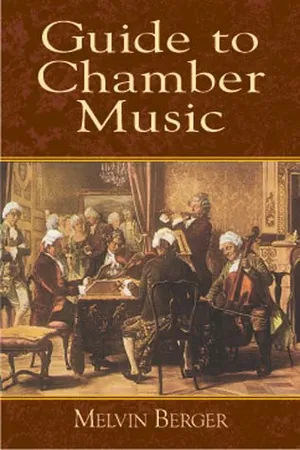
"Not only worhtwhile but so beautifully written and so informative that it should be in every chamber music lover's library." — Los Angeles Times. Authoritative, beautifully written guide presents 231 of the most frequently performed pieces of chamber music by 55 composers. For each, the author gives a brief biography, followed by discussions of the individual compositions — both their historical and musical contexts and their salient features, including formal organization, content, and any extramusical associations. "No lover of chamber music should be without this Guide." — John Barkham Reviews. Preface. Glossary.
- 480 pages
- English
- ePUB (mobile friendly)
- Available on iOS & Android
eBook - ePub
Guide to Chamber Music
About this book
Information
Subtopic
MusicAnton Arensky
Born July 12, 1861, at Novgorod, Russia
Died February 25, 1906, at Terioki, Finland
Died February 25, 1906, at Terioki, Finland
ANTON ARENSKY was a composer, a professor at the Moscow Conservatory and music director of the Imperial Chapel in Saint Petersburg. His music is particularly interesting for the traces one hears in it of the two opposing streams that flowed so vigorously in late nineteenth-century Russian music. One influence was Rimsky-Korsakov, Arensky’s teacher at the Saint Petersburg Conservatory, and a member of The Five, the group of nationalistic Russian composers who strongly advocated the use of native folk melodies and rhythms in concert music and rejected the view that folk music is not a fit subject for serious musical composition. The other was Tchaikovsky, who was far less concerned with expressing the Russian national character and declared that his music was modeled on the style of Mozart and the Italian opera composers.
In addition to his highly successful Piano Trio No. 1, Arensky’s other chamber compositions include String Quartet No. 1, Op. 11 (1888); String Quartet No. 2, Op. 35 (1894), originally for violin, viola, and two cellos, but later transcribed for the more traditional combination; Piano Quintet, Op. 51 (1900); and Piano Trio No. 2, Op. 73 (1905).
Piano Trio in D Minor, Op. 32
I. Allegro moderato. II. Scherzo: Allegro molto. III. Elegia: Adagio. IV. Finale: Allegro non troppo.
Arensky is not generally considered an important figure in the history of music. Yet his First Piano Trio is among the more popular and appealing works in the chamber music repertoire. Little is known about the circumstances of its composition beyond the fact that he wrote it in 1894 and dedicated it to the memory of Karl Davidoff (1838–1889), first cellist of the Saint Petersburg Opera and later director of the Saint Petersburg Conservatory.
Over a murmuring triplet figure in the piano, the violin sings a flowing first theme that seems to have drawn its inspiration from Tchaikovsky. After an agitated transition, the cello is entrusted with the somewhat more vocal second theme. The tempo picks up for the forceful, vigorous concluding theme of the exposition. The following, richly Romantic development section is mostly concerned with the opening theme. The recapitulation brings back all three themes, little changed from the exposition. A slow, quiet coda, really an augmentation of the principal theme, fades out at the end.
The Scherzo pits a florid, virtuosic piano part against extremely spare writing for the strings. A folk influence can be heard in the slightly slower middle section, a lilting waltz with a Slavonic cast. Here the piano is relegated to the role of accompanist as the strings weave their strands of sound into the appealing waltz melody. The movement is rounded off with a slightly expanded return of the Scherzo.
The center of gravity of the entire trio is the Elegia, the movement in which Arensky specifically pays homage to Davidoff. Both strings are muted, giving them an attractive, veiled dark tone color. The tempo increases, and the mood brightens for the middle part of the movement. For the reprise of the opening, the original tempo resumes.
Lively and rhythmic, the Finale explodes in a burst of sound. The quieter second theme seems to be a transformation of the Elegia’s main theme. Toward the end, the tempo slows for a reminder of the first movement theme, before concluding with a fast, brilliant coda.
Samuel Barber
Born March 9, 1910, in West Chester, Pennsylvania
Died January 23, 1981, in New York City
Died January 23, 1981, in New York City
SAMUEL BARBER displayed his very considerable musical talents early, starting piano lessons at age six, composing at seven, holding a position as church organist at twelve and entering the Curtis Institute of Music at fourteen. Success in his career came equally fast. Two of his student works, Dover Beach (1931) for voice and string quartet, and overture to The School for Scandal (1931) for orchestra, were given important, major premieres while the composer was still in his twenties. This acclaim and recognition continued throughout his long career, winning for Barber two Pulitzer Prizes, the Prix de Rome, two Pulitzer Traveling Scholarships, the New York Critics’ Circle Award and two Beams Prizes.
Contibuting to Barber’s popularity was his outstanding ability to write long, flowing melodies, with particularly attractive vocal qualities. This talent, plus his instinctive sense of form and rigorous musical logic, allowed him to develop his extended melodic subjects into well-structured and skillfully organized compositions with the greatest economy of means.
Barber’s expressivity, highly developed lyricism, and emotionality usually lead him to be classified among the Post Romantics; his essentially diatonic style, an extension of eighteenth-and nineteenth-century tonality, has given much of his music a conservative tag. Unlike many other twentieth-century composers, Barber was unaffected by such modern trends as atonality, serialism, electronic or aleatoric composition, or minimalism. While his independent course explains his lack of favor among the avant-garde in contemporary music, it does not detract in the slightest from his wide acceptance by concert audiences everywhere.
Dover Beach for Voice and String Quartet, Op. 3
In 1931, when he was twenty-one years old and still a student at the Curtis Institute in Philadelphia, Samuel Barber composed Dover Beach, a setting of Matthew Arnold’s poem for voice (either mezzo soprano or baritone) and string quartet. Shortly after, Barber played the work to Ralph Vaughan Williams, singing the voice part and performing the instrumental parts on the piano. Vaughan Williams, already recognized as one of England’s leading composers, was obviously very impressed and congratulated the shy young man. “I myself once set Dover Beach,” he said, “but you really got it!” Barber later commented on the occasion: “Enthusiasm for my music was rather uncommon at the time. Coming from a composer of the stature of Vaughan Williams, I found it especially gratifying.”
From the very opening, the gentle rocking motion of the string parts captures the melancholic and elegiac mood of the poem. The ebb and flow of the music very sensitively represents the endless shifting of the sea which, in Arnold’s poem, is a metaphor for the flow of human existence. In creating this extended vocal form, Barber alternates between quite literal settings of the words and vague suggestions of their meanings as he builds to the impassioned ending.
The sea is calm to-night,
The tide is full, the moon lies fair
Upon the straits;—on the French coast the light
Gleams and is gone; the cliffs of England stand,
Glimmering and vast, out in the tranquil bay.
Come to the window, sweet is the night-air!
Only, from the long line of spray
Where the sea meets the moon-blanch’d land,
Listen! you hear the grating roar
Of pebbles which the waves draw back, and fling,
At their return, up the high strand,
Begin, and cease, and then again begin,
With tremulous cadence slow, and bring
The eternal note of sadness in.
Sophocles long ago
Heard it on the Aegean, and it brought
Into his mind the turbid ebb and flow
Of human misery; we
Find also in the sound a thought,
Hearing it by this distant northern sea.
The sea of faith
Was once, too, at the full, and round earth’s shore
Lay like the folds of a bright girdle furl’d.
But now I only hear
Its melancholy, long, withdrawing roar,
Retreating, to the breath
Of the night-wind, down the vast edges drear
And naked shingles of the world.
Ah, love, let us be true
To one another! for the world, which seems
To lie before us like a land of dreams,
So various, so beautiful, so new,
Hath really neither joy, nor love, nor light,
Nor certitude, nor peace, nor help for pain;
And we are here as on a darkling plain
Swept with confused alarms of struggle and flight,
Where ignorant armies clash by night.
Dover Beach was first performed in New York City on March 5, 1933, by Rose Bampton and the New York String Quartet.
String Quartet, Op. 11
I. Molto allegro e appassionato. II. Molto adagio; Molto allegro.
A few popular favorites of the orchestral repertoire originated as individual movements, usually the slow movement, of string quartets. Haydn’s Serenade from his String Quartet, Op. 3, No. 5, the Andante Cantabile of Tchaikovsky’s String Quartet, Op. 11 and the Notturno of Borodin’s Second Quartet come immediately to mind. The most recent addition to this list is Samuel Barber’s Adagio for Strings, the composer’s transcription of the second movement of his String Quartet, Op. 11. The string orchestra arrangement, which Barber prepared at the request of Arturo Toscanini, conductor of the NBC Symphony Orchestra, has become one of the most widely performed works of contemporary American music.
The first movement of Barber’s two-movement string quartet bursts forth with a bold unison statement of the main theme, made even more striking by its slightly awkward rhythmic pattern. In time this gives way to the subsidiary subject, a quiet choralelike section in flexible tempo that is soon interrupted by a brief, skittish transformation of the opening melody. A wide-ranging, spun-out legato melody follows. After a succinct working-out of the three subjects, they are all returned for a pithy recapitulation.
The Adagio is constructed around one long, sinuous theme that moves slowly and deliberately in step-wise motion. Starting with the utmost calmness and tranquility, Barber carries the theme to an intense, exciting climax, with each instrument straining at the uppermost limit of its range. A subdued, sober coda concludes the Adagio. After a short pause, Barber then recapitulates the themes of the first movement, creating a kind of brief third movement that brings the entire quartet full circle, back to its original character.
Barber wrote his Opus 11 in 1936, while on a Pulitzer Traveling Scholarship; the Pro Arte String Quartet gave the premiere in Rome in December of that year.
Summer Music for Woodwind Quintet, Op. 31
Slow and indolent. With motion. Faster. Lively, still faster. Faster.
Most composers receive commissions either from wealthy patrons, highly successful performers, or established performing organizations. Barber’s commission for a woodwind quintet from the Chamber Music Society of Detroit, though, was unique. The society underwrote the project with contributions that it solicited from its members in amounts as small as one dollar. The premiere was given on March 20, 1956, at the Detroit Institute of Arts by the principal wind players of the Detroit Symphony.
Although some of the composer’s marking on the score, such as a tempo direction of “slow and indolent” and instructions for the clarinet to play a passage “with arrogance,” might indicate that Barber had specific images in mind, there are no other indications of extramusical meaning. Instead, the music seems to be shaped entirely by Barber’s highly developed musical thinking and expert craftsmanship.
The piece starts with a brief phrase played twice by the bassoon and French horn and answered in turn by flourishes in the flute and clarinet. This proves to be the germ cell from which the entire one-movement work grows. The phrase ends with the French horn playing several repeated descending half steps in short-long rhythm, which gives rise to the extended cantabile line that the oboe sings in the following With Motion section. An abrupt change of tempo and style signals the Faster episode with its perky rhythmic pattern. After bringing back quotations from earlier sections, the tempo picks up again, and the oboe introduces a jaunty, seemingly new tune. Careful listening, however, reveals that it starts with the same repeated notes as the opening phrase and then moves in a rather free mirror image of that melody. The quintet ends with brilliant virtuosic writing for the various instruments, including several references to melodic material previously introduced.
Béla Bartók
Born March 25, 1881, in Nagyszentmiklós, Hungary (now Rumania)
Died September 26, 1945, in New York City
Died September 26, 1945, in New York City
BARTÓK’S MOTHER, a piano teacher, reported that as an infant he already could pick out tunes on the piano; at age five he started music lessons and in a few years was composing little pieces. When he was eleven he gave his first piano recital. On the program was an original composition, “The Danube River,” which traces the river’s path by using melodies from each of the countries through which it passes. Where the river enters Hungary he wrote a gay, happy polka, commenting, “It is jubilant, for it has come to Hungary.” When the river departs the country, the music turns sad. Bartók’s intense love for Hungary was even then apparent.
While a student at the Royal Academy of Music in Budapest, Bartók became involved in the Hungarian nationalistic movement, and the struggle to free the land from Austrian domination. He extended the effort to his own music, saying that the times “called for something specifically Hungarian to be created in music.” Inspired by these patriotic feelings, he composed his first major work, Kossuth (1903), an orchestral tone poem that uses folk melodies to describe the 1848 Hungarian revolt led by Lajos Kossuth.
Then, in the summer of 1904, a significant new dimension was added to his involvement with Hungarian national music. While on holiday in the remote Hungarian countryside, he heard an eighteen-year-old peasant girl singing a hauntingly beautiful melody—different from anything he had ever heard before. He discovered it was a local folk song, completely unknown outside the area. With great difficulty, Bartók copied down the strange melody and irregular rhythms as the girl sang it for him again. For the first time the thought of collecting truly authentic Hungarian peasant songs occurred to him, and with fellow composer, Zoltán Kodaly, he began combing the countryside, recording and transcribing the many outstanding examples they were able to unearth.
The two composers envisioned composing music that would draw on this source as its inspiration: “In our case it was not a question of merely taking unique melodies and then incorporating them in our works. What we had to do was divine the spirit of this unknown music, and to make this spirit the basis of our works. According to the way I feel, a genuine peasant melody of our land is a musical example of a perfected art. I consider it as much a masterpiece, for instance, as a Bach fugue or a Mozart sonata.”
Bartók’s study of folk music became an important part of his life, as he collected, record...
Table of contents
- Cover Page
- Title Page
- ARENSKY, ANTON
- BRITTEN, BENJAMIN
- HINDEMITH, PAUL
- NIELSEN, CARL
- SCHULLER, GUNTHER
- Back Cover
Trusted by 375,005 students
Access to over 1.5 million titles for a fair monthly price.
Study more efficiently using our study tools.
Frequently asked questions
Yes, you can cancel anytime from the Subscription tab in your account settings on the Perlego website. Your subscription will stay active until the end of your current billing period. Learn how to cancel your subscription
No, books cannot be downloaded as external files, such as PDFs, for use outside of Perlego. However, you can download books within the Perlego app for offline reading on mobile or tablet. Learn how to download books offline
Perlego offers two plans: Essential and Complete
- Essential is ideal for learners and professionals who enjoy exploring a wide range of subjects. Access the Essential Library with 800,000+ trusted titles and best-sellers across business, personal growth, and the humanities. Includes unlimited reading time and Standard Read Aloud voice.
- Complete: Perfect for advanced learners and researchers needing full, unrestricted access. Unlock 1.5M+ books across hundreds of subjects, including academic and specialized titles. The Complete Plan also includes advanced features like Premium Read Aloud and Research Assistant.
We are an online textbook subscription service, where you can get access to an entire online library for less than the price of a single book per month. With over 1.5 million books across 990+ topics, we’ve got you covered! Learn about our mission
Look out for the read-aloud symbol on your next book to see if you can listen to it. The read-aloud tool reads text aloud for you, highlighting the text as it is being read. You can pause it, speed it up and slow it down. Learn more about Read Aloud
Yes! You can use the Perlego app on both iOS and Android devices to read anytime, anywhere — even offline. Perfect for commutes or when you’re on the go.
Please note we cannot support devices running on iOS 13 and Android 7 or earlier. Learn more about using the app
Please note we cannot support devices running on iOS 13 and Android 7 or earlier. Learn more about using the app
Yes, you can access Guide to Chamber Music by Melvin Berger in PDF and/or ePUB format, as well as other popular books in Media & Performing Arts & Music. We have over 1.5 million books available in our catalogue for you to explore.