![]()
III
ON THE TRILL
Although we also consider the correct execution of a trill to be one of the requirements of a fine delivery, we devote a separate chapter to the discussion of this matter; first, because we cannot give our readers much positive information regarding Beethoven, and, secondly, because a review of the question compels us to begin at a considerably earlier date. We shall not deal, of course, with æsthetic directions touching evenness, rapidity, and the like, but rather with a point more or less in dispute in other cases as well, namely,
Shall the trill begin on principal tone or auxiliary?
Now, in accord with the great majority of the hints and teachings of German and French composers and theorists of the eighteenth century,
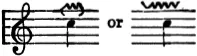
The ordinary trill should begin on the higher auxiliary, which may, however, be written in the form of a long appoggiatura.
Real or apparent deviations from this fundamental rule will be noted later, while discussing the several musicians.
To elucidate the reason for this phenomenon, it might be of utility to trace back the theory of appoggiaturas to its beginning. However, as we have to do with facts only, we may be satisfied with the exact explanation given by Marpurg concerning the Development of the Trill out of the Appoggiatura.*
“The Trill originated in the conjunct appoggiatura from above downward, and is, fundamentally, nothing more than a series of appoggiaturas following each other with the greatest rapidity. The usual definition, which describes it as the swift alternation of a tone with the second above, does not conflict with this hew explanation.”
The further development of the trill is described by Ph. E. Bach.*
“Before this they [trills] were not lightly employed, except after an appoggiatura or on the repetition of the preceding note; in the former case they are termed “angeschlossene Triller” (conjunct trills); but nowadays they occur after leaping notes, directly at the beginning, often one after the other, at Cadenzas, over long fermate, at the ends of divisions, without a preceding appoggiatura, and also after one. Consequently, this grace is much more arbitrary now than formerly.”
We learn where the proper and regular place for the trill was from Tosi’s “Anleitung zur Singkunst,” translated and provided with explanations by Agricola, Royal Prussian Court Composer. [Berlin, 1757.] “Any one who can execute a really fine trill, has the advantage of being able to finish the cadences or closes of a song creditably, the place where the trill is most decidedly essential.” [Tosi.]
Probably because of this association with the cadences, the trill was called “cadence” (besides “tremblement”) in France.
On this head J. J. Rousseau’s “Dictionnaire de Musique” says: “As a term in singing, cadence means the beating in the throat which the Italians call trillo, which we otherwise call tremblement, and which is usually made on the penultimate note of a musical phrase; whence it doubtless took the name of Cadence.”
Having thus sufficiently informed ourselves concerning the origin and regular place of the trill, we give in chronological order the most important directions for its
Execution.
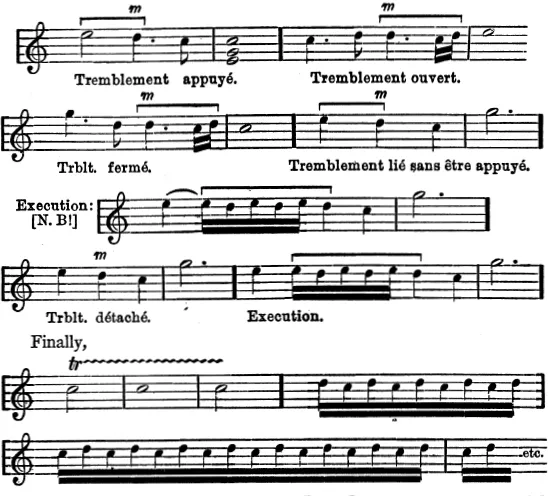
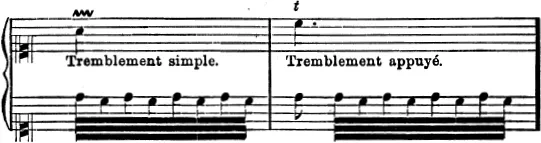
Couperin, surnamed le Grand [1668–1733], gives in his “Pièces de Clavecin” [1713] the following “explication” of the trill. [Plate and Explanation of the Embellishments.]
N
OTE. “
is a sign to mark notes which should be bound and slurred.”
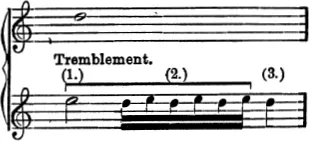
In “L’art de toucher le clavecin” [1717], Couperin adds the following explanation:
“Trills of any considerable extent comprise three parts, which coalesce to one in execution: (1) The suspension, which should be formed on the note above the principal note; (2) The trill-beats; and (3) the final tone * (point of repose).
“As to the other trills, they are arbitrary. Some have the suspension; others are so short as to have neither suspension nor point of repose.”
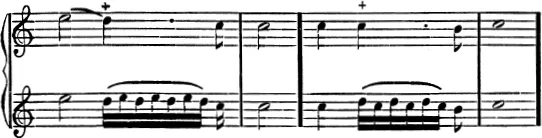
To present this theory in full, we add J. J. Rousseau’s explanation (“Diet. de Musique”) from the second half of the eighteenth century: “There are two kinds of Cadences; one is the Cadence pleine, and consists in not beginning the beating of the voice until the higher note has been dwelt on; the other is called Cadence brisée, and in it the beatings begin quite without preparation:”
[EDITOR’S NOTE. The + is an early sign for tr. In the execution of the first example, we find a case of the abbreviation of a short note after a dot.]
Could Seb. Bach have read these “explications” of Couperin’s?—In a copy, prepared by Fuchs, of a copy made by Bach of two French suites [by Grigny and Dieupart; R. Library, Berlin], occur the following examples of trills:
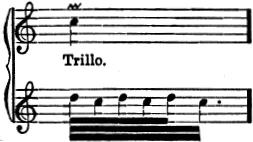
Bach himself, in the “Clavierbüchlein for Wilhelm Friedemann Bach, begun at Cöthen, January 22d, A. D. 1720,” left the following definition of the trill (here transferred from the C-clef to the violinclef):
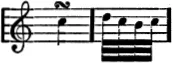
For his part, he calls the
turn a “Cadence”:
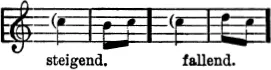
The suspension (appoggiatura) he calls the “Accent” (rising and falling):
J. S. Bach’s colleague at Weimar, court musician and organist Johann Gottfried Walther, a celebrated teacher, writes, in his Lexicon [1732]: “Trillo, pl. trilli (Ital.) is a grace in singing and playing, for the execution of which, according to situation or signature, either the major or minor second is employed, this note being struck, in...