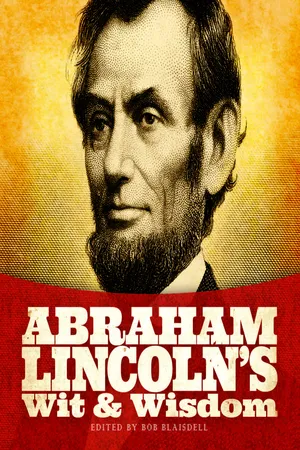
"My politics are short and sweet, like the old woman's dance." The most eloquent of American presidents, Lincoln had a sagacious or humorous comment on everything that mattered. This attractively designed and illustrated gift book features the Great Emancipator's thoughts and opinions on subjects from politics to human nature to the burdens and privileges of the presidency.
- 256 pages
- English
- ePUB (mobile friendly)
- Available on iOS & Android
eBook - ePub
Abraham Lincoln's Wit and Wisdom
About this book
Information
THE WAR AND HIS GENERALS: “We accepted this war for an object, a worthy object, and the war will end when that object is attained”
The rebels attack Fort Sumter, and your citizens attack troops sent to the defense of the Government and the lives and property in Washington, and yet you would have me break my oath and surrender the Government without a blow. There is no Washington in that—no Jackson in that—no manhood nor honor in that.
—Remarks to a YMCA committee from Baltimore, April 22, 1861

I intend at present, always leaving an opportunity for change of mind, to fill Fortress Monroe with men and stores, blockade the ports effectually, provide for the entire safety of the capital, keep them quietly employed in this way, and then go down to Charleston and pay her the little debt we are owing her.
—Remark to his assistant private secretary John Hay, April 25, 1861
I have no desire to invade the South; but I must have troops to defend this Capital. Geographically [Washington] lies surrounded by the soil of Maryland; and mathematically the necessity exists that they should come over her territory. Our men are not moles, and can’t dig under the earth; they are not birds, and can’t fly through the air. There is no way but to march across, and that they must do. But in doing this there is no need of collision. Keep your rowdies in Baltimore, and there will be no bloodshed. Go home and tell your people that if they will not attack us, we will not attack them; but if they do attack us, we will return it, and that severely.
—Remarks to a YMCA committee from Baltimore, April 22, 1861
I will make no apology, gentlemen, for my weakness; but I knew poor Ellsworth well and held him in great regard. Just as you entered the room, Captain Fox left me, after giving me the painful details of Ellsworth’s unfortunate death. The event was so unexpected, and the recital so touching, that it quite unmanned me. . . . Poor fellow, it was undoubtedly an act of rashness, but it only shows the heroic spirit that animates our soldiers, from high to low, in this righteous cause of ours. Yet who can restrain their grief to see them fall in such a way as this, not by the fortunes of war, but by the hand of an assassin?
—Remark to a newspaper reporter after having cried at the news of Colonel Elmer Ellsworth’s death, May 25, 1861
You are green, it is true, but they are green, also; you are all green alike.
—Remark to Brigadier General Irvin McDowell, on his battle plan for Manassas (Bull Run), June 29, 1861
The people of Virginia have thus allowed this giant insurrection to make its nest within her borders; and this government has no choice left but to deal with it where it finds it.
—Message to Congress in Special Session, July 4, 1861
Gentlemen, my position in regard to your state is like that of the woodman, who, returning to his home one night, found coiled around his beautiful children, who were quietly sleeping in their bed, several poisonous snakes. His first impulse was to save his little ones, but he feared that if he struck at the snakes he might strike the children, and yet he dared not let them die without an effort. So it is with me. I know Kentucky and Tennessee are infested with the enemies of the Union, but I know also that there are thousands of patriots in both who will be persecuted even unto death unless the strong hand of the government is interposed for their protection and rescue. We must go in. The old flag must be carried into Tennessee at whatever hazard.
—Remark to commissioners from Kentucky protesting the movement of Union troops, July 1861
Doctor, although you do not know me, I know you. You are getting up a hospital for those who may fall sick or be wounded in the defense of the Union. I have been there and have seen you at work, although you were not aware of it. I want to aid you in your preparations for taking care of the poor fellows who will need all that we can do for them. When you need anything don’t let there be any red tape. Come to me at once without hesitation, and you shall have anything you want if I can get it for you.
—Remark to a staff surgeon for the army, July 1861
It has been said that one bad general is better than two good ones; and the saying is true, if taken to mean no more than that an army is better directed by a single mind, though inferior, than by two superior ones at variance and cross-purposes with each other. And the same is true in all joint operations wherein those engaged can have none but a common end in view, and can differ only as to the choice of means. In a storm at sea no one on board can wish the ship to sink; and yet not infrequently all go down together because too many will direct, and no single mind can be allowed to control.
—Annual Message to Congress, December 3, 1861
“Act well your part, there all the honor lies.” He who does something at the head of one regiment will eclipse him who does nothing at the head of a hundred.
—Letter to Major General David Hunter (Lincoln quotes the poet Alexander Pope), December 31, 1861
Delay is ruining us; and it is indispensable for me to have something definite.
—Telegram to General Henry W. Halleck, January 7, 1862
. . . I state my general idea of this war to be that we have the greater numbers and the enemy has the greater facility of concentrating forces upon points of collision; that we must fail unless we can find some way of making our advantage an overmatch for his; and that this can only be done by menacing him with superior forces at different points at the same time, so that we can safely attack one or both if he makes no change; and if he...
Table of contents
- Cover
- Title Page
- Dedication
- Contents
- Note
- America
- Education and Advice for the Young
- Faith, Morality, and “God’s Will”
- Fathers and Sons
- His Own Life and Character
- Law and the Constitution
- Politics
- Politicians: Henry Clay, Stephen Douglas, and Zachary Taylor
- The Presidency
- Reading and Writing
- Secession
- Slavery, Equality, and the Emancipation Proclamation
- Speech-Making
- Storytelling
- The War and His Generals
- Women and Marriage
- Appendix: Remarks on Abraham Lincoln by His Contemporaries
Trusted by 375,005 students
Access to over 1.5 million titles for a fair monthly price.
Study more efficiently using our study tools.
Frequently asked questions
Yes, you can cancel anytime from the Subscription tab in your account settings on the Perlego website. Your subscription will stay active until the end of your current billing period. Learn how to cancel your subscription
No, books cannot be downloaded as external files, such as PDFs, for use outside of Perlego. However, you can download books within the Perlego app for offline reading on mobile or tablet. Learn how to download books offline
Perlego offers two plans: Essential and Complete
- Essential is ideal for learners and professionals who enjoy exploring a wide range of subjects. Access the Essential Library with 800,000+ trusted titles and best-sellers across business, personal growth, and the humanities. Includes unlimited reading time and Standard Read Aloud voice.
- Complete: Perfect for advanced learners and researchers needing full, unrestricted access. Unlock 1.5M+ books across hundreds of subjects, including academic and specialized titles. The Complete Plan also includes advanced features like Premium Read Aloud and Research Assistant.
We are an online textbook subscription service, where you can get access to an entire online library for less than the price of a single book per month. With over 1.5 million books across 990+ topics, we’ve got you covered! Learn about our mission
Look out for the read-aloud symbol on your next book to see if you can listen to it. The read-aloud tool reads text aloud for you, highlighting the text as it is being read. You can pause it, speed it up and slow it down. Learn more about Read Aloud
Yes! You can use the Perlego app on both iOS and Android devices to read anytime, anywhere — even offline. Perfect for commutes or when you’re on the go.
Please note we cannot support devices running on iOS 13 and Android 7 or earlier. Learn more about using the app
Please note we cannot support devices running on iOS 13 and Android 7 or earlier. Learn more about using the app
Yes, you can access Abraham Lincoln's Wit and Wisdom by Abraham Lincoln, Bob Blaisdell in PDF and/or ePUB format, as well as other popular books in Literature & North American Literary Collections. We have over 1.5 million books available in our catalogue for you to explore.