Written by a prominent Russian mathematician, this concise monograph examines aspects of queuing theory as an application of probability. The three-part treatment begins with a study of the stream of incoming demands (or "calls," in the author's terminology). Subsequent sections explore systems with losses and systems allowing delay. Prerequisites include a familiarity with the theory of probability and mathematical analysis. A. Y. Khinchin made significant contributions to probability theory, statistical physics, and several other fields. His elegant, groundbreaking work will prove of substantial interest to advanced undergraduates, graduate students, and professionals in the fields of statistics, probability, and operations research.
Frequently asked questions
Yes, you can cancel anytime from the Subscription tab in your account settings on the Perlego website. Your subscription will stay active until the end of your current billing period. Learn how to cancel your subscription.
No, books cannot be downloaded as external files, such as PDFs, for use outside of Perlego. However, you can download books within the Perlego app for offline reading on mobile or tablet. Learn more here.
Perlego offers two plans: Essential and Complete
Essential is ideal for learners and professionals who enjoy exploring a wide range of subjects. Access the Essential Library with 800,000+ trusted titles and best-sellers across business, personal growth, and the humanities. Includes unlimited reading time and Standard Read Aloud voice.
Complete: Perfect for advanced learners and researchers needing full, unrestricted access. Unlock 1.4M+ books across hundreds of subjects, including academic and specialized titles. The Complete Plan also includes advanced features like Premium Read Aloud and Research Assistant.
Both plans are available with monthly, semester, or annual billing cycles.
We are an online textbook subscription service, where you can get access to an entire online library for less than the price of a single book per month. With over 1 million books across 1000+ topics, we’ve got you covered! Learn more here.
Look out for the read-aloud symbol on your next book to see if you can listen to it. The read-aloud tool reads text aloud for you, highlighting the text as it is being read. You can pause it, speed it up and slow it down. Learn more here.
Yes! You can use the Perlego app on both iOS or Android devices to read anytime, anywhere — even offline. Perfect for commutes or when you’re on the go. Please note we cannot support devices running on iOS 13 and Android 7 or earlier. Learn more about using the app.
Yes, you can access Mathematical Methods in the Theory of Queuing by A. Y. Khinchin, D. M. Andrews, D. M. Andrews,M. H. Quenouille in PDF and/or ePUB format, as well as other popular books in Mathematics & Probability & Statistics. We have over one million books available in our catalogue for you to explore.
The general theory of streams (of uniform events) might reasonably begin with abstract definitions of the main components of such streams. However, any such general approach will be postponed till Chapter 2 where it will be dealt with to the extent necessary. Meanwhile, we prefer to introduce the reader into the field of concrete investigations of streams of the simplest type in order to achieve from the start a clear picture of the basic ways of thought, of the mathematical models in the theory of mass service, and of the form of this science as a mathematical discipline. When these concrete explanations have been sufficiently mastered, the study of a more abstract general theory should not seem difficult.
We also add that the simple type of stream to be studied in this chapter has, in course of time, shown itself to be almost the only one useful in application; only in comparatively recent years has the necessity been clearly shown for the study of streams of a more general type. Meanwhile, even nowadays the great majority of applications of the theory of mass service (in particular in telephone applications) arise from the assumption that an incoming stream of demands (calls) belongs to this simple type. Explanations, particularly technical ones, of the theory of the simple stream have in the past few decades developed to the extent that even elementary courses in the theory of probability nowadays usually include a special chapter devoted to this theory.
1 Definition and statement of the problem
We will call a stream of uniform events “simple” if it possesses the following three characteristics —
(1) Stationariness. For any t > 0 and integer k
0, the probability that during the period of time (a, a + t) there will occur k events is the same for every a
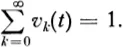
0 (and so depends only on t and k); hereafter we shall indicate this probability by υk(t). Throughout the book we shall deal only with streams in which, during a finite period of time with probability 1, there occur only a finite number of events. Thus, for any t, we shall always have
The stationariness of a stream expresses the invariability of i...