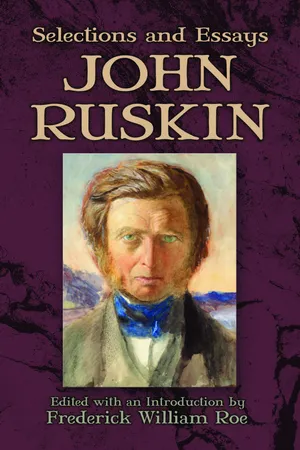
Acclaimed by Tolstoy as "one of the greatest English writers and one of the greatest writers of our age," John Ruskin continues to enjoy widespread popularity among modern readers. In addition to his roles as art critic and patron, watercolorist, and draughtsman, Ruskin ranks among the nineteenth century's most prominent social thinkers and philanthropists. His art criticism redefined the genre and his ideas related to politics and society, revolutionary in their day, anticipated current trends in environmentalism, sustainability, and craft.
Throughout his long and prolific careers as educator and author, Ruskin focused on the associations among nature, art, and society. This anthology features well-chosen examples of that synthesis, drawing from some of his best-known books, including Modern Painters and The Stones of Venice. Students and other readers will find this volume the perfect introduction to the Victorian sage's voluminous works.
- 336 pages
- English
- ePUB (mobile friendly)
- Available on iOS & Android
eBook - ePub
Selections and Essays
About this book
Information
Topic
LittératureSubtopic
Dissertations littérairesIII. ART
GREATNESS IN ART
[Modem Paintens, Vol. I, Pt. 1, § 1, Ch. 2.]
In the 15th Lecture of Sir Joshua Reynolds, incidental notice is taken of the distinction between those excellences in the painter which belong to him as such, and those which belong to him in common with all men of intellect, the general and exalted powers of which art is the evidence and expression, not the subject. But the distinction is not there dwelt upon as it should be, for it is owing to the slight attention ordinarily paid to it, that criticism is open to every form of coxcombry, and liable to every phase of error. It is a distinction on which depend all sound judgment of the rank of the artist, and all just appreciation of the dignity of art.
Painting, or art generally, as such, with all its technicalities, difficulties, and particular ends, is nothing but a noble and expressive language, invaluable as the vehicle of thought, but by itself nothing. He who has learned what is commonly considered the whole art of painting, that is, the art of representing any natural object faithfully, has as yet only learned the language by which his thoughts are to be expressed. He has done just as much toward being that which we ought to respect as a great painter, as a man who has learned how to express himself grammatically and melodiously has toward being a great poet. The language is, indeed, more difficult of acquirement in the one case than in the other, and possesses more power of delighting the sense, while it speaks to the intellect; but it is, nevertheless, nothing more than language, and all those excellences which are peculiar to the painter as such, are merely what rhythm, melody, precision, and force are in the words of the orator and the poet, necessary to their greatness, but not the test of their greatness. It is not by the mode of representing and saying, but by what is represented and said, that the respective greatness either of the painter or the writer is to be finally determined.
Speaking with strict propriety, therefore, we should call a man a great painter only as he excelled in precision and force in the language of lines, and a great versifier, as he excelled in precision and force in the language of words. A great poet would then be a term strictly, and in precisely the same sense, applicable to both, if warranted by the character of the images or thoughts which each in their respective languages conveyed.
Take, for instance, one of the most perfect poems or pictures (I used the words as synonymous) which modern times have seen:—the “Old Shepherd’s Chief-mourner.” Here the exquisite execution of the glossy and crisp hair of the dog, the bright sharp touching of the green bough beside it, the clear painting of the wood of the coffin and the folds of the blanket, are language—language clear and expressive in the highest degree. But the close pressure of the dog’s breast against the wood, the convulsive clinging of the paws, which has dragged the blanket off the trestle, the total powerlessness of the head laid, close and motionless, upon its folds, the fixed and tearful fall of the eye in its utter hopelessness, the rigidity of repose which marks that there has been no motion nor change in the trance of agony since the last blow was struck on the coffin-lid, the quietness and gloom of the chamber, the spectacles marking the place where the Bible was last closed, indicating how lonely has been the life, how un-watched the departure of him who is now laid solitary in his sleep;—these are all thoughts—thoughts by which the picture is separated at once from hundreds of equal merit, as far as mere painting goes, by which it ranks as a work of high art, and stamps its author, not as the neat imitator of the texture of a skin, or the fold of a drapery, but as the Man of Mind.
It is not, however, always easy, either in painting or literature, to determine where the influence of language stops, and where that of thought begins. Many thoughts are so dependent upon the language in which they are clothed, that they would lose half their beauty if otherwise expressed. But the highest thoughts are those which are least dependent on language, and the dignity of any composition, and praise to which it is entitled, are in exact proportion to its independency of language or expression. A composition is indeed usually most perfect, when to such intrinsic dignity is added all that expression can do to attract and adorn; but in every case of supreme excellence this all becomes as nothing. We are more gratified by the simplest lines or words which can suggest the idea in its own naked beauty, than by the robe and the gem which conceal while they decorate; we are better pleased to feel by their absence how little they could bestow, than by their presence how much they can destroy.
There is therefore a distinction to be made between what is ornamental in language and what is expressive. That part of it which is necessary to the embodying and conveying of the thought is worthy of respect and attention as necessary to excellence, though not the test of it. But that part of it which is decorative has little more to do with the intrinsic excellence of the picture than the frame or the varnishing of it. And this caution in distinguishing between the ornamental and the expressive is peculiarly necessary in painting; for in the language of words it is nearly impossible for that which is not expressive to be beautiful, except by mere rhythm or melody, any sacrifice to which is immediately stigmatized as error. But the beauty of mere language in painting is not only very attractive and entertaining to the spectator, but requires for its attainment no small exertion of mind and devotion of time by the artist. Hence, in art, men have frequently fancied that they were becoming rhetoricians and poets when they were only learning to speak melodiously, and the judge has over and over again advanced to the honor of authors those who were never more than ornamental writing-masters.
Most pictures of the Dutch school, for instance, excepting always those of Rubens, Vandyke, and Rembrandt, are ostentatious exhibitions of the artist’s power of speech, the clear and vigorous elocution of useless and senseless words; while the early efforts of Cimabue and Giotto are the burning messages of prophecy, delivered by the stammering lips of infants. It is not by ranking the former as more than mechanics, or the latter as less than artists, that the taste of the multitude, always awake to the lowest pleasures which art can bestow, and blunt to the highest, is to be formed or elevated. It must be the part of the judicious critic carefully to distinguish what is language, and what is thought, and to rank and praise pictures chiefly for the latter, considering the former as a totally inferior excellence, and one which cannot be compared with nor weighed against thought in any way nor in any degree whatsoever. The picture which has the nobler and more numerous ideas, however awkwardly expressed, is a greater and a better picture than that which has the less noble and less numerous ideas, however beautifully expressed. No weight, nor mass, nor beauty of execution, can outweigh one grain or fragment of thought. Three penstrokes of Raffaelle are a greater and a better picture than the most finished work that ever Carlo Dolci polished into inanity. A finished work of a great artist is only better than its sketch, if the sources of pleasure belonging to color and realization—valuable in themselves—are so employed as to increase the impressiveness of the thought. But if one atom of thought has vanished, all color, all finish, all execution, all ornament, are too dearly bought. Nothing but thought can pay for thought, and the instant that the increasing refinement or finish of the picture begins to be paid for by the loss of the faintest shadow of an idea, that instant all refinement or finish is an excrescence and a deformity.
Yet although in all our speculations on art, language is thus to be distinguished from, and held subordinate to, that which it conveys, we must still remember that there are certain ideas inherent in language itself, and that, strictly speaking, every pleasure connected with art has in it some reference to the intellect. The mere sensual pleasure of the eye, received from the most brilliant piece of coloring, is as nothing to that which it receives from a crystal prism, except as it depends on our perception of a certain meaning and intended arrangement of color, which has been the subject of intellect. Nay, the term idea, according to Locke’s definition of it, will extend even to the sensual impressions themselves as far as they are “things which the mind occupies itself about in thinking”; that is, not as they are felt by the eye only, but as they are received by the mind through the eye. So that, if I say that the greatest picture is that which conveys to the mind of the spectator the greatest number of the greatest ideas, I have a definition which will include as subjects of comparison every pleasure which art is capable of conveying. If I were to say, on the contrary, that the best picture was that which most closely imitated nature, I should assume that art could only please by imitating nature; and I should cast out of the pale of criticism those parts of works of art which are not imitative, that is to say, intrinsic beauties of color and form, and those works of art wholly, which, like the Arabesques of Raffaelle in the Loggias, are not imitative at all. Now, I want a definition of art wide enough to include all its varieties of aim. I do not say, therefore, that the art is greatest which gives most pleasure, because perhaps there is some art whose end is to teach, and not to please. I do not say that the art is greatest which teaches us most, because perhaps there is some art whose end is to please, and not to teach. I do not say that the art is greatest which imitates best, because perhaps there is some art whose end is to create and not to imitate. But I say that the art is greatest which conveys to the mind of the spectator, by any means whatsoever, the greatest number of the greatest ideas; and I call an idea great in proportion as it is received by a higher faculty of the mind, and as it more fully occupies, and in occupying, exercises and exalts, the faculty by which it is received.
If this, then, be the definition of great art, that of a great artist naturally follows. He is the greatest artist who has embodied, in the sum of his works, the greatest number of the greatest ideas.
IDEAS OF TRUTH, BEAUTY, AND RELATION
[Modern Painters, Vol. I, Pt. 2, § 1, Chs. 5, 6, 7.]
(a) Ideas of Truth: The word Truth, as applied to art, signifies the faithful statement, either to the mind or senses, of any fact of nature.
We receive an idea of truth, then, when we perceive the faithfulness of such a statement.
The difference between ideas of truth and of imitation lies chiefly in the following points:
First,—Imitation can only be of something material, but truth has reference to statements both of the qualities of material things, and of emotions, impressions, and thoughts. There is a moral as well as material truth,—a truth of impression as well as of form,—of thought as well as of matter; and the truth of impression and thought is a thousand times the more important of the two. Hence, truth is a term of universal application, but imitation is limited to that narrow field of art which takes cognizance only of material things.
Secondly,—Truth may be stated by any signs or symbols which have a definite signification in the minds of those to whom they are addressed, although such signs be themselves no image nor likeness of anything. Whatever can excite in the mind the conception of certain facts, can give ideas of truth, though it be in no degree the imitation or resemblance of those facts. If there be—we do not say there is,—but if there be in painting anything which operates, as words do, not by resembling anything, but by being taken as a symbol and substitute for it, and thus inducing the effect of it, then this channel of communication can convey uncorrupted truth, though it do not in any degree resemble the facts whose conception it induces. But ideas of imitation, of course, require the likeness of the object. They speak to the perceptive faculties only: truth to the conceptive.
Thirdly, and in consequence of what is above stated, an idea of truth exists in the statement of one attribute of anything, but an idea of imitation requires the resemblance of as many attributes as we are usually cognizant of in its real presence. A pencil outline of the bough of a tree on white paper is a statement of a certain number of facts of form. It does not yet amount to the imitation of anything. The idea of that form is not given in nature by lines at all, still less by black lines with a white space between them. But those lines convey to the mind a distinct impression of a certain number of facts, which it recognizes as agreeable with its previous impressions of the bough of a tree; and it receives, therefore, an idea of truth. If, instead of two lines, we give a dark form with the brush, we convey information of a certain relation of shade between the bough and sky, recognizable for another idea of truth; but we have still no imitation, for the white paper is not the least like air, nor the black shadow like wood. It is not until after a certain number of ideas of truth have been collected together, that we arrive at an idea of imitation.
Hence it might at first sight appear, that an idea of imitation, inasmuch as several ideas of truth are united in it, is nobler than a simple idea of truth. And if it were necessary that the ideas of truth should be perfect, or should be subjects of contemplation as such, it would be so. But, observe, we require to produce the effect of imitation only so many and such ideas of truth as the senses are usually cognizant of. Now the senses are not usually, nor unless they be especially devoted to the service, cognizant, with accuracy, of any truths but those of space and projection. It requires long study and attention before they give certain evidence of even the simplest truths of form. For instance, the quay on which the figure is sitting, with his hand at his eyes, in Claude’s “Seaport,” No. 14 in the National Gallery, is egregiously out of perspective. The eye of this artist, with all his study, had thus not acquired the power of taking cognizance of the apparent form even of a simple parallelo-piped: how much less of the complicated forms of boughs, leaves, or limbs? Although, therefore, something resembling the real form is necessary to deception, this something is not to be called a truth of form; for, strictly speaking, there are no degrees of truth, there are only degrees of approach to it; and an approach to it, whose feebleness and imperfection would instantly offend and give pain to a mind really capable of distinguishing truth, is yet quite sufficient for all the purposes of deceptive imitation. It is the same with regard to color. If we were to paint a tree sky-blue, or a dog rose-pink, the discernment of the public would be keen enough to discover the falsehood; but so that there be just so much approach to truth of color as may come up to the common idea of it in men’s minds, that is to say, if the trees be all bright green, and flesh unbroken buff, and ground unbroken brown, though all the real and refined truths of color be wholly omitted, or rather defied and contradicted, there is yet quite enough for all purposes of imitation. The only facts, then, which we are usually and certainly cognizant of, are those of distance and projection; and if these be tolerably given, with something like truth of form and color to assist them, the idea of imitation is complete. I would undertake to paint an arm, with every muscle out of its place, and every bone of false form and dislocated articulation, and yet to observe certain coarse and broad resemblances of true outline, which, with careful shading, would induce deception, and draw down the praise and delight of the...
Table of contents
- Cover
- Title Page
- Copyright Page
- Contents
- I. Autobiography
- II. Nature
- III. Art
- IV. Art and Society
Trusted by 375,005 students
Access to over 1.5 million titles for a fair monthly price.
Study more efficiently using our study tools.
Frequently asked questions
Yes, you can cancel anytime from the Subscription tab in your account settings on the Perlego website. Your subscription will stay active until the end of your current billing period. Learn how to cancel your subscription
No, books cannot be downloaded as external files, such as PDFs, for use outside of Perlego. However, you can download books within the Perlego app for offline reading on mobile or tablet. Learn how to download books offline
Perlego offers two plans: Essential and Complete
- Essential is ideal for learners and professionals who enjoy exploring a wide range of subjects. Access the Essential Library with 800,000+ trusted titles and best-sellers across business, personal growth, and the humanities. Includes unlimited reading time and Standard Read Aloud voice.
- Complete: Perfect for advanced learners and researchers needing full, unrestricted access. Unlock 1.5M+ books across hundreds of subjects, including academic and specialized titles. The Complete Plan also includes advanced features like Premium Read Aloud and Research Assistant.
We are an online textbook subscription service, where you can get access to an entire online library for less than the price of a single book per month. With over 1.5 million books across 990+ topics, we’ve got you covered! Learn about our mission
Look out for the read-aloud symbol on your next book to see if you can listen to it. The read-aloud tool reads text aloud for you, highlighting the text as it is being read. You can pause it, speed it up and slow it down. Learn more about Read Aloud
Yes! You can use the Perlego app on both iOS and Android devices to read anytime, anywhere — even offline. Perfect for commutes or when you’re on the go.
Please note we cannot support devices running on iOS 13 and Android 7 or earlier. Learn more about using the app
Please note we cannot support devices running on iOS 13 and Android 7 or earlier. Learn more about using the app
Yes, you can access Selections and Essays by John Ruskin, Frederick William Roe in PDF and/or ePUB format, as well as other popular books in Littérature & Dissertations littéraires. We have over 1.5 million books available in our catalogue for you to explore.