Linear Mathematics
eBook - ePub

Linear Mathematics

A Practical Approach

  1. 416 pages
  2. English
  3. ePUB (mobile friendly)
  4. Available on iOS & Android
eBook - ePub

Linear Mathematics

A Practical Approach

About this book

Designed to help students appreciate the beauty of abstract patterns and the thrill of modeling the "real" world, this versatile, time-tested, and widely used text requires only two years of high school algebra. Suitable for a traditional one-year course in linear algebra or a more streamlined single-semester course, it can also serve for courses in finite mathematics or mathematics in the contemporary world for liberal arts students.
Carefully chosen examples and exercises form the basis of this treatment, in which students solve problems related to biology (nesting habits of birds), sociology (rural-urban migration patterns), transportation (traffic flow), psychology (verifying claims of ESP), business (maximizing profits), and other fields. Topics include matrices, Gauss-Jordan row operations, systems of linear equations without unique solutions, determinants, linear programming, the simplex algorithm, dual problems, probability, and game theory. Each chapter features sample tests with answers.

Frequently asked questions

Yes, you can cancel anytime from the Subscription tab in your account settings on the Perlego website. Your subscription will stay active until the end of your current billing period. Learn how to cancel your subscription.
At the moment all of our mobile-responsive ePub books are available to download via the app. Most of our PDFs are also available to download and we're working on making the final remaining ones downloadable now. Learn more here.
Perlego offers two plans: Essential and Complete
  • Essential is ideal for learners and professionals who enjoy exploring a wide range of subjects. Access the Essential Library with 800,000+ trusted titles and best-sellers across business, personal growth, and the humanities. Includes unlimited reading time and Standard Read Aloud voice.
  • Complete: Perfect for advanced learners and researchers needing full, unrestricted access. Unlock 1.4M+ books across hundreds of subjects, including academic and specialized titles. The Complete Plan also includes advanced features like Premium Read Aloud and Research Assistant.
Both plans are available with monthly, semester, or annual billing cycles.
We are an online textbook subscription service, where you can get access to an entire online library for less than the price of a single book per month. With over 1 million books across 1000+ topics, we’ve got you covered! Learn more here.
Look out for the read-aloud symbol on your next book to see if you can listen to it. The read-aloud tool reads text aloud for you, highlighting the text as it is being read. You can pause it, speed it up and slow it down. Learn more here.
Yes! You can use the Perlego app on both iOS or Android devices to read anytime, anywhere — even offline. Perfect for commutes or when you’re on the go.
Please note we cannot support devices running on iOS 13 and Android 7 or earlier. Learn more about using the app.
Yes, you can access Linear Mathematics by Patricia Clark Kenschaft in PDF and/or ePUB format, as well as other popular books in Mathematics & Linear Algebra. We have over one million books available in our catalogue for you to explore.

Information

Chapter 1
MATRICES: BASIC SKILLS AND APPLICATIONS
1.1 Definitions, Addition, Scalar Multiplication, and Notation
Arithmetic is the study of numbers. Geometry is the study of shapes. Algebra is the study of equations. And linear algebra, the subject matter of the first four chapters of this book, is the study of matrices.
1.1.1 Definition
A matrix (plural: matrices) is a rectangular array of numbers.
1.1.2 Example
images
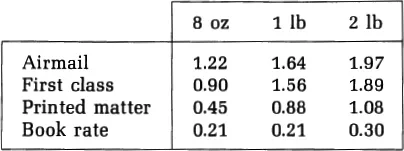
is a matrix. You have already seen matrices in many contexts. The matrix above, for example, appears in a table of the cost of mailing books:
images
The first chapter of this text reminds you of some facts you already know about matrices, introduces some unfamiliar applications, and explores some properties of matrices that mathematicians use. In many ways matrices are like numbers; they can be added and multiplied, for example. And they also have novel useful properties, as we shall see. The next three chapters explore these properties further.
In Chapters 5 through 8 of this book rectangular arrays of numbers will be used in a somewhat different subject, linear programming, which uses some of the same skills that you will develop in linear algebra. Linear programming problems involve maximizing or minimizing some variable (often profit or cost, respectively) given certain restrictions on other variables. A good course in first-year algebra is the only prerequisite for this text; if you need to review algebra, you can read the appendixes and do the exercises given there. No geometry or calculus will be used.
The words row and column in matrix theory follow ordinary English usage. The elements (numbers) in the first row of the matrix in Example 1.1.2 are 1.22, 1.64, and 1.97; the elements in the first column are 1.22, 0. 90, 0.45, and 0.21. We say that this matrix is a 4 by 3 matrix because it has 4 rows and 3 columns.
1.1.3 Definition
A matrix with n rows and m columns is said to be of dimension n by m.
1.1.4 Definition
Two matrices are said to be equal if they have the same dimension and each element in one is equal to the corresponding element in the other.
Matrix addition is straightforward. Two matrices must have the same dimension if they are to be added; to add them, we merely add corresponding elements.
1.1.5 Example
images
1.1.6 Example
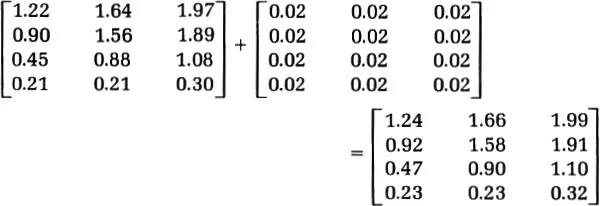
Suppose that the Postal Service decides to increase the rates across-the-board by $0.02 over the rates given in Example 1.1.2. To find the new matrix describing the postal rates, we add to our original matrix one that has the same dimensions and in which each element equals 0.02.
images
Subtraction of matrices is similar to addition; it is done element by element. Again, the matrices must have the same dimension.
1.1.7 Example
If the Postal Service decides to decrease (!) the rates across-the-board by $0.02 from those given in Example 1.1.2, we can find the new rates as follows:
images
Suppose that the Postal Service decides instead to increase all the rates by 10 percent. This would be the same as multiplying all the rates by 1.1 (because an increase of 10 percent is the same as adding 0.1 times the original price to the original price and 0.1x + x = 1.1x). Thus, to get the matrix describing the new rates, we would use scalar multiplication; that is, we would multiply every element of the matrix by the same number (which is called a “scalar” in this context).
1.1.8 Example
Use scalar multiplication to show how a 10 percent rate increase affects the postal rate matrix of Example 1.1.2. Round off the results to the nearest cent.
images
If the postal rates are doubled, the scalar multiplication of the matrix is easy indeed:
images
Matrix Notation
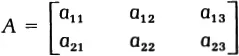
Often we shall want to denote the elements of a matrix symbolically. The standard way of writing a general 2 by 3 matrix is
images
The subscripts look like two-digit numbers occurring in the expected order, but each subscript actually consists of two different one-digit numbers, the first indicating the row in which the element appears and the second indicating the column. The upper ri...
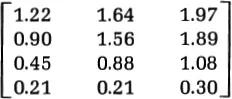
Table of contents

  1. Cover
  2. Title Page
  3. Copyright Page
  4. Preface
  5. Contents
  6. Chapter 1 Matrices: Basic Skills and Applications
  7. Chapter 2 Gauss–Jordan Row Operations
  8. Chapter 3 Systems of Linear Equations Without Unique Solutions
  9. Chapter 4 Determinants
  10. Chapter 5 Introduction To Linear Programming
  11. Chapter 6 The Simplex Algorithm
  12. *Chapter 7 Dual Problems
  13. *Chapter 8 The Transportation Problem
  14. Chapter 9 Probability
  15. Chapter 10 Game Theory
  16. Appendixes
  17. 2 Slopes and Graphs of Linear Equations
  18. 3 Solving Two Simultaneous Equations in Two Unknowns
  19. Answers to Sample Tests
  20. Glossary
  21. Index