Undergraduates in engineering and the physical sciences receive a thorough introduction to perturbation theory in this useful and accessible text. Students discover methods for obtaining an approximate solution of a mathematical problem by exploiting the presence of a small, dimensionless parameter — the smaller the parameter, the more accurate the approximate solution. Knowledge of perturbation theory offers a twofold benefit: approximate solutions often reveal the exact solution's essential dependence on specified parameters; also, some problems resistant to numerical solutions may yield to perturbation methods. In fact, numerical and perturbation methods can be combined in a complementary way.
The text opens with a well-defined treatment of finding the roots of polynomials whose coefficients contain a small parameter. Proceeding to differential equations, the authors explain many techniques for handling perturbations that reorder the equations or involve an unbounded independent variable. Two disparate practical problems that can be solved efficiently with perturbation methods conclude the volume.
Written in an informal style that moves from specific examples to general principles, this elementary text emphasizes the "why" along with the "how"; prerequisites include a knowledge of one-variable calculus and ordinary differential equations. This newly revised second edition features an additional appendix concerning the approximate evaluation of integrals.
- 160 pages
- English
- ePUB (mobile friendly)
- Available on iOS & Android
eBook - ePub
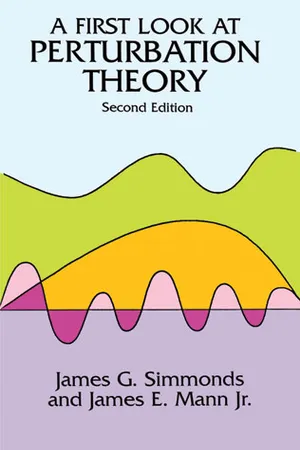
A First Look at Perturbation Theory
About this book
Information
Chapter 1
Introduction and Overview
Perturbation theory is the study of the effects of small disturbances. If the effects are small, the disturbances or perturbations are said to be regular; otherwise, they are said to be singular. The basic idea in perturbation theory is to obtain an approximate solution of a mathematical problem by exploiting the presence of a small dimensionless parameter—the smaller the parameter, the more accurate the approximate solution.
Regular perturbations are assumed nearly every time we construct a mathematical model of a real world phenomenon. Our choice of language reflects this: the flow is almost steady, the density varies essentially with altitude only, the conductivity is virtually independent of temperature, the spring is nearly linear, the friction is practically negligible.
Singular perturbations are probably less familiar. Fig. 1.1 illustrates two examples. The top in Fig. 1.1a is set spinning rapidly about a vertical axis. During one revolution, the effects of aerodynamic drag and the friction at the tip are small (regular perturbations). Eventually, though, the top falls and comes to rest in a position far from its initial one. Thus, over a long period of time, the perturbations are singular. Models such as this are characterized by what may be called a singularity in the domain. For the top, this means that we are interested in w...
Table of contents
- Cover
- Title Page
- Copyright
- Dedication
- Contents
- Preface
- 1 Introduction and Overview
- 2 Roots of Polynomials
- 3 Singular Perturbations in Ordinary Differential Equations
- 4 Periodic Solutions of the Simplest Nonlinear Differential Equations. Poincaré’s Method
- 5 Introduction to the Two-Scale Method
- 6 The WKB Approximation
- 7 Transition Point Problems and Langer’s Method of Uniform Approximation
- 8 Introduction to Boundary Layer Theory
- 9 Cables and Cells: Ancient and Modern Problems
- Bibliography
- A Roots of Tε(z) and T0(z)
- B Proof that RN+1 = O (βN+1)
- C Approximate Evaluation of Integrals
- Index
Trusted by 375,005 students
Access to over 1.5 million titles for a fair monthly price.
Study more efficiently using our study tools.
Frequently asked questions
Yes, you can cancel anytime from the Subscription tab in your account settings on the Perlego website. Your subscription will stay active until the end of your current billing period. Learn how to cancel your subscription
No, books cannot be downloaded as external files, such as PDFs, for use outside of Perlego. However, you can download books within the Perlego app for offline reading on mobile or tablet. Learn how to download books offline
Perlego offers two plans: Essential and Complete
- Essential is ideal for learners and professionals who enjoy exploring a wide range of subjects. Access the Essential Library with 800,000+ trusted titles and best-sellers across business, personal growth, and the humanities. Includes unlimited reading time and Standard Read Aloud voice.
- Complete: Perfect for advanced learners and researchers needing full, unrestricted access. Unlock 1.5M+ books across hundreds of subjects, including academic and specialized titles. The Complete Plan also includes advanced features like Premium Read Aloud and Research Assistant.
We are an online textbook subscription service, where you can get access to an entire online library for less than the price of a single book per month. With over 1.5 million books across 990+ topics, we’ve got you covered! Learn about our mission
Look out for the read-aloud symbol on your next book to see if you can listen to it. The read-aloud tool reads text aloud for you, highlighting the text as it is being read. You can pause it, speed it up and slow it down. Learn more about Read Aloud
Yes! You can use the Perlego app on both iOS and Android devices to read anytime, anywhere — even offline. Perfect for commutes or when you’re on the go.
Please note we cannot support devices running on iOS 13 and Android 7 or earlier. Learn more about using the app
Please note we cannot support devices running on iOS 13 and Android 7 or earlier. Learn more about using the app
Yes, you can access A First Look at Perturbation Theory by James G. Simmonds,James E. Mann, James E. Mann in PDF and/or ePUB format, as well as other popular books in Mathematics & Applied Mathematics. We have over 1.5 million books available in our catalogue for you to explore.