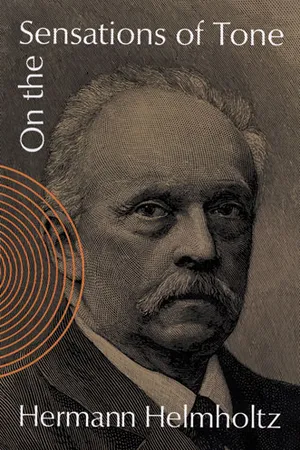
On the Sensations of Tone is one of the world's greatest scientific classics. It bridges the gap between the natural sciences and music theory and, nearly a century after its first publication, it is still a standard text for the study of physiological acoustics — the scientific basis of musical theory. It is also a treasury of knowledge for musicians and students of music and a major work in the realm of aesthetics, making important contributions to physics, anatomy, and physiology in its establishment of the physical theory of music. Difficult scientific concepts are explained simply and easily for the general reader.
The first two parts of this book deal with the physics and physiology of music. Part I explains the sensation of sound in general, vibrations, sympathetic resonances, and other phenomena. Part II cover combinational tones and beats, and develops Helmholtz's famous theory explaining why harmonious chords are in the ratios of small whole numbers (a problem unsolved since Pythagoras).
Part III contains the author's theory on the aesthetic relationship of musical tones. After a survey of the different principles of musical styles in history (tonal systems of Pythagoras, the Church, the Chinese, Arabs, Persians, and others), he makes a detailed study of our own tonal system (keys, discords, progression of parts).
Important points in this 576-page work are profusely illustrated with graphs, diagrams, tables, and musical examples. 33 appendices discuss pitch, acoustics, and music, and include a very valuable table and study of the history of pitch in Europe from the fourteenth to the nineteenth centuries.
- 608 pages
- English
- ePUB (mobile friendly)
- Available on iOS & Android
eBook - ePub
On the Sensations of Tone
About this book
Information
Subtopic
Music Theory & AppreciationPART I.
ON THE COMPOSITION OF VIBRATIONS.

UPPER PARTIAL TONES, AND QUALITIES OF TONE.
CHAPTER I.
ON THE SENSATION OF SOUND IN GENERAL.
SENSATIONS result from the action of an external stimulus on the sensitive apparatus of our nerves. Sensations differ in kind, partly with the organ of sense excited, and partly with the nature of the stimulus employed. Each organ of sense produces peculiar sensations, which cannot be excited by means of any other; the eye gives sensations of light. the ear sensations of sound, the skin sensations of touch. Even when the same sunbeams which excite in the eye sensations of light, impinge on the skin and excite its nerves, they are felt only as heat, not as light, In the same way the vibration of elastic bodies heard by the ear, can also be felt by the skin, but in that case produce only a whirring fluttering sensation, not sound. The sensation of sound is therefore a species of reaction against external stimulus, peculiar to the ear, and excitable in no other organ of the body, and is completely distinct from the sensation of any other sense.
As our problem is to study the laws of the sensation of hearing, our first business will be to examine how many kinds of sensation the ear can generate, and what differences in the external means of excitement or sound, correspond to these differences of sensation.
The first and principal difference between various sounds experienced by our ear, is that between noises and musical tones. The soughing, howling, and whistling of the wind, the splashing of water, the rolling and rumbling of carriages, are examples of the first kind, and the tones of all musical instruments of the second. Noises and musical tones may certainly intermingle in very various degrees, and pass insensibly into one another, but their extremes are widely separated.
The nature of the difference between musical tones and noises, can generally be determined by attentive aural observation without artificial assistance. We perceive that generally, a noise is accompanied by a rapid alternation of different kinds of sensations of sound. Think, for example, of the rattling of a carriage over granite paving stones, the splashing or seething of a waterfall or of the waves of the sea, the rustling of leaves in a wood. In all these cases we have rapid, irregular, but distinctly perceptible alternations of various kinds of sounds, which crop up fitfully. When the wind howls the alternation is slow, the sound slowly and gradually rises and then falls again. It is also more or less possible to separate restlessly alternating sounds in case of the greater number of other noises. We shall hereafter become acquainted with an instrument, called a resonator, which will materially assist the ear in making this separation. On the other hand, a musical tone strikes the ear as a perfectly undisturbed, uniform sound which remains unaltered as long as it exists, and it presents no alternation of various kinds of constituents. To this then corresponds a simple, regular kind of sensation, whereas in a noise many various sensations of musical tone are irregularly mixed up and as it were tumbled about in confusion. We can easily compound noises out of musical tones, as, for example, by simultaneously striking all the keys contained in one or two octaves of a pianoforte. This shews us that musical tones are the simpler and more regular elements of the sensations of hearing, and that we have consequently first to study the laws and peculiarities of this class of sensations.
Then comes the further question: On what difference in the external means of excitement does the difference between noise and musical tone depend? The normal and usual means of excitement for the human ear is atmospheric vibration. The irregularly alternating sensation of the ear in the case of noises leads us to conclude that for these the vibration of the air must also change irregularly. For musical tones on the other hand we anticipate a regular motion of the air, continuing uniformly, and in its turn excited by an equally regular motion of the sonorous body, whose impulses were conducted to the ear by the air.
Those regular motions which produce musical tones have been exactly investigated by physicists. They are oscillations, vibrations, or swings, that is, up and down, or to and fro motions of sonorous bodies, and it is necessary that these oscillations should be regularly periodic. By a periodic motion we mean one which constantly returns to the same condition after exactly equal intervals of time. The length of the equal intervals of time between one state of the motion and its next exact repetition, we call the length of the oscillation vibration or swing, or the period of the motion. In what manner the moving body actually moves during one period, is perfectly indifferent. As illustrations of periodical motion, take the motion of a clock pendulum, of a stone attached to a string and whirled round in a circle with uniform velocity, of a hammer made to rise and fall uniformly by its connection with a water wheel. All these motions, however different be their form, are periodic in the sense here, explained. The length of their periods, which in the cases adduced is generally from one to several seconds, is relatively long in comparison with the much shorter periods of the vibrations producing musical tones, the lowest or deepest of which makes at least 30 in a second, while in other cases their number may increase to several thousand in a second.
Our definition of periodic motion then enables us to answer the question proposed as follows:—The sensation of a musical tone is due to a rapid periodic motion of the sonorous body; the sensation of a noise to non-periodic motions.
The musical vibrations of solid bodies are often visible. Although they may be too rapid for the eye to follow them singly, we easily recognise that a sounding string, or tuning-fork, or the tongue of a reed-pipe, is rapidly vibrating between two fixed limits, and the regular, apparently immovable image that we see, notwithstanding the real motion of the body, leads us to conclude that the backward and forward motions are quite regular. In other cases we can feel the swinging motions of sonorous solids. Thus, the player feels the trembling of the reed in the mouthpiece of a clarinet, oboe, or bassoon, or of his own lips in the mouthpieces of trumpets and trombones.
The motions proceeding from the sounding bodies are usually conducted to our ear by means of the atmosphere. The particles of air must also execute periodically recurrent vibrations, in order to excite the sensation of a musical tone in our ear. This is actually the case, although in daily experience sound at first seems to be some agent, which is constantly advancing through the air, and propagating itself further and further. We must, however, here distinguish between the motion of the individual particles of air—which takes place periodically backwards and forwards within very narrow limits—and the propagation of the sonorous tremor. The latter is constantly advancing by the constant attraction of fresh particles into its sphere of tremor.
This is a peculiarity of all so-called undulatory motions. Suppose a stone to be thrown into a piece of calm water. Round the spot struck there forms a little ring of wave, which, advancing equally in all directions, expands to a constantly increasing circle. Corresponding to this ring of wave, sound also proceeds in the air from the excited point and advances in all directions as far as the limits of the mass of air extend. The process in the air is essentially identical with that on the surface of the water. The principal difference consists in the spherical propagation of sound in all directions through the atmosphere which fills all surrounding space, whereas the waves of the water can only advance in rings or circles on its surface. The crests of the waves of water correspond in the waves of sound to spherical shells where the air is condensed, and the troughs to shells where it is rarefied. On the free surface of the water, the mass when compressed can slip upwards and so form ridges, but in the interior of the sea of air, the mass must be condensed, as there is no unoccupied spot for its escape.
The waves of water, therefore, continually advance without returning. But we must not suppose that the particles of water of which the waves are composed advance in a similar manner to the waves themselves. The motion of the particles of water on the surface can easily be rendered visible by floating a chip of wood upon it. This will exactly share the motion of the adjacent particles. Now, such a chip is not carried on by the rings of wave. It only bobs up and down and finally rests on its original spot. The adjacent particles of water move in the same manner. When the ring of wave reaches them they are set bobbing; when it has passed over them they are still in their old place, and remain there at rest, while the ring of wave continues to advance towards fresh spots on the surface of the water, and sets new particles of water in motion. Hence the waves which pass over the surface of the water are constantly built up of fresh particles of water. What really advances as a wave is only the tremor, the altered form of the surface, while the individual particles of water themselves merely move up and down transiently, and never depart far from their original position.
The same relation is seen still more clearly in the waves of a rope or chain. Take a flexible string of several feet in length, or a thin metal chain, hold it at one end and let the other hang down, stretched by its own weight alone. Now, move the hand by which you hold it quickly to one side and back again. The excursion which we have caused in the upper end of the string by moving the hand, will run down it as a kind of wave, so that constantly lower parts of the string will make a sidewards excursion while the upper return again into the straight position of rest. But it is evident that while the wave runs down, each individual particle of the string can have only moved horizontally backwards and forwards, and can have taken no share at all in the advance of the wave.
The experiment succeeds still better with a long elastic line, such as a thick piece of india-rubber tubing, or a brass-wire spiral spring, from eight to twelve feet in length, fastened at one end, and slightly stretched by being held with the hand at the other. The hand is then easily able to excite waves which will run very regularly to the other end of the line, be there reflected and return. In this case it is also evident that it can be no part of the line itself which runs backwards and forwards, but that the advancing wave is composed of continually fresh particles of the line. By these examples the ...
Table of contents
- Cover
- Title Page
- Copyright Page
- Translator’s Notice to the Second English Edition
- Author’s Preface to the First German Edition
- Author’s Preface to the Third German Edition
- Author’s Preface to the Fourth German Edition
- Contents
- List of Figures
- List of Passages in Musical Notes
- List of Tables
- Introduction
- Relation of Musical Science to Acoustics
- Part I On the Composition of Vibrations
- Part II On the Interruptions of Harmony
- Part II The Relationship of Musical Tones
- Appendices
- Index
Trusted by 375,005 students
Access to over 1.5 million titles for a fair monthly price.
Study more efficiently using our study tools.
Frequently asked questions
Yes, you can cancel anytime from the Subscription tab in your account settings on the Perlego website. Your subscription will stay active until the end of your current billing period. Learn how to cancel your subscription
No, books cannot be downloaded as external files, such as PDFs, for use outside of Perlego. However, you can download books within the Perlego app for offline reading on mobile or tablet. Learn how to download books offline
Perlego offers two plans: Essential and Complete
- Essential is ideal for learners and professionals who enjoy exploring a wide range of subjects. Access the Essential Library with 800,000+ trusted titles and best-sellers across business, personal growth, and the humanities. Includes unlimited reading time and Standard Read Aloud voice.
- Complete: Perfect for advanced learners and researchers needing full, unrestricted access. Unlock 1.5M+ books across hundreds of subjects, including academic and specialized titles. The Complete Plan also includes advanced features like Premium Read Aloud and Research Assistant.
We are an online textbook subscription service, where you can get access to an entire online library for less than the price of a single book per month. With over 1.5 million books across 990+ topics, we’ve got you covered! Learn about our mission
Look out for the read-aloud symbol on your next book to see if you can listen to it. The read-aloud tool reads text aloud for you, highlighting the text as it is being read. You can pause it, speed it up and slow it down. Learn more about Read Aloud
Yes! You can use the Perlego app on both iOS and Android devices to read anytime, anywhere — even offline. Perfect for commutes or when you’re on the go.
Please note we cannot support devices running on iOS 13 and Android 7 or earlier. Learn more about using the app
Please note we cannot support devices running on iOS 13 and Android 7 or earlier. Learn more about using the app
Yes, you can access On the Sensations of Tone by Hermann Helmholtz in PDF and/or ePUB format, as well as other popular books in Media & Performing Arts & Music Theory & Appreciation. We have over 1.5 million books available in our catalogue for you to explore.