Noted folklorist's rich compilation of stories includes fairies, sprites and demons, tales of the black arts, Arthurian romances, Breton lays of Marie de France, stories of the saints of Brittany and more. Also, background on the land, people, costumes, and customs. 36 atmospheric illustrations by W. Otway Cannell. Glossary.
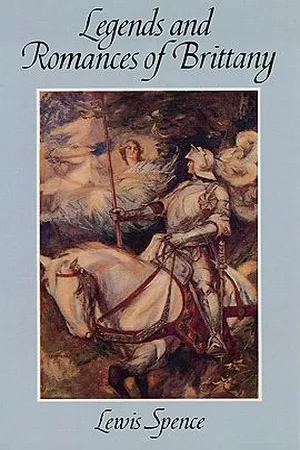
- 448 pages
- English
- ePUB (mobile friendly)
- Available on iOS & Android
eBook - ePub
Legends and Romances of Brittany
About this book
Information
Subtopic
British HistoryIndex
Social SciencesCHAPTER I: THE LAND, THE PEOPLE AND THEIR STORY
THE romantic region which we are about to traverse in search of the treasures of legend was in ancient times known as Armorica, a Latinized form of the Celtic name, Armor (‘On the Sea’). The Brittany of to-day corresponds to the departments of Finistère, Côtes-du-Nord, Morbihan, Ille-et-Vilaine, and Loire-Inférieure. A popular division of the country is that which partitions it into Upper, or Eastern, and Lower, or Western, Brittany, and these tracts together have an area of some 13,130 square miles.
Such parts of Brittany as are near to the sea-coast present marked differences to the inland regions, where raised plateaux are covered with dreary and unproductive moorland. These plateaux, again, rise into small ranges of hills, not of any great height, but, from their wild and rugged appearance, giving the impression of an altitude much loftier than they possess. The coast-line is ragged, indented, and inhospitable, lined with deep reefs and broken by the estuaries of brawling rivers. In the southern portion the district known as ‘the Emerald Coast’ presents an almost subtropical appearance; the air is mild and the whole region pleasant and fruitful. But with this exception Brittany is a country of bleak shores and grey seas, barren moorland and dreary horizons, such a land as legend loves, such a region, cut off and isolated from the highways of humanity, as the discarded genii of ancient faiths might seek as a last stronghold.
Regarding the origin of the race which peoples this secluded peninsula there are no wide differences of opinion. If we take the word ‘Celt’ as describing any branch of the many divergent races which came under the influence of one particular type of culture, the true originators of which were absorbed among the folk they governed and instructed before the historic era, then the Bretons are ‘Celts’ indeed, speaking the tongue known as ‘Celtic’ for want of a more specific name, exhibiting marked signs of the possession of ‘Celtic’ customs, and having those racial characteristics which the science of anthropology until recently laid down as certain indications of ‘Celtic’ relationship—the short, round skull, swarthy complexion, and blue or grey eyes. It is to be borne in mind, however, that the title ‘Celtic’ is shared by the Bretons with the fair or rufous Highlander of Scotland, the dark Welshman, and the long-headed Irishman. But the Bretons exhibit such special characteristics as would warrant the new anthropology in labelling them the descendants of that ‘Alpine’ race which existed in Central Europe in Neolithic times, and which, perhaps, possessed distant Mongoloid affinities. This people spread into nearly all parts of Europe, and later in some regions acquired Celtic speech and custom from a Celtic aristocracy.
It is remarkable how completely this Celtic leaven —the true history of which is lost in the depths of prehistoric darkness—succeeded in impressing not only its language but its culture and spirit upon the various peoples with whom it came into contact. To impose a special type of civilization upon another race must always prove a task of almost superhuman proportions. To compel the use of an alien tongue by a conquered folk necessitates racial tact as well as strength of purpose. But to secure the adoption of the racial spirit by the conquered, and adherence to it for centuries, so that men of widely divergent origins shall all have the same point of view, the same mode of thought, manner of address, aye, even the same facies or general racial appearance, as have Bretons, some Frenchmen, Cornishmen, Welshmen, and Highlanders—that surely would argue an indwelling racial strength such as not even the Roman or any other world-empire might pretend to.
But this Celtic civilization was not one and undivided. In late prehistoric times it evolved from one mother tongue two dialects which afterward displayed all the differences of separate languages springing from a common stock. These are the Goidelic, the tongue spoken by the Celts of Scotland, Ireland, and the Isle of Man, and the Brythonic, the language of the Welsh, the Cornish, and the people of Brittany.
The Bretons Tongue
The Brezonek, the Brythonic tongue of Brittany, is undoubtedly the language of those Celtic immigrants who fled from Britain the Greater to Britain the Less to escape the rule of the Saxon invaders, and who gave the name of the country which they had left to that Armorica in which they settled. In the earliest stages of development it is difficult to distinguish Breton from Welsh. From the ninth to the eleventh centuries the Breton language is described as ‘Old Breton.’ ‘Middle Breton’ flourished from the eleventh to the seventeenth centuries, since when ‘Modern Breton’ has been in use. These stages indicate changes in the language more or less profound, due chiefly to admixture with French. Various distinct dialects are indicated by writers on the subject, but the most marked difference in Breton speech seems to be that between the dialect of Vannes and that of the rest of Brittany. Such differences do not appear to be older than the sixteenth century.1
The Ancient Armoricans
The written history of Brittany opens with the account of Julius Caesar. At that period (57 B.C.) Armorica was inhabited by five principal tribes: the Namnetes, the Veneti, the Osismii, the Curiosolitæ, and the Redones. These offered a desperate resistance to Roman encroachment, but were subdued, and in some cases their people were sold wholesale into slavery. In 56 B.C. the Veneti threw off the yoke and retained two of Caesar’s officers as hostages. Caesar advanced upon Brittany in person, but found that he could make no headway while he was opposed by the powerful fleet of flat-bottomed boats, like floating castles, which the Veneti were so skilful in manoeuvring. Ships were hastily constructed upon the waters of the Loire, and a desperate naval engagement ensued, probably in the Gulf of Morbihan, which resulted in the decisive defeat of the Veneti, the Romans resorting to the stratagem of cutting down the enemy’s rigging with sickles bound upon long poles. The members of the Senate of the conquered people were put to death as a punishment for their defection, and thousands of the tribesmen went to swell the slave-markets of Europe.
Between A.D. 450 and 500, when the Roman power and population were dwindling, many vessels brought fugitives from Britain to Armorica. These people, fleeing from the conquering barbarians, Saxons, Picts, and Scots, sought as asylum a land where a kindred race had not yet been disturbed by invasion. Says Thierry, in his Norman Conquest: “With the consent of the ancient inhabitants, who acknowledged them as brethren of the same origin, the new settlers distributed themselves over the whole northern coast, as far as the little river Coesoron, and southward as far as the territory of the city of the Veneti, now called Vannes. In this extent of country they founded a sort of separate state, comprising all the small places near the coast, but not including within its limits the great towns of Vannes, Nantes, and Rennes. The increase of the population of this western corner of the country, and the great number of people of the Celtic race and language thus assembled within a narrow space, preserved it from the irruption of the Roman tongue, which, under forms more or less corrupted, was gradually becoming prevalent in every other part of Gaul. The name of Brittany was attached to these coasts, and the names of the various indigenous tribes disappeared; while the island which had borne this name for so many ages now lost it, and, taking the name of its conquerors, began to be called the land of the Saxons and Angles, or, in one word, England.”
Samson
One of these British immigrants was the holy Samson, who laboured to convert pagan Brittany to Christianity. He hailed from Pembrokeshire, and the legend relates that his parents, being childless, constructed a menhir2 of pure silver and gave it to the poor in the hope that a son might be born to them. Their desire was fulfilled, and Samson, the son in question, became a great missionary of the Church. Accompanied by forty monks, he crossed the Channel and landed on the shores of the Bay of Saint-Brieuc, a savage and deserted district.
As the keel of his galley grated on the beach the Saint beheld a man on the shore seated at the door of a miserable hut, who endeavoured to attract his attention by signs. Samson approached the shore-dweller, who took him by the hand and, leading him into the wretched dwelling, showed him his wife and daughter, stricken with sickness. Samson relieved their pain, and the husband and father, who, despite his humble appearance, was chief of the neighbouring territory, gave him a grant of land hard by. Here, close to the celebrated menhir of Dol, he and his monks built their cells. Soon a chapel rose near the ancient seat of pagan worship—in later days the site of a great cathedral.
Telio, a British monk, with the assistance of St Samson, planted near Dol an orchard three miles in length, and to him is attributed the introduction of the apple-tree into Brittany. Wherever the monks went they cultivated the soil; all had in their mouths the words of the Apostle: “If any would not work, neither should he eat.” The people admired the industry of the new-comers, and from admiration they passed to imitation. The peasants joined the monks in tilling the ground, and even the brigands from the hills and forests became agriculturists. “The Cross and the plough, labour and prayer,” was the motto of these early missionaries.
Wax for Wine
The monks of Dol were renowned bee-farmers, as we learn from an anecdote told by Count Montalembert in his Moines d’Occident. One day when St Samson of Dol, and St Germain, Bishop of Paris, were conversing on the respective merits of their monasteries, St Samson said that his monks were such good and careful preservers of their bees that, besides the honey which the bees yielded in abundance, they furnished more wax than was used in the churches for candles during the year, but that the climate not being suitable for the growth of vines, there was great scarcity of wine. Upon hearing this St Germain replied: “We, on the contrary, produce more wine than we can consume, but we have to buy wax; so, if you will furnish us with wax, we will give you a tenth of our wine.” Samson accepted this offer, and the mutual arrangement was continued during the lives of the two saints.
Two British kingdoms were formed in Armorica—Domnonia and Cornubia. The first embraced the Côtes-du-Nord and Finistère north of the river Élorn, Cornubia, or Cornouaille, as it is now known, being situated below that river, as far south as the river Ellé. At first these states paid a nominal homage to their native kings in Britain, but on the final fall of the British power they proclaimed a complete independence.
The Vision of Jud-Hael
A striking story relating to the migration period is told concerning a Cambrian chieftain of Brittany, one Jud-Hael, and the famous British bard Taliesin. Shortly after the arrival of Taliesin in Brittany Jud-Hael had a remarkable vision. He dreamt that he saw a high mountain, on the summit of which was placed a lofty column fixed deeply in the earth, with a base of ivory, and branches which reached to the heavens. The lower part was iron, brilliantly polished, and to it were attached rings of the same metal, from which were suspended cuirasses, casques, lances, javelins, bucklers, trumpets, and many other warlike trophies. The upper portion was of gold, and upon it hung candelabra, censers, stoles, chalices, and ecclesiastical symbols of every description. As the Prince stood admiring the spectacle the heavens opened and a maiden of marvellous beauty descended and approached him.
“I salute you, O Jud-Hael,” she said, “and I confide to your keeping for a season this column and all that it supports”; and with these words she vanished.
On the following day Jud-Hael made public his dream, but, like Nebuchadnezzar of old, he could find no one to interpret it, so he turned to the bard Taliesin as to another Daniel. Taliesin, says the legend, then an exile from his native land of Britain, dwelt on the seashore. To him came the messenger of Jud-Hael and said: “O thou who so truly dost interpret all things ambiguous, hear and make clear the strange vision which my lord hath seen.” He then recounted Jud-Hael’s dream to the venerable bard.
For a time the sage sat pondering deeply, and then replied: “Thy master reigneth well and wisely, O messenger, but he has a son who will reign still more happily even than himself, and who will become one of the greatest men in the Breton land. The sons of his loins will be the fathers of powerful counts and pious Churchmen, but he himself, the greatest man of that race, shall be first a valiant warrior and later a mighty champion of heaven. The earlier part of his life shall be given to the world; the latter portion shall be devoted to God.”
The prophecy of Taliesin was duly fulfilled. For Judik-Hael, the son of Jud-Hael, realized the bard’s prediction, and entered the cloister after a glorious reign.
Taliesin
Taliesin (‘Shining ...
Table of contents
- Title Page
- Copyright Page
- PREFACE
- Table of Contents
- CHAPTER I: THE LAND, THE PEOPLE AND THEIR STORY
- CHAPTER II: MENHIRS AND DOLMENS
- CHAPTER III : THE FAIRIES OF BRITTANY
- CHAPTER IV : SPRITES AND DEMONS OF BRITTANY
- CHAPTER V : WORLD-TALES IN BRITTANY
- CHAPTER VI : BRETON FOLK-TALES
- CHAPTER VII : POPULAR LEGENDS OF BRITTANY
- CHAPTER VIII : HERO-TALES OF BRITTANY
- CHAPTER IX: THE BLACK ART AND ITS MINISTERS
- CHAPTER X : ARTHURIAN ROMANCE IN BRITTANY
- CHAPTER XI: THE BRETON LAYS OF MARIE DE FRANCE
- CHAPTER XII: THE SAINTS OF BRITTANY
- CHAPTER XIII: COSTUMES AND CUSTOMS OF BRITTANY
- GLOSSARY & INDEX
Trusted by 375,005 students
Access to over 1.5 million titles for a fair monthly price.
Study more efficiently using our study tools.
Frequently asked questions
Yes, you can cancel anytime from the Subscription tab in your account settings on the Perlego website. Your subscription will stay active until the end of your current billing period. Learn how to cancel your subscription
No, books cannot be downloaded as external files, such as PDFs, for use outside of Perlego. However, you can download books within the Perlego app for offline reading on mobile or tablet. Learn how to download books offline
Perlego offers two plans: Essential and Complete
- Essential is ideal for learners and professionals who enjoy exploring a wide range of subjects. Access the Essential Library with 800,000+ trusted titles and best-sellers across business, personal growth, and the humanities. Includes unlimited reading time and Standard Read Aloud voice.
- Complete: Perfect for advanced learners and researchers needing full, unrestricted access. Unlock 1.5M+ books across hundreds of subjects, including academic and specialized titles. The Complete Plan also includes advanced features like Premium Read Aloud and Research Assistant.
We are an online textbook subscription service, where you can get access to an entire online library for less than the price of a single book per month. With over 1.5 million books across 990+ topics, we’ve got you covered! Learn about our mission
Look out for the read-aloud symbol on your next book to see if you can listen to it. The read-aloud tool reads text aloud for you, highlighting the text as it is being read. You can pause it, speed it up and slow it down. Learn more about Read Aloud
Yes! You can use the Perlego app on both iOS and Android devices to read anytime, anywhere — even offline. Perfect for commutes or when you’re on the go.
Please note we cannot support devices running on iOS 13 and Android 7 or earlier. Learn more about using the app
Please note we cannot support devices running on iOS 13 and Android 7 or earlier. Learn more about using the app
Yes, you can access Legends and Romances of Brittany by Lewis Spence in PDF and/or ePUB format, as well as other popular books in Social Sciences & British History. We have over 1.5 million books available in our catalogue for you to explore.