Based on his extensive experience as an educator, F. G. Tricomi wrote this practical and concise teaching text to offer a clear idea of the problems and methods of the theory of differential equations. The treatment is geared toward advanced undergraduates and graduate students and addresses only questions that can be resolved with rigor and simplicity. Starting with a consideration of the existence and uniqueness theorem, the text advances to the behavior of the characteristics of a first-order equation, boundary problems for second-order linear equations, asymptotic methods, and differential equations in the complex field. The author discusses only ordinary differential equations, excluding coverage of the methods of integration and stressing the importance of reading the properties of the integrals directly from the equations. An extensive bibliography and helpful indexes conclude the text.
Frequently asked questions
Yes, you can cancel anytime from the Subscription tab in your account settings on the Perlego website. Your subscription will stay active until the end of your current billing period. Learn how to cancel your subscription.
No, books cannot be downloaded as external files, such as PDFs, for use outside of Perlego. However, you can download books within the Perlego app for offline reading on mobile or tablet. Learn more here.
Perlego offers two plans: Essential and Complete
Essential is ideal for learners and professionals who enjoy exploring a wide range of subjects. Access the Essential Library with 800,000+ trusted titles and best-sellers across business, personal growth, and the humanities. Includes unlimited reading time and Standard Read Aloud voice.
Complete: Perfect for advanced learners and researchers needing full, unrestricted access. Unlock 1.4M+ books across hundreds of subjects, including academic and specialized titles. The Complete Plan also includes advanced features like Premium Read Aloud and Research Assistant.
Both plans are available with monthly, semester, or annual billing cycles.
We are an online textbook subscription service, where you can get access to an entire online library for less than the price of a single book per month. With over 1 million books across 1000+ topics, weāve got you covered! Learn more here.
Look out for the read-aloud symbol on your next book to see if you can listen to it. The read-aloud tool reads text aloud for you, highlighting the text as it is being read. You can pause it, speed it up and slow it down. Learn more here.
Yes! You can use the Perlego app on both iOS or Android devices to read anytime, anywhere ā even offline. Perfect for commutes or when youāre on the go. Please note we cannot support devices running on iOS 13 and Android 7 or earlier. Learn more about using the app.
Yes, you can access Differential Equations by F.G. Tricomi, Elizabeth A. McHarg in PDF and/or ePUB format, as well as other popular books in Mathematics & Differential Equations. We have over one million books available in our catalogue for you to explore.
So far we have been concerned exclusively with differential equations in the real field which in most cases is the natural field to use. However there are several questionsāfor example, that of asymptotic behaviour which has already been discussed in the preceding chapterāwhich are most naturally developed in the complex field, or as is sometimes said the analytic field, as the functions under consideration are supposed to be analytic, i.e. they may be represented by power series.
As a first step in introducing the complex field we require to supplement the fundamental theorem of existence of Chapter I to establish that when the differential equations of a given system are analytic then the solutions are also analytic; we therefore prove the following theorem:
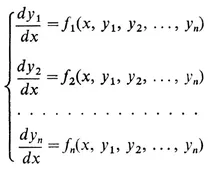
Given a normal system of differential equations of the form
(1)
where f1, f2, . . , fnare n analytic functions of the n + 1 complex variables x, y1, y2, . . . , ynregular within the vicinity of the point
(2)
i.e. such that each function considered as a function of x may be developed in a power series (of positive integral powers) of x ā x0, considered as a function of y1may be developed in a power series of
, etc., where all the radii of convergence are non-zero, then there exists one and only one system of analytic functions of x regular within a certain vicinity (whose bounds can be explicitly stated), which system satisfied (1) identically and which assumes respectively the values
,
, . . . ,
for x = x0.
This theorem may be proved by the method of successive approximations as used in Chapter I, with few modifications. It is however of real value to use a different methodāa method which may also be used for systems of equations in the real field although it belongs most naturally to the complex fieldāoriginally used by Cauchy and developed earlier than the method of successive approximations; it was in fact the first method to produce rigorous resul...
Table of contents
Title Page
Copyright Page
Preface to the English edition
Preface to the first Italian edition
Preface to the second Italian edition
Table of Contents
I. The existence and uniqueness theorem
II. The behaviour of the characteristics of a first-order equation
III. Boundary problems for linear equations of the second order
