Fibonacci numbers date back to an 800-year-old problem concerning the number of offspring born in a single year to a pair of rabbits. This book offers the solution and explores the occurrence of Fibonacci numbers in number theory, continued fractions, and geometry. A discussion of the "golden section" rectangle, in which the lengths of the sides can be expressed as a ration of two successive Fibonacci numbers, draws upon attempts by ancient and medieval thinkers to base aesthetic and philosophical principles on the beauty of these figures. Recreational readers as well as students and teachers will appreciate this light and entertaining treatment of a classic puzzle.
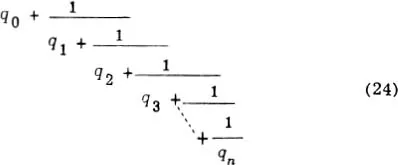
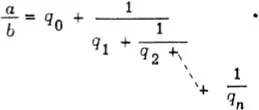
where q1, q2, …, qn are whole positive numbers and q0 is a whole non-negative number. Thus in contrast to the numbers q1q2 …, qn, the number q0 can equal zero. We shall keep this somewhat special position of the number q0 in mind, and not mention it specially on each occasion.
The expression (24) is called a continued fraction and the numbers q0, q1, …, qn are called the partial denominators of this fraction.
Sometimes continued fractions are also known as chain fractions. They are of use in a wide assortment of mathematical problems. The reader who wants to study them in greater detail is referred to A.Ya. Khinchin, “Chain Fractions”*.
The process of transformation of a certain number into a continued fraction is called the development of this number into a continued fraction.
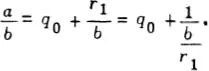
Let us see how we can find the partial denominators of such an expansion of the ordinary fraction
.
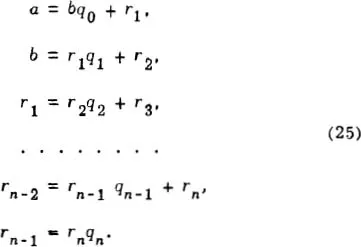
We consider the Euclidean algorithm, as applied to the numbers a and b.
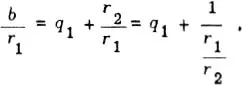
The first of these equations gives us
But it follows from the second equation of set (25) that
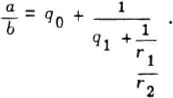
so that
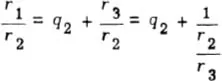
From the third equation of (25) we deduce
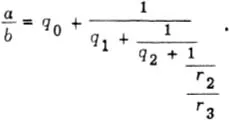
and therefore
Continuing this process to the end (induction!) we arrive, as is seen easily, at the equation
By the very sense of the Euclidean algorithm, qn > 1. (If qn were equal to unity then rn−1 would equal rn and rn−2 would have been divisible by rn−1, exactly, i.e. the whole algorithm would have terminated one step earlier.) This means that in place of qn we can consider the expression (qn –1) +
i.e. consider (qn−1) the last but one partial denominator, and 1 the last. Such a convention turns out to be convenient for what follows.
The Euclidean algorithm as applied to a given pair of natural numbers a and b is realized in a completely definite and unique way. The partial denominators of the development of
into a continuous fraction are also defined in a unique way by the system of equations describing this algorithm. Any rational fraction
, th...
Table of contents
Cover
Title Page
Copyright Page
Contents
Foreword
Introduction
I. The Simplest Properties of Fibonacci Numbers
II. Nmber-theoretic Properties of Fibonacci Numbers
III. Fibonacci Numbers and Continued Fractions
IV. Fibonacci Numbers and Geometry
V. Conclusion
Back Cover
Trusted by 375,005 students
Access to over 1.5 million titles for a fair monthly price.
Study more efficiently using our study tools.
Frequently asked questions
Yes, you can cancel anytime from the Subscription tab in your account settings on the Perlego website. Your subscription will stay active until the end of your current billing period. Learn how to cancel your subscription
No, books cannot be downloaded as external files, such as PDFs, for use outside of Perlego. However, you can download books within the Perlego app for offline reading on mobile or tablet. Learn how to download books offline
Perlego offers two plans: Essential and Complete
Essential is ideal for learners and professionals who enjoy exploring a wide range of subjects. Access the Essential Library with 800,000+ trusted titles and best-sellers across business, personal growth, and the humanities. Includes unlimited reading time and Standard Read Aloud voice.
Complete: Perfect for advanced learners and researchers needing full, unrestricted access. Unlock 1.5M+ books across hundreds of subjects, including academic and specialized titles. The Complete Plan also includes advanced features like Premium Read Aloud and Research Assistant.
Both plans are available with monthly, semester, or annual billing cycles.
We are an online textbook subscription service, where you can get access to an entire online library for less than the price of a single book per month. With over 1.5 million books across 990+ topics, we’ve got you covered! Learn about our mission
Look out for the read-aloud symbol on your next book to see if you can listen to it. The read-aloud tool reads text aloud for you, highlighting the text as it is being read. You can pause it, speed it up and slow it down. Learn more about Read Aloud
Yes! You can use the Perlego app on both iOS and Android devices to read anytime, anywhere — even offline. Perfect for commutes or when you’re on the go. Please note we cannot support devices running on iOS 13 and Android 7 or earlier. Learn more about using the app
Yes, you can access Fibonacci Numbers by Nikolai Nikolaevich Vorob'ev in PDF and/or ePUB format, as well as other popular books in Matemáticas & Teoría de números. We have over 1.5 million books available in our catalogue for you to explore.