What do Newton's falling apple and the moon's orbit have in common? How does relativity theory apply to everyday life, what's a quantum leap, and why is Schrödinger's cat inside that box? The answers lie within your grasp! John Gribbin, a physicist and author of bestselling popular-science books, offers down-to-earth discussions of technical topics. Playful engravings and cartoons illustrate his imaginative accounts of the workings of string theory, black holes, superfluidity, and other cosmic oddities. Readers of all ages will appreciate these memorable explanations of the laws of physics and their application to everything from massive stars to miniscule atoms.
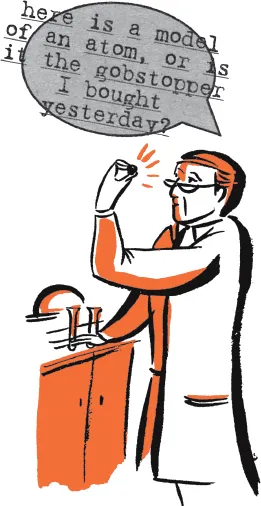
An atom is the smallest unit of an element that can exist. The most appropriate image of it is a tiny hard sphere, like a minute billiard ball. Some substances in the everyday world (such as pure gold) are made of only one kind of atom. A pure-gold ring, for example, simply contains billions and billions of gold atoms.
Tragic genius
Austrian physicist Ludwig Boltzmann (1844–1906) played a key role in developing the kinetic theory of gases, thereby helping to establish, albeit indirectly, that atoms are real. He became clinically depressed, partly because the atomic theory came under attack in his native Austria, and killed himself in 1906 - just a year after Einstein’s work had, unknown to Boltzmann, proved the existence of atoms.
LINKING UP
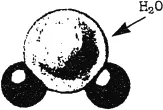
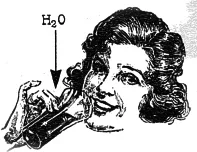
In some elements, identical ATOMS join together to form MOLECULES. This happens in the case of hydrogen, where each molecule is made up of two hydrogen atoms and is written as H2. Other substances, such as water, are made of two or more different types of atom combined with one another to form molecules. The symbol for a hydrogen atom is H and the symbol for an oxygen atom is O – so, since two hydrogen atoms combine with one oxygen atom to form a molecule of water, the symbol for a molecule of water is H2O.
When they are on their own, oxygen atoms also like to link up with one another – so that the most common form of oxygen, including the stuff we all breathe, is O2. For the moment, though, all that matters is that these atoms and molecules can all he pictured as tiny balls, constantly in motion, bouncing off one another.
HOW GASES BEHAVE
The people who worked out the details of this image of a gas as molecules in motion were James Clerk Maxwell, in Britain, and Ludwig Boltzmann, in Germany, in the mid-19th century. They didn’t just speculate about this image of little balls bouncing off one another, but instead they developed a fully worked-out kinetic theory of gases founded upon Newton’s laws.
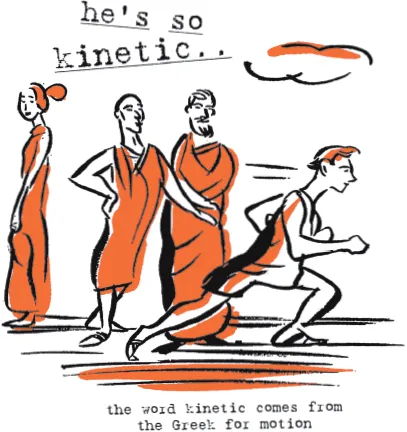
The word ‘kinetic’ comes from the Greek for motion, and according to Maxwell and Boltzmann’s theory the pressure that a gas applies to the walls of its container is explained in terms of action and reaction (Newton’s third law again) – each atom or molecule collides with the wall and bounces off, giving a push to the wall as it does so. This happens time and again, as the atoms rebound off each other and bounce back to hit the walls again.
KEY WORDS
ATOM:
the smallest unit of a chemical element that can take part in a chemical reaction
MOLECULE:
two or more atoms of the same element or different elements held together by their chemical attraction
KINETIC THEORY:
theory describing the behaviour of matter in terms of the movement of its component atoms and molecules
MOLECULES IN MOTION
A key feature of the kinetic theory is that it explains heat simply in terms of the motion of the molecules involved. If you heat up a container full of gas, the molecules move faster - so they give a bigger kick to the walls of the container each time they hit them, and the pressure increases. All of this was described mathematically, using equations (based on Newton’s laws) that made it possible to calculate, for example, how much the temperature of a container full of gas would go up if it was heated by a particular amount.
KEY WORDS
THERMODYNAMICS:
the branch of physics that deals with heat and motion (especially the way heat is transformed into other forms of energy)
SOLID TO LIQUID
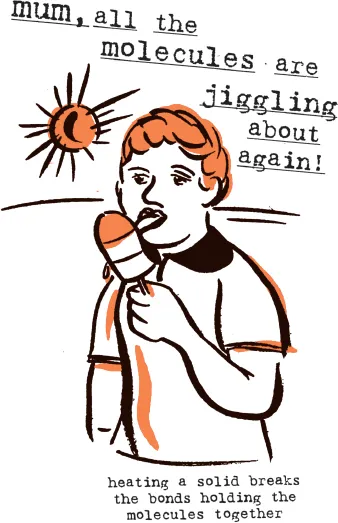
The kinetic theory also explains the differences between solids, liquids and gases. In a solid, the atoms and molecules are held together – we now know, by electric forces – but jiggle about slightly as if they were running on the spot. This is a bit like a restless theatre audience shifting in their seats during a dull play.
When the solid is heated, the molecules jiggle about more and more (which is why the solid expands), until they have generated enough kinetic energy (energy arising from motion) to break the bonds that hold them in place and are able to slide past one another relatively freely. The solid has now become a liquid.
LIQUID TO GAS
In a liquid, the molecules are still more or less in contact with one another, but constantly brush past each other. You might make an analogy with the jostling crowd of theatre-goers streaming out of the auditorium after the show.
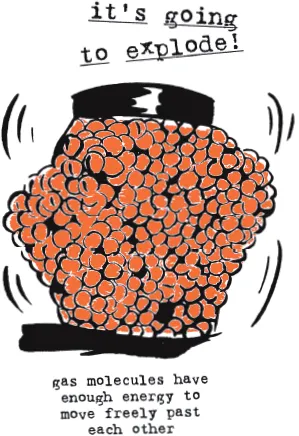
Carry on heating the liquid, and at a critical temperature the molecules will have so much energy that they fly freely past one another and can bounce off each other, ricocheting wildly, like balls in a crazy pinball machine. The liquid has now become a gas.
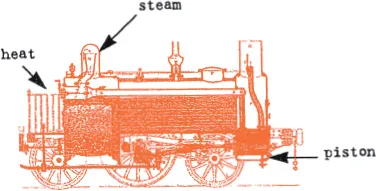
Piston power
If you Imagine not a fixed...
Table of contents
Cover Page
Title Page
Copyright Page
Contents
Introduction
CHAPTER 1: Atoms and Molecules
CHAPTER 2: Beyond Newton
CHAPTER 3: The Quantum World
CHAPTER 4: Even Newer Physics
CHAPTER 5: Back to the Future
CHAPTER 6: Tomorrow’s Physics
INDEX
Back Cover
Trusted by 375,005 students
Access to over 1.5 million titles for a fair monthly price.
Study more efficiently using our study tools.
Frequently asked questions
Yes, you can cancel anytime from the Subscription tab in your account settings on the Perlego website. Your subscription will stay active until the end of your current billing period. Learn how to cancel your subscription
No, books cannot be downloaded as external files, such as PDFs, for use outside of Perlego. However, you can download books within the Perlego app for offline reading on mobile or tablet. Learn how to download books offline
Perlego offers two plans: Essential and Complete
Essential is ideal for learners and professionals who enjoy exploring a wide range of subjects. Access the Essential Library with 800,000+ trusted titles and best-sellers across business, personal growth, and the humanities. Includes unlimited reading time and Standard Read Aloud voice.
Complete: Perfect for advanced learners and researchers needing full, unrestricted access. Unlock 1.5M+ books across hundreds of subjects, including academic and specialized titles. The Complete Plan also includes advanced features like Premium Read Aloud and Research Assistant.
Both plans are available with monthly, semester, or annual billing cycles.
We are an online textbook subscription service, where you can get access to an entire online library for less than the price of a single book per month. With over 1.5 million books across 990+ topics, we’ve got you covered! Learn about our mission
Look out for the read-aloud symbol on your next book to see if you can listen to it. The read-aloud tool reads text aloud for you, highlighting the text as it is being read. You can pause it, speed it up and slow it down. Learn more about Read Aloud
Yes! You can use the Perlego app on both iOS and Android devices to read anytime, anywhere — even offline. Perfect for commutes or when you’re on the go. Please note we cannot support devices running on iOS 13 and Android 7 or earlier. Learn more about using the app
Yes, you can access Get a Grip on Physics by John Gribbin in PDF and/or ePUB format, as well as other popular books in Physical Sciences & Physics. We have over 1.5 million books available in our catalogue for you to explore.