Gravitational Curvature
eBook - ePub

Gravitational Curvature

An Introduction to Einstein's Theory

  1. 192 pages
  2. English
  3. ePUB (mobile friendly)
  4. Available on iOS & Android
eBook - ePub

Gravitational Curvature

An Introduction to Einstein's Theory

About this book

This classic text and reference monograph applies modern differential geometry to general relativity. A brief mathematical introduction to gravitational curvature, it emphasizes the subject's geometric essence, replacing the often-tedious analytical computations with geometric arguments. Clearly presented and physically motivated derivations express the deflection of light, Schwarzchild's exterior and interior solutions, and the Oppenheimer-Volkoff equations.
A perfect choice for advanced students of mathematics, this volume will also appeal to mathematicians interested in physics. It stresses the global aspects of cosmology and is suitable for independent study as well as for courses in differential geometry, relativity, and cosmology. Prerequisites include a background in Riemannian geometry and basic physics or a familiarity with relativity theory. Background chapters, with derivations, cover special relativity, continuum mechanics, and electromagnetism.

Frequently asked questions

Yes, you can cancel anytime from the Subscription tab in your account settings on the Perlego website. Your subscription will stay active until the end of your current billing period. Learn how to cancel your subscription.
No, books cannot be downloaded as external files, such as PDFs, for use outside of Perlego. However, you can download books within the Perlego app for offline reading on mobile or tablet. Learn more here.
Perlego offers two plans: Essential and Complete
  • Essential is ideal for learners and professionals who enjoy exploring a wide range of subjects. Access the Essential Library with 800,000+ trusted titles and best-sellers across business, personal growth, and the humanities. Includes unlimited reading time and Standard Read Aloud voice.
  • Complete: Perfect for advanced learners and researchers needing full, unrestricted access. Unlock 1.4M+ books across hundreds of subjects, including academic and specialized titles. The Complete Plan also includes advanced features like Premium Read Aloud and Research Assistant.
Both plans are available with monthly, semester, or annual billing cycles.
We are an online textbook subscription service, where you can get access to an entire online library for less than the price of a single book per month. With over 1 million books across 1000+ topics, we’ve got you covered! Learn more here.
Look out for the read-aloud symbol on your next book to see if you can listen to it. The read-aloud tool reads text aloud for you, highlighting the text as it is being read. You can pause it, speed it up and slow it down. Learn more here.
Yes! You can use the Perlego app on both iOS or Android devices to read anytime, anywhere — even offline. Perfect for commutes or when you’re on the go.
Please note we cannot support devices running on iOS 13 and Android 7 or earlier. Learn more about using the app.
Yes, you can access Gravitational Curvature by Theodore Frankel in PDF and/or ePUB format, as well as other popular books in Physical Sciences & Physics. We have over one million books available in our catalogue for you to explore.

Information

1
Special Relativity
The Lorentz Transformations as Viewed by Einstein
Classical mechanics rests on the notions of absolute space and absolute time. Absolute space is assumed to be an affine 3-space with a Euclidean metric that is unique up to constant multiples. One can introduce Cartesian coordinates x, y, z. Absolute time is measured by a time coordinate t, unique up to transformations t → at + b, where a and b are constants. Newton’s laws of motion are assumed valid when x, y, z, t are used as coordinates for space and time. Newton thought of absolute space as existing independently of matter in the universe, whereas Bishop Berkeley interpreted absolute space as being fixed with respect to the bulk of matter in the universe (the so-called ā€œfixed starsā€).
An inertial (coordinate) system is a Cartesian coordinate system that moves uniformly, i.e., without acceleration, and, in particular, without rotation, with respect to absolute space. It was realized that Newton’s laws of motion are also valid in any inertial system, since accelerations are unaffected by uniform motion. Any two inertial systems are in uniform translational motion with respect to each other.
The existence of an absolute space or absolute frame of reference became dubious much later when highly accurate optical experiments were performed. It was found, toward the end of the last century, that light is propagated isotropically, i.e., with the same speed in all directions, in each supposed inertial system. Consider two inertial systems S and S′ passing one another. A light pulse is emitted at their common origin at time t = 0. It is observed (essentially in the Michelson-Morley experiment) that both systems see their respective origins as the centers of the resulting spherical light pulse for all time (the ā€œlight pulse paradoxā€)!
This, together with other electromagnetic considerations, led Einstein (among others) to reject the notion of an absolute space. He still retained, however, the notion of a distinguished (but undefined) class of inertial systems. Einstein then showed that this rejection of an absolute space and the resulting notion of absolute motion of an inertial system forces us to abandon also the idea of an absolute time! Einstein (1905) reasoned as follows.
Consider two space-time events E1 and E2. When viewed from an inertial system S these events have coordinates (x1, y1, z1, t1) and (x2, y2, z2, t2). Since light is propagated isotropically in the system S, the two events will occur simultaneously (at the same time t) in S if and only if light pulses emitted E1 and E2 reach the spatial midpoint
Image
at the same instant. Consider, for example, two lightning bolts that strike a railway embankment in S at t = 0 at spatial coordinates (x, 0, 0) and (āˆ’x, 0, 0). These strikes are seen simultaneously at the origin of S at time x/c, where c is the speed of light. Consider an inertial system S′ (a train) moving along the tracks (the x direction in S) and suppose that the two ends of the train are struck by the same bolts. If the origin of S′ is at the midpoint of the train (equal number of cars forward and behind), it is clear that the forward bolt will be seen at this midpoint before the backward bolt. (It is important here that the speed of light is not infinite.) Two inertial systems in relative motion will disagree as to whether or not certain spatially separated events are simultaneous. S and S′ must be keeping different times. This simple observation by Einstein distingui...
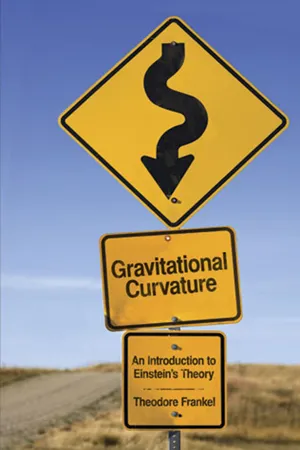
Table of contents

  1. Cover Page
  2. Title Page
  3. Copyright Page
  4. Dedication
  5. Contents
  6. Preface to the Dover Edition
  7. Preface
  8. Notation
  9. 1 Special Relativity
  10. 2 Clocks and Gravitational Potential
  11. 3 A Heuristic Derivation of Einstein’s Equations
  12. 4 The Geometry of Einstein’s Equations
  13. 5 The Schwarzschild Solution
  14. 6 The Classical Motion of a Continuum
  15. 7 The Relativistic Equations of Motion
  16. 8 Light Rays and Fermat’s Principle
  17. 9 Electromagnetism in Three-Space and Minkowski Space
  18. 10 Electromagnetism in General Relativity
  19. 11 The Interior Solution
  20. 12 Cosmology
  21. References
  22. Index
  23. Back Cover
