![]()
The Muscles
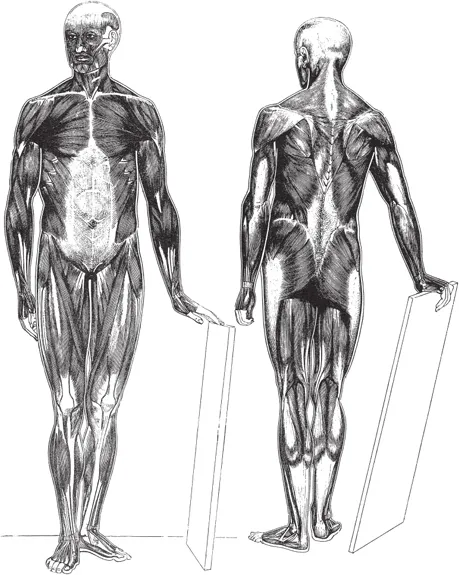
THE MUSCULAR SYSTEM IN THE MALE.
THE VALUE of a knowledge of anatomy on the part of an artist, may be over-rated; from insufficiency, rather than proficiency of acquirement, it has sometimes been a snare; to some, it has proved absolutely hurtful. But it need not be paraded, obtruded, or misemployed. It should be the artist’s help, not his hindrance. It must not be allowed to become the trick of a school, the basis of a conventional method, or the substitute for a knowledge of the living figure. A placid generalisation of form, a smooth negation of underlying structural details, are compatible with a certain amount of beauty, sentiment and grace, and are préferable to bringing such details too near to the surface represented, and too plainly into view. The eye of the educated observer should not be offended by an absence of the living and the substitution of the dead form, by the appearance of action, where there should be repose, or of spasm, where there should be action. There must be no substitution, by the aid of mechanical methods and rules, of conventional lines and masses, for a perfect harmony of form and action, in every part, with the conception of the artist, which must itself be subordinated to, and compatible with, the true purposes of art. A defective acquaintance with anatomical facts, or still worse, with their relation to the outward surface, is even more dangerous than an absolute ignorance of anatomy; for, in the former case, errors are sure to be committed, whilst in the latter, the artist must rely entirely on what he sees in his model,—no unsafe guide.
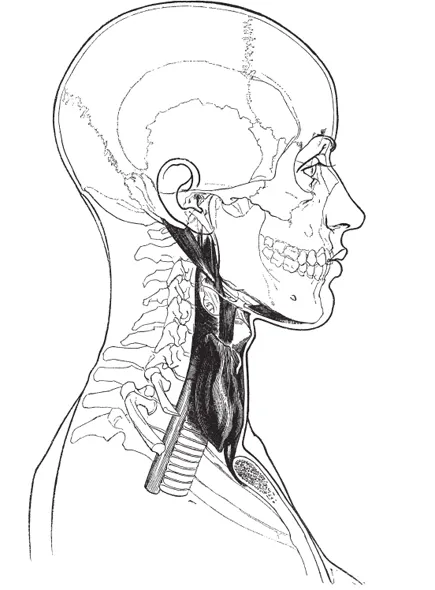
Hyoid Apparatus, Larnyx, and Thyroid Body, in the Female, with the Bones of the Neck, and Head.
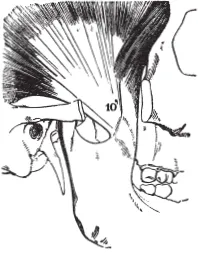
THE CORONOID process is removed, to show the external petrogoid muscle with some of its fibres attached to the cartilage.
Insertion of the Right Temporal Muscle.
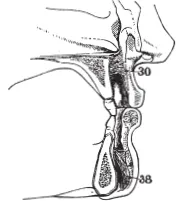
Deep Muscles of the Nose and Lips, in section.
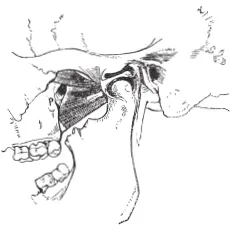
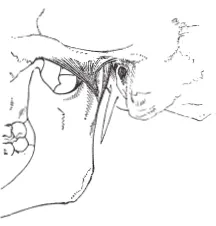
The two joints of the lower jaw represent a double hinge, which acts with great security up and down; it also permits direct backward and forward movements, and lateral horizontal ones of the whole bone, the latter being dependent on alternate oblique forward and backward movements of one or the other condyle. All these movements are employed during mastication, providing not merely for the closure of the jaws, but also for the rotation of the lower teeth beneath the upper ones. It is important to note that, in opening the mouth, which occurs not only in eating, but in oratory, in singing, in yawning, and in the expression of certain strong or startling emotions, the condyles, and with them the whole lower jaw, move a little forwards, and yet the chin and the angle are carried backwards; at the same time, both the body and rami change their direction in regard to neighboring parts, though not to each other. In closing the mouth, the condyles again move backwards, but the angle and the chin are carried forwards, the rami and body recovering their respective positions in reference to adjacent parts. The backward and forward movements of the jaw are employed in grimacing, and so, in fact, are the side to side motions of the Chin, in making “wry” faces.
The Articulation of the Lower Jaw laid open, to show the inter-articular cartilage.
The Ligaments of the left side of the Lower Jaw.
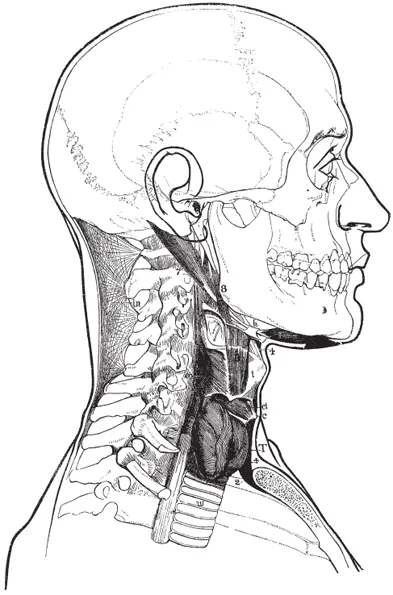
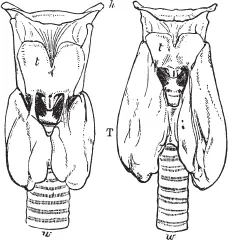
Hyoid Apparatus, Larnyx, and Thyroid Body, in the Male, with the Bones of the Neck, and Head.
BELOW THE larynx, the thyroid body, T, which is covered by the depressor muscles of the hyoid bone, nevertheless, chiefly determines the general surface-forms of the throat. In the shorter and thicker neck of the male, this body, the function of which is not determined, sinks backwards, and retires even beneath the top of the sternum; whereas, in the longer, and more slender “swan-like”, female neck, it is longer and relatively fuller, especially below, where it gives rise to the peculiar smooth contour of the lower part of the female throat, and produces a rounded fulness on either side of the middle line, a beauty sufficiently appreciated by artists. Between the Pomum Adami and the supra-sternal notch, the outline of the male throat sometimes shows a second smaller eminence, due to the cricoid cartilage, c; but, in the female, this cartilage is not perceptible on the surface, and the profile line pursues a long, gentle and uninterrupted curve, from the thyroid eminence down to the root of the neck. The great difference in the size, shape and proportions of the cranium and face, in the two sexes, are illustrated in these two heads.
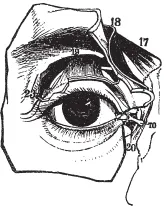
The Muscles of the Right Eyebrow and Eyelids.
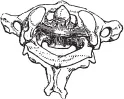
Posterior view of the transverse atlanto-axial ligament, and its upward and downward slips, constituting the cruciform ligament.
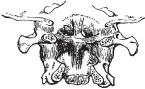
Posterior view of the occipito-axial or odontoid-ligaments, namely, the central ligament and the two alar, or check ligaments.
Hyoid Bone, Larnyx, and Thyroid
Body in the Male.
The same parts in the Female.
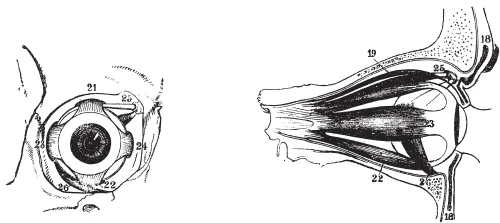
Muscles of the Right Eyeball, within the orbit, seen from the front, The same, seen from the outer side.
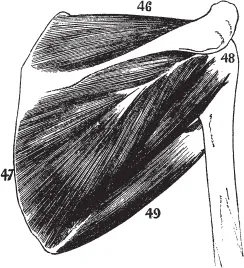
The Scapular Group.
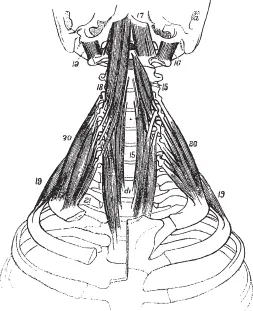
The Præ-Vertebral Group; with the Scaleni.
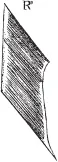
Rhomboid Muscles See Page 42.
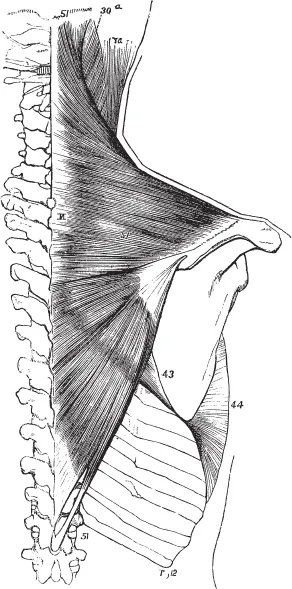
The Trapezius, of the Superficia Dorsal Group.
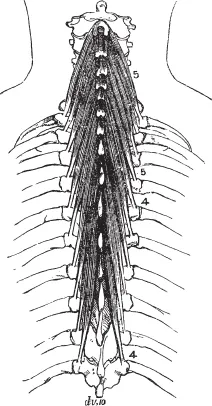
Deep Vertebral Muscles; the Semi-spinales.
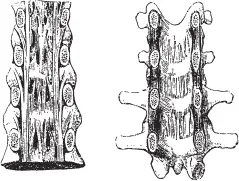
Posterior view of the bodies of four vertebræ, one dorsal and three lumbar, to show posterior com...