Advanced undergraduate and first-year graduate students have long regarded this text as one of the best available works on matrix theory in the context of modern algebra. Teachers and students will find it particularly suited to bridging the gap between ordinary undergraduate mathematics and completely abstract mathematics. The first five chapters treat topics important to economics, psychology, statistics, physics, and mathematics. Subjects include equivalence relations for matrixes, postulational approaches to determinants, and bilinear, quadratic, and Hermitian forms in their natural settings. The final chapters apply chiefly to students of engineering, physics, and advanced mathematics. They explore groups and rings, canonical forms for matrixes with respect to similarity via representations of linear transformations, and unitary and Euclidean vector spaces. Numerous examples appear throughout the text.

Frequently asked questions
Yes, you can cancel anytime from the Subscription tab in your account settings on the Perlego website. Your subscription will stay active until the end of your current billing period. Learn how to cancel your subscription.
No, books cannot be downloaded as external files, such as PDFs, for use outside of Perlego. However, you can download books within the Perlego app for offline reading on mobile or tablet. Learn more here.
Perlego offers two plans: Essential and Complete
Essential is ideal for learners and professionals who enjoy exploring a wide range of subjects. Access the Essential Library with 800,000+ trusted titles and best-sellers across business, personal growth, and the humanities. Includes unlimited reading time and Standard Read Aloud voice.
Complete: Perfect for advanced learners and researchers needing full, unrestricted access. Unlock 1.4M+ books across hundreds of subjects, including academic and specialized titles. The Complete Plan also includes advanced features like Premium Read Aloud and Research Assistant.
Both plans are available with monthly, semester, or annual billing cycles.
We are an online textbook subscription service, where you can get access to an entire online library for less than the price of a single book per month. With over 1 million books across 1000+ topics, we’ve got you covered! Learn more here.
Look out for the read-aloud symbol on your next book to see if you can listen to it. The read-aloud tool reads text aloud for you, highlighting the text as it is being read. You can pause it, speed it up and slow it down. Learn more here.
Yes! You can use the Perlego app on both iOS or Android devices to read anytime, anywhere — even offline. Perfect for commutes or when you’re on the go. Please note we cannot support devices running on iOS 13 and Android 7 or earlier. Learn more about using the app.
Yes, you can access Linear Algebra and Matrix Theory by Robert R. Stoll in PDF and/or ePUB format, as well as other popular books in Mathematics & Linear Algebra. We have over one million books available in our catalogue for you to explore.
1.1. Examples. By a linear equation in x1, x2,…, xn† is meant an equation of the form
where a1, a2,…, an, y are (for the moment, at least) fixed real numbers. A solution of (1) is any set of n real numbers
such that
This chapter is devoted to the discussion of an elimination method for determining all simultaneous solutions of one or more linear equations in several unknowns. We begin with an examination of several simple examples which can be studied geometrically and which offer suggestions for handling the general case.
EXAMPLE 1.1
Find all solutions of the single equation
We observe that this equation is equivalent to the equation
in the sense that a solution of one is a solution of the other, so that we can study (3) in place of (2). In (3) it is clear that x1 may be chosen arbitrarily and that for each choice of x1, x2 is uniquely determined. If we let t stand for any real number, our solution may be put in the form
which shows that we have an endless number of solutions. If we interpret
as the rectangular coordinates of a point in the plane, the above solutions of (2) are the points of a straight line l1, called the graph of the equation.
EXAMPLE 1.2
Find all solutions of the system of linear equations
Since the second equation is a nonzero multiple of the first, the system is equivalent to that consisting of the first equation alone. Hence the solutions of (4) are precisely those of (2). Interpreted geometrically, the graphs of the two equations of (4) coincide so that the graph of the first equation gives the solutions of the system.
EXAMPLE 1.3
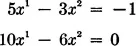
Find all solutions of the system of equations
Since, for any solution
of the first equation,
, while, for any solution
of the second,
or
, no solution of one is a solution of the other. Consequently, the system has no simultaneous solutions and because of this fact is called inconsistent. The graphs of the equations are parallel and distinct straight lines.
EXAMPLE 1.4
Find all solutions of the system of equations
The first equation has the graph l1 mentioned above, and the second has a straight-line graph l2. Since these two lines have a single point P
in common, the system has a single solution
It cannot be emphasized too strongly that this solution is again a pair of simultaneous equations in x1 and x2; it is only because of its simplicity that we label this system the solution. Actually this pair of equations is one of infinitely many pairs which are equivalent to the original pair. Interpreted geometrically, the equations of any pair of distinct straigh...
Table of contents
Cover Page
Title Page
Copyright Page
Dedication
Preface
Contents
Some Notation and Conventions Used in this Book
Chapter 1: SYSTEMS OF LINEAR EQUATIONS
Chapter 2: VECTOR SPACES
Chapter 3: BASIC OPERATIONS FOR MATRICES
Chapter 4: DETERMINANTS
Chapter 5: BILINEAR AND QUADRATIC FUNCTIONS AND FORMS
Chapter 6: LINEAR TRANSFORMATIONS ON A VECTOR SPACE
Chapter 7: CANONICAL REPRESENTATIONS OF A LINEAR TRANSFORMATION