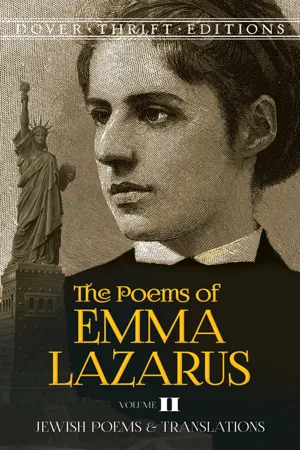
New York City–based poet Emma Lazarus (1849–87) is best known for "The New Colossus," which is inscribed upon the base of the Statue of Liberty. The highly respected writer and intellectual corresponded with Ralph Waldo Emerson and was an advocate for indigent Jewish refugees and a forerunner of the Zionist movement. This two-volume edition of The Poems of Emma Lazarus marks the work's first major reappearance since its last printing in 1900.
Volume II features verse with historic Jewish themes as well as translations of eleventh-century Hebrew poetry and works by Heinrich Heine, Petrarch, and Alfred de Musset. Selections include "The New Ezekiel," "The Feast of Lights," "1492," "By the Waters of Babylon: Little Poems in Prose," "Longing for Jerusalem," and many other poems. Volume I, available separately, features epochs, sonnets, and naturalist poems as well as the celebrated "The New Colossus."
- 272 pages
- English
- ePUB (mobile friendly)
- Available on iOS & Android
eBook - ePub
About this book
Information
Subtopic
American PoetryIndex
LiteratureTHE DANCE TO DEATH;
This play is dedicated, in profound veneration and respect, to the memory of George Eliot, the illustrious writer, who did most among the artists of our day towards elevating and ennobling the spirit of Jewish nationality.
THE PERSONS.
FREDERICK THE GRAVE, Landgrave of Thuringia and Margrave of Meissen, Protector and Patron of the Free City of Nordhausen.
PRINCE WILLIAM OF MEISSEN, his son.
SÜSSKIND VON ORB, a Jew.
HENRY SCHNETZEN, Governor of Salza.
HENRY NORDMANN OF NORDMANNSTEIN, Knight of Treffurt.
REINHARD PEPPERCORN, Prior of Wartburg Monastery.
RABBI JACOB.
DIETRICH VON TETTENBORN, President of the Council.
REUBEN VON ORB, a boy, Süsskind’s son.
BARUCH, |  | Jews. |
NAPHTALI, |
RABBI CRESSELIN.
LAY-BROTHER.
PAGE.
PUBLIC SCRIVENER.
PRINCESS MATHILDIS, wife to Frederick.
LIEBHAID VON ORB.
CLAIRE CRESSELIN.
Jews, Jewesses, Burghers, Senators, Citizens, Citizen’s Wife and Boy, Flagellants, Servants, Guardsmen.
Scene—Partly in Nordhausen, partly in Eisenach. Time, May, 4th, 5th, 6th, 1349.
ACT I.—In Nordhausen.
SCENE I.
A street in the Judengasse, outside the Synagogue. During this Scene Jews and Jewesses, singly and in groups, with prayer-books in their hands, pass across the stage, and go into the Synagogue. Among them, enter BARUCH and NAPHTALI.
NAPHTALI.
Hast seen him yet?
BARUCH.
Nay; Rabbi Jacob’s door
Swung to behind him, just as I puffed up
O’erblown with haste. See how our years weigh, cousin.
Who’d judge me with this paunch a temperate man,
A man of modest means, a man withal
Scarce overpast his prime? Well, God be praised,
If age bring no worse burden! Who is this stranger?
Simon the Leech tells me he claims to bear
Some special message from the Lord—no doubt
To-morrow, fresh from rest, he’ll publish it
Within the Synagogue.
NAPHTALI.
To-morrow, man?
He will not hear of rest—he comes anon—
Shall we within?
BARUCH.
Rather let’s wait,
And scrutinize him as he mounts the street.
Since you denote him so remarkable,
You’ve whetted my desire.
NAPHTALI.
A blind, old man,
Mayhap is all you 11 find him—spent with travel,
His raiment fouled with dust, his sandaled feet
Road-bruised by stone and bramble. But his face!—
Majestic with long fall of cloud-white beard,
And hoary wreath of hair—oh, it is one
Already kissed by angels.
BARUCH.
Look, there limps
Little Manasseh, bloated as his purse,
And wrinkled as a frost-pinched fruit. I hear
His last loan to the Syndic will result
In quadrupling his wealth. Good Lord! what luck
Blesses some folk, while good men stint and sweat
And scrape, to merely fill the household larder.
What said you of this pilgrim, Naphtali?
These inequalities of fortune rub
My sense of justice so against the grain,
I lose my very name. Whence does he come?
Is he alone?
NAPHTALI.
He comes from Chinon, France.
Rabbi Cresselin he calls himself—alone
Save for his daughter who has led him hither.
A beautiful, pale girl with round black eyes.
BARUCH.
Bring they fresh tidings of the pestilence?
NAPHTALI.
I know not—but I learn from other source
It has burst forth at Erfurt.
BARUCH.
God have mercy!
Have many of our tribe been stricken?
NAPHTALI.
No.
They cleanse their homes and keep their bodies sweet,
Nor cease from prayer—and so...
Table of contents
- Cover
- Title Page
- Copyright Page
- Contents
- The New Year
- The Crowing of The Red Cock
- In Exile
- In Memoriam—Rev. J. J. Lyons
- The Valley of Baca
- The Banner of The Jew
- The Guardian of The Red Disk
- The New Ezekiel
- The Choice
- The World’S Justice
- The Supreme Sacrifice
- The Feast of Lights
- Gifts
- Bar Kochba
- 1492
- The Birth of Man
- Raschi In Prague
- The Death of Raschi
- An Epistle
- By The Waters of Babylon: Little Poems In Prose
- To Carmen Sylva
- The Dance To Death
- Translations
- Nachum
- A Translation And Two Imitations
- Translations From Petrarch
- Translations From Alfred De Musset
- Notes To “Epistle” of Joshua Ibn Vives of Allorqui
Trusted by 375,005 students
Access to over 1.5 million titles for a fair monthly price.
Study more efficiently using our study tools.
Frequently asked questions
Yes, you can cancel anytime from the Subscription tab in your account settings on the Perlego website. Your subscription will stay active until the end of your current billing period. Learn how to cancel your subscription
No, books cannot be downloaded as external files, such as PDFs, for use outside of Perlego. However, you can download books within the Perlego app for offline reading on mobile or tablet. Learn how to download books offline
Perlego offers two plans: Essential and Complete
- Essential is ideal for learners and professionals who enjoy exploring a wide range of subjects. Access the Essential Library with 800,000+ trusted titles and best-sellers across business, personal growth, and the humanities. Includes unlimited reading time and Standard Read Aloud voice.
- Complete: Perfect for advanced learners and researchers needing full, unrestricted access. Unlock 1.5M+ books across hundreds of subjects, including academic and specialized titles. The Complete Plan also includes advanced features like Premium Read Aloud and Research Assistant.
We are an online textbook subscription service, where you can get access to an entire online library for less than the price of a single book per month. With over 1.5 million books across 990+ topics, we’ve got you covered! Learn about our mission
Look out for the read-aloud symbol on your next book to see if you can listen to it. The read-aloud tool reads text aloud for you, highlighting the text as it is being read. You can pause it, speed it up and slow it down. Learn more about Read Aloud
Yes! You can use the Perlego app on both iOS and Android devices to read anytime, anywhere — even offline. Perfect for commutes or when you’re on the go.
Please note we cannot support devices running on iOS 13 and Android 7 or earlier. Learn more about using the app
Please note we cannot support devices running on iOS 13 and Android 7 or earlier. Learn more about using the app
Yes, you can access The Poems of Emma Lazarus, Volume II by Emma Lazarus in PDF and/or ePUB format, as well as other popular books in Literature & American Poetry. We have over 1.5 million books available in our catalogue for you to explore.