- 144 pages
- English
- ePUB (mobile friendly)
- Available on iOS & Android
eBook - ePub
88 Piano Classics for Beginners
About this book
Beginning pianists of all ages will cherish this excellent compilation of classics. Each piece was carefully selected and simplified to help students develop their skills. Many of the greatest composers — J. S. Bach, Beethoven, Brahms, Mendelssohn, Mozart, Rimsky-Korsakov, Rachmaninoff, Tchaikovsky, and others — are represented by several pieces each, some newly adapted for the piano. Composers and works not usually featured in beginner's books include pieces by Borodin, Gluck, Rameau, and Tallis.
Well-known classics include Bach's Brandenburg Concerto No. 3, Debussy's Claire de Lune, Moussorgsky's Pictures at an Exhibition, Satie's Gymnopedie No. 1, Schumann's Child Falling Asleep, and "Spring" from Vivaldi's Four Seasons. Several orchestral pieces have been newly adapted for the piano, including "Elephant" from Carnival of the Animals, "Largo" from Xerxes, and "Waltz of the Flowers" from TheNutcracker.
Frequently asked questions
Yes, you can cancel anytime from the Subscription tab in your account settings on the Perlego website. Your subscription will stay active until the end of your current billing period. Learn how to cancel your subscription.
No, books cannot be downloaded as external files, such as PDFs, for use outside of Perlego. However, you can download books within the Perlego app for offline reading on mobile or tablet. Learn more here.
Perlego offers two plans: Essential and Complete
- Essential is ideal for learners and professionals who enjoy exploring a wide range of subjects. Access the Essential Library with 800,000+ trusted titles and best-sellers across business, personal growth, and the humanities. Includes unlimited reading time and Standard Read Aloud voice.
- Complete: Perfect for advanced learners and researchers needing full, unrestricted access. Unlock 1.4M+ books across hundreds of subjects, including academic and specialized titles. The Complete Plan also includes advanced features like Premium Read Aloud and Research Assistant.
We are an online textbook subscription service, where you can get access to an entire online library for less than the price of a single book per month. With over 1 million books across 1000+ topics, we’ve got you covered! Learn more here.
Look out for the read-aloud symbol on your next book to see if you can listen to it. The read-aloud tool reads text aloud for you, highlighting the text as it is being read. You can pause it, speed it up and slow it down. Learn more here.
Yes! You can use the Perlego app on both iOS or Android devices to read anytime, anywhere — even offline. Perfect for commutes or when you’re on the go.
Please note we cannot support devices running on iOS 13 and Android 7 or earlier. Learn more about using the app.
Yes, you can access 88 Piano Classics for Beginners by David Dutkanicz in PDF and/or ePUB format, as well as other popular books in Media & Performing Arts & Classical Music. We have over one million books available in our catalogue for you to explore.
Information
Carl Philip Emmanuel Bach
1714–1788
Solfegietto
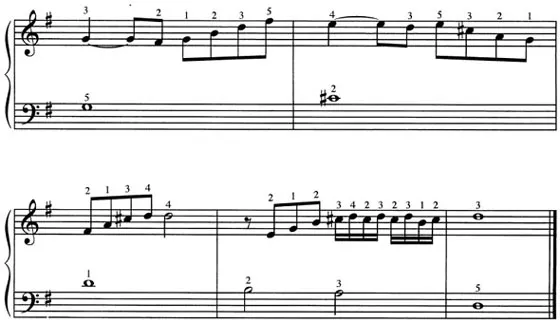
Carl Philipp Emanuel was the son of the monumental Johann Sebastian Bach. He and his other brothers—Johann Christian, Wilhelm Friedemann, and Johann Christoph Friedrich—all inherited their father’s wonderful talent and were musically famous in their own right. In this work, be mindful of the dialogue between the two hands, and use the “borrowed” fingerings (written above the left hand) to ease some passages.
Moderato

Johann Sebastian Bach
1685–1750
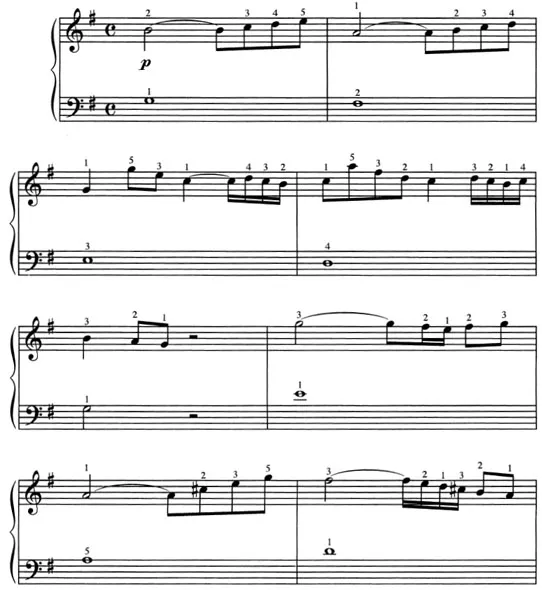
Arioso in G
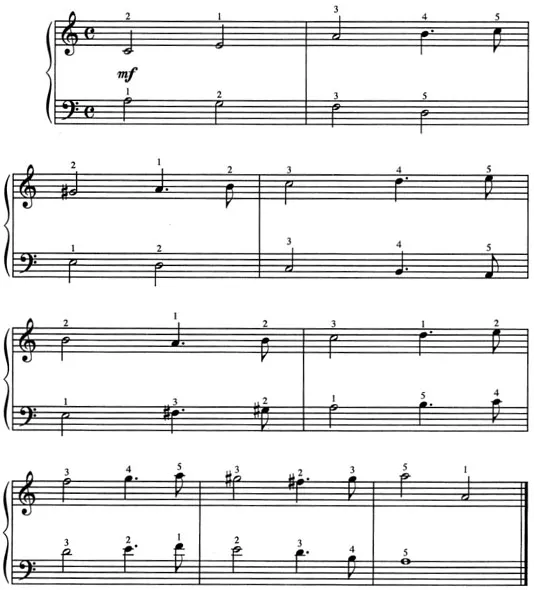
An arioso is a short piece, usually found in a cantata, where a story is sung by a solo singer. Keep the slow Largo tempo consistent, and try to shape the phrases as a singer would.
Largo


Johann Sebastian Bach
1685–1750
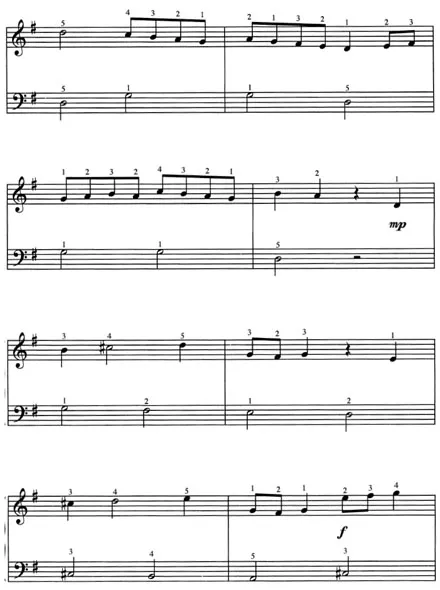
Affetuoso from Brandenburg Concerto No. 5
Bach composed six magnificent concertos for the Prince of Brandenburg. This melody is the opening of the second movement of the fifth. It is marked as affetuoso, meaning “affectionate.”
Moderato

Johann Sebastian Bach
1685–1750
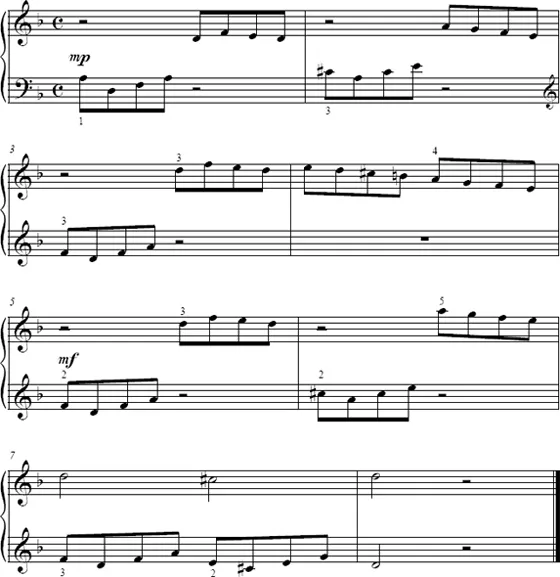
Brandenburg Concerto No. 3 (opening)
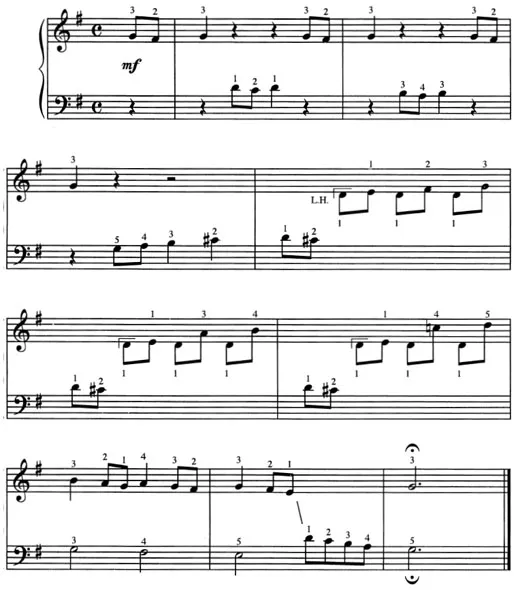
This excerpt from the Brandenburg Concertos opens with a dialogue between the right and left hand. Keep the tempo steady so that the melody is uninterrupted. Also, use the left thumb on the repeated Ds to ease the right hand.
Moderato

Johann Sebastian Bach
1685–1750
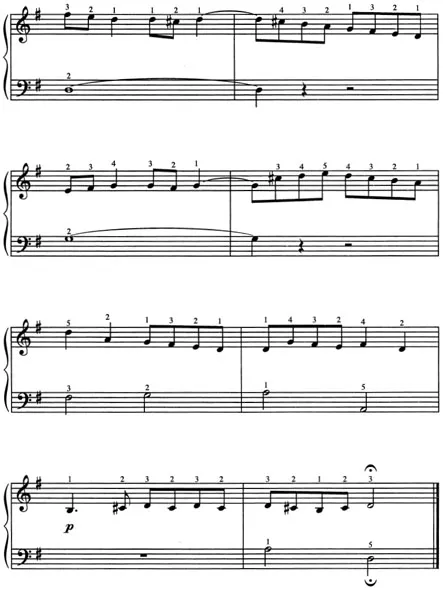
Menuet from Anna Magdalena’s Notebook
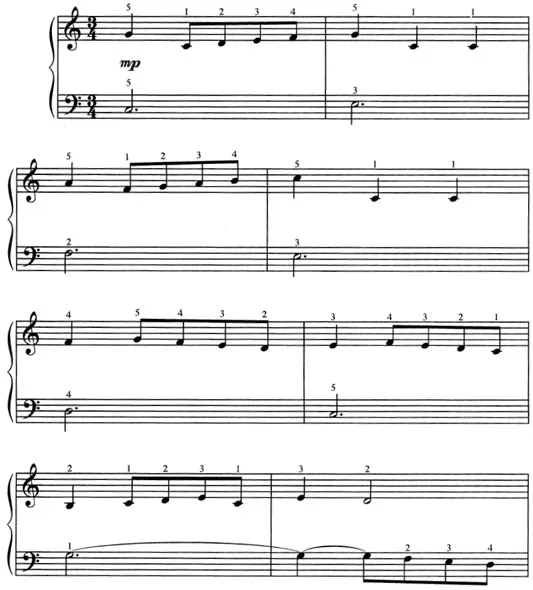
This charming piece was found in a notebook of music Bach had written for his wife, Anna Magdalena. Some of the pieces were for teaching, but most were small gifts. Keep the mood merry and light.
Andante


Johann Sebastian Bach
1685–1750
Invention in A Minor
Just like the other Inventions, this one was written to instruct new pupils. Here, Bach presents a challenging arpeggio workout. The music should flow evenly, helped by smoothness in the wrist and fingers.
Moderato


Johann Sebastian Bach
1685–1750
Wachet Auf (“Sleepers Awake”)
This wonderful melody is taken from a church, and translates into “Sleepers Awake.” Keep a firm hold on the tempo – don’t let the dips in melody slow you down. For the full effect, use dynamics to contrast different moods.
Calm and Steady


Ludwig van Beethoven
(1770–1827)
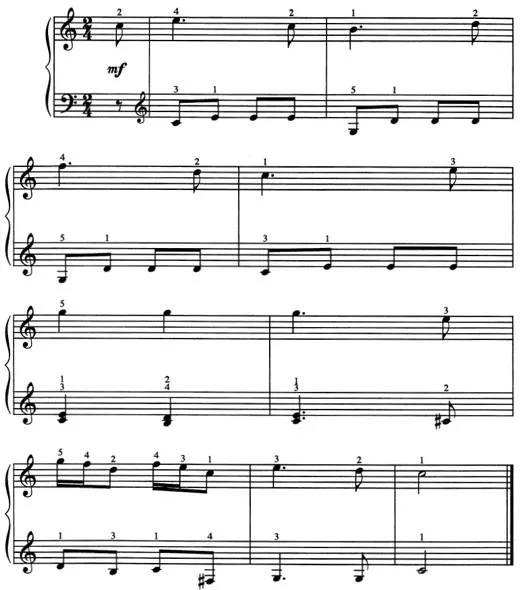
Symphony No. 3 (theme)
Symphony No. 3 is nicknamed the “Eroica.” It was written to honor “heroes” and was originally dedicated to Napoleon Bonaparte. Play the melody in a crisp manner, as if it were a military march.
Allegretto

Ludwig van Beethoven
(1770–1827)
Adagio Cantabile from Sonata No. 8
This famous piece is the opening to the second movement of the Piano Sonata No. 8, which is also kno...
Table of contents
- Cover Page
- Title Page
- Copyright Page
- Contents
- Editor’s Note
- Glossary of Musical Terms
- C.P.E. Bach
- Notes
- Back Cover