Written by J. Willard Gibbs, the most distinguished American mathematical physicist of the nineteenth century, this book was the first to bring together and arrange in logical order the works of Clausius, Maxwell, Boltzmann, and Gibbs himself. The lucid, advanced-level text remains a valuable collection of fundamental equations and principles. Topics include the general problem and the fundamental equation of statistical mechanics, the canonical distribution of the average energy values in a canonical ensemble of systems, and formulas for evaluating important functions of the energies of a system. Additional discussions cover maximum and minimal properties of distribution in phase, a valuable comparison of statistical mechanics with thermodynamics, and many other subjects.
GENERAL NOTIONS. THE PRINCIPLE OF CONSERVATION OF EXTENSION-IN-PHASE.
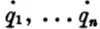
WE shall use Hamilton’s form of the equations of motion for a system of n degrees of freedom, writing q1, … qn for the (generalized) coördinates,
for the (generalized) velocities, and
for the moment of the forces. We shall call the quantities F1, … Fn the (generalized) forces, and the quantities p1 … pn, defined by the equations
where ∊p denotes the kinetic energy of the system, the (generalized) momenta. The kinetic energy is here regarded as a function of the velocities and coördinates. We shall usually regard it as a function of the momenta and coördinates,* and on this account we denote it by ∊p. This will not prevent us from occasionally using formulae like (2), where it is sufficiently evident the kinetic energy is regarded as function of the
and q’s. But in expressions like d∊p/dq1, where the denominator does not determine the question, the kinetic energy is always to be treated in the differentiation as function of the p’s and q’s.
We have then
These equations will hold for any forces whatever. If the forces are conservative, in other words, if the expression (1) is an exact differential, we may set
where ∊q is a function of the coördinates which we shall call the potential energy of the system. If we write ∊ for the total energy, we shall have
and equations (3) may be written
The potential energy (∊q) may depend on other variables beside the coördinates q1… qn. We shall often suppose it to depend in part on coördinates of external bodies, which we shall denote by a1, a2, etc. We shall then have for the complete value of the differential of the potential energy *
where A1, A2, etc., represent forces (in the generalized sense) exerted by the system on external bodies. For the total energy (∊) we shall have
It will be observed that the kinetic energy (∊p) in the most general case is a quadratic function of the p’s (or
’s) involving also the q’s but not the a’s ; that the potential energy, when it exists, is function of the q’s and a’s ; and that the total energy, when it exists, is function of the p’s (or
’s), the q’s, and the a’s. In expressions like d∊/dq1 the p’s, and not the
’s, are to be taken as independent variables, as has already been stated with respect to the kinetic energy.
Let us imagine a great number of independent systems, identical in nature, but differing in phase, that is, in their condition with respect to configuration and velocity. The forces are supposed to be determined for every system by the same law, being functions of the coördinates of the system q1, … qn, either alone or with the coördinates a1, a2, etc. of certain external bodies. It is not necessary that they should be derivable from a force-function. The external coördinates a1, a2, etc. may vary with the time, but at any given time have fixed values. In this they differ from the internal coördinates q1, … qn, which at the same time have different values in the different systems considered.
Let us especially consider the number of systems which at a given instant fall within specified limits of phase, viz., those for which
the accented letters denoting constants. We shall suppose the differences
, etc. to be infinitesimal, and that the systems are distributed in phase in some continuous manner,* so that the number having phases within the limits specified may be represented by
or more briefly by
where...
Table of contents
Cover
Title Page
Copyright Page
Preface
Contents
Chapter I. General Notions. The Principle of Conservation of Extension–In–Phase.
Chapter II. Application of the Principle of Conservation of Extension–In–Phase to the Theory of Errors.
Chapter III. Application of the Principle of Conservation of Extension–In–Phase to the Integration of the Differential Equations of Motion.
Chapter IV. On the Distribution–In–Phase Called Canonical, in which the Index of Probability is a Linear Function of the Energy.
Chapter V. Average Values in a Canonical Ensemble Of Systems.
Chapter VI. Extension–In–Configuration and Extension–In–Velocity.
Chapter VII. Farther Discussion of Averages in a Canonical Ensemble of Systems.
Chapter VIII. On Certain Important Functions of the Energies of a System.
Chapter IX. The Function ϕ and the Canonical Distribution.
Chapter X. On a Distribution in Phase Called Microcanonical in which all the Systems have the Same Energy.
Chapter XI. Maximum and Minimum Properties of Various Distributions in Phase.
Chapter XII. On the Motion of Systems and Ensembles of Systems through Long Periods of Time.
Chapter XIII. Effect of Various Processes on an Ensemble of Systems.
Chapter XIV. Discussion of Thermodynamic Analogies.
Chapter XV. Systems Composed of Molecules.
Trusted by 375,005 students
Access to over 1.5 million titles for a fair monthly price.
Study more efficiently using our study tools.
Frequently asked questions
Yes, you can cancel anytime from the Subscription tab in your account settings on the Perlego website. Your subscription will stay active until the end of your current billing period. Learn how to cancel your subscription
No, books cannot be downloaded as external files, such as PDFs, for use outside of Perlego. However, you can download books within the Perlego app for offline reading on mobile or tablet. Learn how to download books offline
Perlego offers two plans: Essential and Complete
Essential is ideal for learners and professionals who enjoy exploring a wide range of subjects. Access the Essential Library with 800,000+ trusted titles and best-sellers across business, personal growth, and the humanities. Includes unlimited reading time and Standard Read Aloud voice.
Complete: Perfect for advanced learners and researchers needing full, unrestricted access. Unlock 1.5M+ books across hundreds of subjects, including academic and specialized titles. The Complete Plan also includes advanced features like Premium Read Aloud and Research Assistant.
Both plans are available with monthly, semester, or annual billing cycles.
We are an online textbook subscription service, where you can get access to an entire online library for less than the price of a single book per month. With over 1.5 million books across 990+ topics, we’ve got you covered! Learn about our mission
Look out for the read-aloud symbol on your next book to see if you can listen to it. The read-aloud tool reads text aloud for you, highlighting the text as it is being read. You can pause it, speed it up and slow it down. Learn more about Read Aloud
Yes! You can use the Perlego app on both iOS and Android devices to read anytime, anywhere — even offline. Perfect for commutes or when you’re on the go. Please note we cannot support devices running on iOS 13 and Android 7 or earlier. Learn more about using the app
Yes, you can access Elementary Principles in Statistical Mechanics by J. Willard Gibbs in PDF and/or ePUB format, as well as other popular books in Physical Sciences & Physics. We have over 1.5 million books available in our catalogue for you to explore.