"Absolutely wonderful; a marvelous journey which meanders through some of the most formative literature, non-fiction, and poetry to come out of the United States." — The Literary Sisters
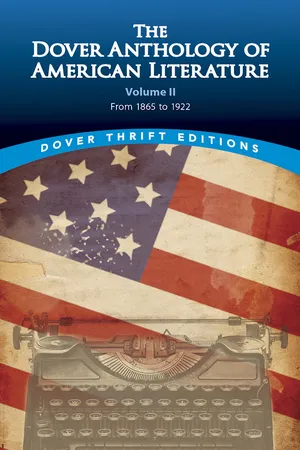
At the end of the Civil War, another long and arduous struggle began as the nation attempted to reunite. Literature offered a path toward solidarity, and this concise anthology surveys the writings of major American authors from the war's end to the dawn of the Jazz Age.
Featured works include those of Emily Dickinson, Wallace Stevens, William Carlos Williams, Robert Frost, Langston Hughes, and other poets. Mark Twain is prominently represented among the storytellers, along with Ambrose Bierce, Stephen Crane, and F. Scott Fitzgerald. Three short novels appear in their entirety: Daisy Miller by Henry James, The Call of the Wild by Jack London, and Ethan Frome by Edith Wharton. Speeches by Sitting Bull and Theodore Roosevelt, memoirs by Booker T. Washington and Helen Keller, and many other selections recapture a vibrant era in American literature. Informative introductory notes supplement the authoritative texts.
- 688 pages
- English
- ePUB (mobile friendly)
- Available on iOS & Android
eBook - ePub
About this book
Information
EDITH WHARTON
Edith Wharton (1862–1937) hit her stride as a novelist in her early forties. This grimly romantic novel opens with a long introduction telling of the male narrator’s interest in the mystery of the hard life of Ethan Frome and concludes with his reflections and discoveries; the middle, the bulk of the story, is told in the third person. “The qualities that make Wharton a great writer,” observes her excellent biographer Hermione Lee, “her mixture of harshly detached, meticulously perceptive, disabused realism, with a language of poignant feeling and deep passion, and her setting of the most confined of private lives in a thick, complex network of social forces—were the product of years of observation, reading, practice and refinement.”1
Ethan Frome (1911)
I HAD THE story, bit by bit, from various people, and, as generally happens in such cases, each time it was a different story.
If you know Starkfield, Massachusetts, you know the post-office. If you know the post-office you must have seen Ethan Frome drive up to it, drop the reins on his hollow-backed bay and drag himself across the brick pavement to the white colonnade; and you must have asked who he was.
It was there that, several years ago, I saw him for the first time; and the sight pulled me up sharp. Even then he was the most striking figure in Starkfield, though he was but the ruin of a man. It was not so much his great height that marked him, for the “natives” were easily singled out by their lank longitude from the stockier foreign breed: it was the careless powerful look he had, in spite of a lameness checking each step like the jerk of a chain. There was something bleak and unapproachable in his face, and he was so stiffened and grizzled that I took him for an old man and was surprised to hear that he was not more than fifty-two. I had this from Harmon Gow, who had driven the stage from Bettsbridge to Starkfield in pre-trolley days and knew the chronicle of all the families on his line.
“He’s looked that way ever since he had his smash-up; and that’s twenty-four years ago come next February,” Harmon threw out between reminiscent pauses.
The “smash-up” it was—I gathered from the same informant—which, besides drawing the red gash across Ethan Frome’s forehead, had so shortened and warped his right side that it cost him a visible effort to take the few steps from his buggy to the post-office window. He used to drive in from his farm every day at about noon, and as that was my own hour for fetching my mail I often passed him in the porch or stood beside him while we waited on the motions of the distributing hand behind the grating. I noticed that, though he came so punctually, he seldom received anything but a copy of the Bettsbridge Eagle, which he put without a glance into his sagging pocket. At intervals, however, the post-master would hand him an envelope addressed to Mrs. Zenobia—or Mrs. Zeena—Frome, and usually bearing conspicuously in the upper left-hand corner the address of some manufacturer of patent medicine and the name of his specific. These documents my neighbour would also pocket without a glance, as if too much used to them to wonder at their number and variety, and would then turn away with a silent nod to the post-master.
Every one in Starkfield knew him and gave him a greeting tempered to his own grave mien; but his taciturnity was respected and it was only on rare occasions that one of the older men of the place detained him for a word. When this happened he would listen quietly, his blue eyes on the speaker’s face, and answer in so low a tone that his words never reached me; then he would climb stiffly into his buggy, gather up the reins in his left hand and drive slowly away in the direction of his farm.
“It was a pretty bad smash-up?” I questioned Harmon, looking after Frome’s retreating figure, and thinking how gallantly his lean brown head, with its shock of light hair, must have sat on his strong shoulders before they were bent out of shape.
“Wust kind,” my informant assented. “More’n enough to kill most men. But the Fromes are tough. Ethan’ll likely touch a hundred.”
“Good God!” I exclaimed. At the moment Ethan Frome, after climbing to his seat, had leaned over to assure himself of the security of a wooden box—also with a druggist’s label on it—which he had placed in the back of the buggy, and I saw his face as it probably looked when he thought himself alone. “That man touch a hundred? He looks as if he was dead and in hell now!”
Harmon drew a slab of tobacco from his pocket, cut off a wedge and pressed it into the leather pouch of his cheek. “Guess he’s been in Starkfield too many winters. Most of the smart ones get away.”
“Why didn’t he?”
“Somebody had to stay and care for the folks. There warn’t ever anybody but Ethan. Fust his father—then his mother—then his wife.”
“And then the smash-up?”
Harmon chuckled sardonically. “That’s so. He had to stay then.”
“I see. And since then they’ve had to care for him?”
Harmon thoughtfully passed his tobacco to the other cheek. “Oh, as to that: I guess it’s always Ethan done the caring.”
Though Harmon Gow developed the tale as far as his mental and moral reach permitted there were perceptible gaps between his facts, and I had the sense that the deeper meaning of the story was in the gaps. But one phrase stuck in my memory and served as the nucleus about which I grouped my subsequent inferences: “Guess he’s been in Starkfield too many winters.”
Before my own time there was up I had learned to know what that meant. Yet I had come in the degenerate day of trolley, bicycle and rural delivery, when communication was easy between the scattered mountain villages, and the bigger towns in the valleys, such as Bettsbridge and Shadd’s Falls, had libraries, theatres and Y.M.C.A. halls to which the youth of the hills could descend for recreation. But when winter shut down on Starkfield, and the village lay under a sheet of snow perpetually renewed from the pale skies, I began to see what life there—or rather its negation—must have been in Ethan Frome’s young manhood.
I had been sent up by my employers on a job connected with the big power-house at Corbury Junction, and a long-drawn carpenters’ strike had so delayed the work that I found myself anchored at Starkfield—the nearest habitable spot—for the best part of the winter. I chafed at first, and then, under the hypnotising effect of routine, gradually began to find a grim satisfaction in the life. During the early part of my stay I had been struck by the contrast between the vitality of the climate and the deadness of the community. Day by day, after the December snows were over, a blazing blue sky poured down torrents of light and air on the white landscape, which gave them back in an intenser glitter. One would have supposed that such an atmosphere must quicken the emotions as well as the blood; but it seemed to produce no change except that of retarding still more the sluggish pulse of Starkfield. When I had been there a little longer, and had seen this phase of crystal clearness followed by long stretches of sunless cold; when the storms of February had pitched their white tents about the devoted village and the wild cavalry of March winds had charged down to their support; I began to understand why Starkfield emerged from its six months’ siege like a starved garrison capitulating without quarter. Twenty years earlier the means of resistance must have been far fewer, and the enemy in command of almost all the lines of access between the beleaguered villages; and, considering these things, I felt the sinister force of Harmon’s phrase: “Most of the smart ones get away.” But if that were the case, how could any combination of obstacles have hindered the flight of a man like Ethan Frome?
During my stay at Starkfield I lodged with a middle-aged widow colloquially known as Mrs. Ned Hale. Mrs. Hale’s father had been the village lawyer of the previous generation, and “lawyer Varnum’s house,” where my landlady still lived with her mother, was the most considerable mansion in the village. It stood at one end of the main street, its classic portico and small-paned windows looking down a flagged path between Norway spruces to the slim white steeple of the Congregational church. It was clear that the Varnum fortunes were at the ebb, but the two women did what they could to preserve a decent dignity; and Mrs. Hale, in particular, had a certain wan refinement not out of keeping with her pale old-fashioned house.
In the “best parlour,” with its black horse-hair and mahogany weakly illuminated by a gurgling Carcel lamp, I listened every evening to another and more delicately shaded version of the Starkfield chronicle. It was not that Mrs. Ned Hale felt, or affected, any social superiority to the people about her; it was only that the accident of a finer sensibility and a little more education had put just enough distance between herself and her neighbours to enable her to judge them with detachment. She was not unwilling to exercise this faculty, and I had great hopes of getting from her the missing facts of Ethan Frome’s story, or rather such a key to his character as should co-ordinate the facts I knew. Her mind was a store-house of innocuous anecdote and any question about her acquaintances brought forth a volume of detail; but on the subject of Ethan Frome I found her unexpectedly reticent. There was no hint of disapproval in her reserve; I merely felt in her an insurmountable reluctance to speak of him or his affairs, a low “Yes, I knew them both . . . it was awful . . .” seeming to be the utmost concession that her distress could make to my curiosity.
So marked was the change in her manner, such depths of sad initiation did it imply, that, with some doubts as to my delicacy, I put the case anew to my village oracle, Harmon Gow; but got for my pains only an uncomprehending grunt.
“Ruth Varnum was always as nervous as a rat; and, come to think of it, she was the first one to see ’em after they was picked up. It happened right below lawyer Varnum’s, down at the bend of the Corbury road, just round about the time that Ruth got engaged to Ned Hale. The young folks was all friends, and I guess she just can’t bear to talk about it. She’s had troubles enough of her own.”
All the dwellers in Starkfield, as in more notable communities, had had troubles enough of their own to make them comparatively indifferent to those of their neighbours; and though all conceded that Ethan Frome’s had been beyond the common measure, no one gave me an explanation of the look in his face which, as I persisted in thinking, neither poverty nor physical suffering could have put there. Nevertheless, I might have contented myself with the story pieced together from these hints had it not been for the provocation of Mrs. Hale’s silence, and—a little later—for the accident of personal contact with the man.
On my arrival at Starkfield, Denis Eady, the rich Irish grocer, who was the proprietor of Starkfield’s nearest approach to a livery stable, had entered into an agreement to send me over daily to Corbury Flats, where I had to pick up my train for the Junction. But about the middle of the winter Eady’s horses fell ill of a local epidemic. The illness spread to the other Starkfield stables and for a day or two I was put to it to find a means of transport. Then Harmon Gow suggested that Ethan Frome’s bay was still on his legs and that his owner might be glad to drive me over.
I stared at the suggestion. “Ethan Frome? But I’ve never even spoken to him. Why on earth should he put himself out for me?”
Harmon’s answer surprised me still more. “I don’t know as he would; but I know he wouldn’t be sorry to earn a dollar.”
I had been told that Frome was poor, and that the sawmill and the arid acres of his farm yielded scarcely enough to keep his household through the winter; but I had not supposed him to be in such want as Harmon’s words implied, and I expressed my wonder.
“Well, matters ain’t gone any too well with him,” Harmon said. “When a man’s been setting round like a hulk for twenty years or more, seeing things that want doing, it eats inter him, and he loses his grit. That Frome farm was always ’bout as bare’s a milkpan when the cat’s been round; and you know what one of them old watermills is wuth nowadays. When Ethan could sweat over ’em both from sun-up to dark he kinder choked a living out of ’em; but his folks ate up most everything, even then, and I don’t see how he makes out now. Fust his father got a kick, out haying, and went soft in the brain, and gave away money like Bible texts afore he died. Then his mother got queer and dragged along for years as weak as a baby; and his wife Zeena, she’s always been the greatest hand at doctoring in the county. Sickness and trouble: that’s what Ethan’s had his plate full up with, ever since the very first helping.”
The next morning, when I looked out, I saw the hollow-backed bay between the Varnum spruces, and Ethan Frome, throwing back his worn bearskin, made room for me in the sleigh at his side. After that, for a week, he drove me over every morning to Corbury Flats, and on my return in the afternoon met me again and carried me back through the icy night to Starkfield. The distance each way was barely three miles, but the old bay’s pace was slow, and even with firm snow under the runners we were nearly an hour on the way. Ethan Frome drove in silence, the reins loosely held in his left hand, his brown seamed profile, under the helmet-like peak of the cap, relieved against the banks of snow like the bronze image of a hero. He never turned his face to mine, or answered, except in monosyllables, the questions I put, or such slight pleasantries as I ventured. He seemed a part of the mute melancholy landscape, an incarnation of its frozen woe, with all that was warm and sentient in him fast bound below the surface; but there was nothing unfriendly in his silence. I simply felt that he lived in a depth of moral isolation too remote for casual access, and I had the sense that his loneliness was not merely the result of his personal plight, tragic as I guessed that to be, but had in it, as Harmon Gow had hinted, the profound accumulated cold of many Starkfield winters.
Only once or twice was the distance between us bridged for a moment; and the glimpses thus gained confirmed my desire to know more. Once I happened to speak of an engineering job I had been on the previous year in Florida, and of the contrast between the winter landscape about us and that in which I had found myself the year before; and to my surprise Frome said suddenly: “Yes: I was down there once, and for a good while afterward I could call up the sight of it in winter. But now it’s all snowed under.”
He said no more, and I had to guess the rest from the inflection of his voice and his sharp relapse into silence.
Another day, on getting into my train at the Flats, I missed a volume of popular science—I think it was on some recent discoveries in biochemistry—which I had carried with me to read on the way. I thought no more about it till I got into the sleigh again that evening, and saw the book in Frome’s hand.
“I found it after you were gone,” he said.
I put the volume into my pocket and we dropped back i...
Table of contents
- Cover
- Title Page
- Copyright Page
- Contents
- Note
- Emily Dickinson
- Mark Twain
- Sitting Bull, Tatanka Yotanka
- Bret Harte
- Henry James
- Ulysses S. Grant
- Ambrose Bierce
- Mary E. Wilkins Freeman
- Charlotte Perkins Gilman
- Paul Laurence Dunbar
- Navajo, Pima, Inuit
- Stephen Crane
- Kate Chopin
- Charles W. Chesnutt
- Booker T. Washington
- Helen Keller
- Jack London
- Theodore Roosevelt
- O. Henry
- Emma Goldman
- Ezra Pound
- Edith Wharton
- Carl Sandburg
- H.D. (Hilda Doolittle)
- T. S. Eliot
- Wallace Stevens
- William Carlos Williams
- Theodore Dreiser
- Robert Frost
- Rose Cohen
- Willa Cather
- Sherwood Anderson
- Edna St. Vincent Millay
- Langston Hughes
- Gertrude Stein
- F. Scott Fitzgerald
- Index of Authors
Trusted by 375,005 students
Access to over 1.5 million titles for a fair monthly price.
Study more efficiently using our study tools.
Frequently asked questions
Yes, you can cancel anytime from the Subscription tab in your account settings on the Perlego website. Your subscription will stay active until the end of your current billing period. Learn how to cancel your subscription
No, books cannot be downloaded as external files, such as PDFs, for use outside of Perlego. However, you can download books within the Perlego app for offline reading on mobile or tablet. Learn how to download books offline
Perlego offers two plans: Essential and Complete
- Essential is ideal for learners and professionals who enjoy exploring a wide range of subjects. Access the Essential Library with 800,000+ trusted titles and best-sellers across business, personal growth, and the humanities. Includes unlimited reading time and Standard Read Aloud voice.
- Complete: Perfect for advanced learners and researchers needing full, unrestricted access. Unlock 1.5M+ books across hundreds of subjects, including academic and specialized titles. The Complete Plan also includes advanced features like Premium Read Aloud and Research Assistant.
We are an online textbook subscription service, where you can get access to an entire online library for less than the price of a single book per month. With over 1.5 million books across 990+ topics, we’ve got you covered! Learn about our mission
Look out for the read-aloud symbol on your next book to see if you can listen to it. The read-aloud tool reads text aloud for you, highlighting the text as it is being read. You can pause it, speed it up and slow it down. Learn more about Read Aloud
Yes! You can use the Perlego app on both iOS and Android devices to read anytime, anywhere — even offline. Perfect for commutes or when you’re on the go.
Please note we cannot support devices running on iOS 13 and Android 7 or earlier. Learn more about using the app
Please note we cannot support devices running on iOS 13 and Android 7 or earlier. Learn more about using the app
Yes, you can access The Dover Anthology of American Literature, Volume II by Bob Blaisdell in PDF and/or ePUB format, as well as other popular books in Literature & Classics. We have over 1.5 million books available in our catalogue for you to explore.