This is the definitive popular exploration of what the fourth dimension means, both physically and spiritually. Mathematician and science-fiction novelist Rudy Rucker takes readers on a guided tour of a higher reality that explores what the fourth dimension is and what it has meant to generations of thinkers. The exciting and challenging journey is enhanced by more than 200 illustrations and a host of puzzles and problems (with answers).
"This is an invigorating book, a short but spirited slalom for the mind." — Timothy Ferris, The New York Times Book Review
"Highly readable. One is reminded of the breadth and depth of Hofstadter's Gödel, Escher, Bach." — Science
"Anyone with even a minimal interest in mathematics and fantasy will find The Fourth Dimension informative and mind-dazzling... [Rucker] plunges into spaces above three with a zest and energy that is breathtaking." — Martin Gardner
"Those who think the fourth dimension is nothing but time should be encouraged to read The Fourth Dimension, along with anyone else who feels like opening the hinges of his mind and letting in a bit of fresh air." — John Sladek, Washington Post Book World
"A mine of mathematical insights and a thoroughly satisfying read." — Paul Davies, Nature Magazine
- 240 pages
- English
- ePUB (mobile friendly)
- Available on iOS & Android
eBook - ePub
The Fourth Dimension: Toward a Geometry of Higher Reality
About this book
Information
Subtopic
Applied MathematicsIndex
Biological SciencesPart III
HOW TO
GET THERE
9
Spacetime Diary
Monday, November 15, 1982
IF IT WASN’T for time, I could live forever. Does that make sense? If it wasn’t for space, I could be everywhere. Is there a difference? I want to go back to my happy college days. I want to be a newlywed again. I want to be three feet tall and sit on my mother’s lap. I don’t want to die. I want to see the future. Time won’t let me. Let’s kill time. Let’s get past time. Let’s reach through time and grab hold of eternity. Now there’s no time. There’s no time now.
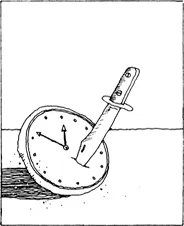
Fig. 132. Let’s kill time.
Later. Do you hate time? Alarm clocks, sure. Changing the clocks for daylight-saving time is the worst. How can they just take an hour away like that? Remember in 1973 when Nixon took away two hours for the oil companies?
“The older I get, the faster time goes” my mother told me. “The years just fly by. Every time I turn around, it’s Christmas or Thanksgiving.” Party time speeds up and slows down like an out-of-control movie. Ten minutes lasts for two hours, but the next time you look at your watch, it’s three in the morning. Airport time. Sex time. Street time. Fast or slow, it all passes.
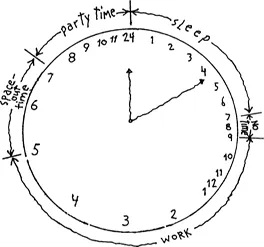
Fig. 133. Fast and slow.
That was my big realization twenty years ago. It all passes. Here I am at the bathroom door, and how can I ever get to the sink? How can high school ever end, how can I ever finish college, how can I ever be married? But then I’m at the sink, I’m back out the door, I have a Ph.D., I’m married with three kids, and twenty years have passed. Here I am alive, and how can I ever die? But I will, I know I will, I know it in my soul.
Death. It’s like the basic puzzle issued to each of us at birth. Hi, you’re alive now, isn’t it nice? Someday you’ll die and it’ll be over. What are you going to do about it? It’s awful, it’s terrifying, it’s enough to make a person commit suicide!
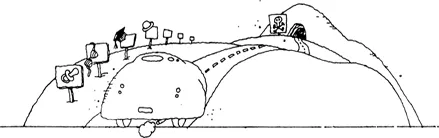
Fig. 134. It all passes.
Philosophia perennis — the phrase was coined by Leibniz; but the thing — the metaphysic that recognizes a divine Reality substantial to the world of things and lives and minds, the psychology that finds in the soul something similar to, or even identical with, divine Reality, the ethic that places man’s final end in the knowledge of the imminent and transcendent Ground of all being — the thing is immemorial and universal.
ALDOUS HUXLEY,
The Perennial Philosophy, 1944
If time didn’t pass, I’d always be here now, writing this chapter. I’m scared of dying. I’d like to think that time doesn’t really pass. What I’m going to do in this chapter is to present some scientific justifications for the belief that the passage of time is an illusion.
People ordinarily think of the world as being a three-dimensional space that changes with the passage of time. The past is gone, the future doesn’t exist yet, and only the present is real. But there is another way of looking at the world: we can regard the world as a block universe. When we think of the world as a block universe, we put all of space and time together to make a single huge object. The block universe is made up of spacetime. Spacetime is four-dimensional: three space dimensions plus one time dimension. To look at spacetime from the outside is to stand outside of history and view things sub specie aeternitatis.
“Spacetime” may sound like something technical and far removed from ordinary life. But I would argue that it is really a more natural concept than “space that changes with time.”
Suppose you work in an office miles away from your house. At 7:00 you see your bedroom; at 10:00 you see your desk. One day at 10:00 you sit in your office and wonder what is real. If you believe the world consists of a space that changes with time, then you are more or less committed to the view that the past is gone. So you will feel that your 10:00 bedroom exists, but your 7:00 bedroom does not exist. Yet your 10:00 bedroom is not something you can see, sitting there in your office. Wouldn’t it be more reasonable to believe that the 7:00 bedroom (which you saw and can well remember) is real, and that it is the 10:00 bedroom whose existence is doubtful?
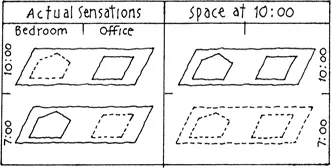
Fig. 135. What’s real!
My world is, in the last analysis, the sum total of my sensations. These sensations can be most naturally arranged as a pattern in four-dimensional spacetime. My life is a sort of four-dimensional worm embedded in a block universe. To complain that my lifeworm is only (let us say) seventy-two years long is perhaps as foolish as it would be to complain that my body is only six feet long. Eternity is right outside of spacetime. Eternity is right now.
This is not a new idea by any means. The teaching that all history is an eternal Now is central to the classic mystic tradition. In one of his sermons, the fourteenth-century priest Meister Eckhart expressed the basic idea as vividly as anyone before or since:
A day, whether six or seven ago, or more than six thousand years ago, is just as near to the present as yesterday. Why? Because all time is contained in the present Now-moment.
To talk about the world as being made by God tomorrow, or yesterday, would be talking nonsense. God makes the world and all things in this present now. Time gone a thousand years ago is now as present and as near to God as this very instant.
Whether or not we share Eckhart’s beliefs about God, the image of spacetime being created all at once is a powerful one. Whenever I read his words I get an image of a big old man with a white beard flinging a bucket of paint at a barn wall. Splat: there’s all of spacetime, created all at once, created right now.
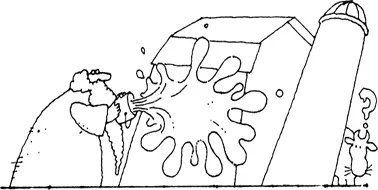
Fig. 136. “God makes the world and all the things in this present now.”
Tuesday, November 16, 1982
Space is made up of locations; spacetime is made up of events. An “event” is just what it sounds like: a given place at a given time. Each of your sense impressions is a little event. The events you experience fall into a natural four-dimensional order: north/south, east/west, up/down, sooner/later. When you look back at your life, you are really looking at a four-dimensional spacetime pattern. So there is nothing very strange or confusing about spacetime, as long as we are looking at it from the “inside.”
Looking at spacetime from the “outside” is a little harder: four-dimensional things are always difficult to visualize. Let us, once again, think about Flatland. Imagine that A Square is resting alone in an empty field, and that shortly after noon his father, A Triangle, slides up to him and then slides off. If we take time to be a third dimension perpendicular to the plane of Flatland, then we can illustrate these events by a spacetime diagram as shown in figure 137. Here A Square and A Triangle are wormlike patterns in spacetime. Their brief encounter at 12:05 is represented as a bending together of their lifeworms. Nothing really moves here; this is just an eternal pattern in spacetime. At 12:05 A Triangle is next to A Square; this is an eternal fact, a fact that can never change.
Try to imagine a picture like figure 137 that encompasses the entire space and time of Flatland. This vast tangle of worms and threads would make up what we call the Flat-land block universe. You could think of making a model of the Flatland block universe by standing above Flatland and filming the action as the polygons move around. If you then cut apart the film’s frames and stacked them up in temporal order, you’d have a good model of part of the Flatland block universe.
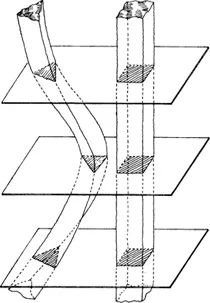
Fig. 137. A region of Flatland’s spacetime.
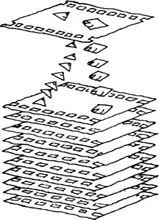
Fig. 138. Flatland’s spacetime is like a stack of film frames.
Before going any further, I should stop to answer a question that some of you may be asking. If we’re going to think of time as a fourth dimension, does that mean that all the things we’ve said about the fourth dimension are really about time? The answer is no. Just as there is no one fixed direction in space that we always call “width,” there need be no one fixed higher dimension that is always called “time.” All our talk about the fourth dimension has enabled us to think of a variety of higher dimensions: a direction in which one can jump out of space, a direction in which space is curved, a direction in which one moves to reach alternate universes. We can, if we like, insist that the past/future axis of time is the fourth dimension. And then we pretty well have to say that the ana/kata axis out of space is the fifth dimension, and the sixth dimensi...
Table of contents
- Cover
- Title
- Copyright Page
- Dedication
- Contents
- Preface to the Dover Edition
- Foreword by Martin Gardner
- Preface
- I. The Fourth Dimension
- II. Space
- III. How To Get There
- Puzzle Answers
- Bibliography
- Index
Trusted by 375,005 students
Access to over 1.5 million titles for a fair monthly price.
Study more efficiently using our study tools.
Frequently asked questions
Yes, you can cancel anytime from the Subscription tab in your account settings on the Perlego website. Your subscription will stay active until the end of your current billing period. Learn how to cancel your subscription
No, books cannot be downloaded as external files, such as PDFs, for use outside of Perlego. However, you can download books within the Perlego app for offline reading on mobile or tablet. Learn how to download books offline
Perlego offers two plans: Essential and Complete
- Essential is ideal for learners and professionals who enjoy exploring a wide range of subjects. Access the Essential Library with 800,000+ trusted titles and best-sellers across business, personal growth, and the humanities. Includes unlimited reading time and Standard Read Aloud voice.
- Complete: Perfect for advanced learners and researchers needing full, unrestricted access. Unlock 1.5M+ books across hundreds of subjects, including academic and specialized titles. The Complete Plan also includes advanced features like Premium Read Aloud and Research Assistant.
We are an online textbook subscription service, where you can get access to an entire online library for less than the price of a single book per month. With over 1.5 million books across 990+ topics, we’ve got you covered! Learn about our mission
Look out for the read-aloud symbol on your next book to see if you can listen to it. The read-aloud tool reads text aloud for you, highlighting the text as it is being read. You can pause it, speed it up and slow it down. Learn more about Read Aloud
Yes! You can use the Perlego app on both iOS and Android devices to read anytime, anywhere — even offline. Perfect for commutes or when you’re on the go.
Please note we cannot support devices running on iOS 13 and Android 7 or earlier. Learn more about using the app
Please note we cannot support devices running on iOS 13 and Android 7 or earlier. Learn more about using the app
Yes, you can access The Fourth Dimension: Toward a Geometry of Higher Reality by Rudy Rucker in PDF and/or ePUB format, as well as other popular books in Biological Sciences & Applied Mathematics. We have over 1.5 million books available in our catalogue for you to explore.