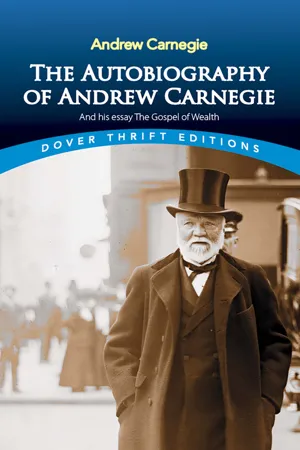
A native of Scotland, Andrew Carnegie emigrated to Allegheny, Pennsylvania, in his youth and through voracious reading and personal initiative became one of the richest men in American history. His autobiography recounts the real-life, rags-to-riches tale of an immigrant's rise from telegrapher's clerk to captain of industry and steel magnate. One of the earliest memoirs of an American capitalist, The Autobiography of Andrew Carnegie appeared shortly after the 84-year-old author's death in 1919.
Industrialist, innovator, scholar, and philanthropist, Carnegie gave away more than 90 percent of his wealth for the establishment of libraries, schools, and hospitals. In addition to describing how he amassed his enormous fortune, his memoirs chronicle the deliberate and systematic distribution of his fortune for the enlightenment and betterment of humanity. This volume includes Carnegie's essay "The Gospel of Wealth," in which he outlines his philanthropic views, stating that "the millionaire will be but a trustee for the poor," bestowing charity on those willing to help themselves.
- 304 pages
- English
- ePUB (mobile friendly)
- Available on iOS & Android
eBook - ePub
The Autobiography of Andrew Carnegie and His Essay The Gospel of Wealth
About this book
Information
CHAPTER I
PARENTS AND CHILDHOOD
IF THE STORY of any man’s life, truly told, must be interesting, as some sage avers, those of my relatives and immediate friends who have insisted upon having an account of mine may not be unduly disappointed with this result. I may console myself with the assurance that such a story must interest at least a certain number of people who have known me, and that knowledge will encourage me to proceed.
A book of this kind, written years ago by my friend, Judge Mellon, of Pittsburgh, gave me so much pleasure that I am inclined to agree with the wise one whose opinion I have given above; for, certainly, the story which the Judge told has proved a source of infinite satisfaction to his friends, and must continue to influence succeeding generations of his family to live life well. And not only this; to some beyond his immediate circle it holds rank with their favorite authors. The book contains one essential feature of value—it reveals the man. It was written without any intention of attracting public notice, being designed only for his family. In like manner I intend to tell my story, not as one posturing before the public, but as in the midst of my own people and friends, tried and true, to whom I can speak with the utmost freedom, feeling that even trifling incidents may not be wholly destitute of interest for them.
To begin, then, I was born in Dunfermline, in the attic of the small one-story house, corner of Moodie Street and Priory Lane, on the 25th of November, 1835, and, as the saying is, “of poor but honest parents, of good kith and kin.” Dunfermline had long been noted as the center of the damask trade in Scotland.1 My father, William Carnegie, was a damask weaver, the son of Andrew Carnegie after whom I was named.
My Grandfather Carnegie was well known throughout the district for his wit and humor, his genial nature and irrepressible spirits. He was head of the lively ones of his day, and known far and near as the chief of their joyous club—“Patiemuir College.” Upon my return to Dunfermline, after an absence of fourteen years, I remember being approached by an old man who had been told that I was the grandson of the “Professor,” my grandfather’s title among his cronies. He was the very picture of palsied eld;
“His nose and chin they threatened ither.”
As he tottered across the room toward me and laid his trembling hand upon my head he said: “And ye are the grandson o’ Andra Carnegie! Eh, mon, I ha’e seen the day when your grandfaither and I could ha’e hallooed ony reasonable man oot o’ his jidgment.”
Several other old people of Dunfermline told me stories of my grandfather. Here is one of them:
One Hogmanay night2 an old wifey, quite a character in the village, being surprised by a disguised face suddenly thrust in at the window, looked up and after a moment’s pause exclaimed, “Oh, it’s jist that daft callant Andra Carnegie.” She was right; my grandfather at seventy-five was out frightening his old lady friends, disguised like other frolicking youngsters.
I think my optimistic nature, my ability to shed trouble and to laugh through life, making “all my ducks swans,” as friends say I do, must have been inherited from this delightful old masquerading grandfather whose name I am proud to bear.3 A sunny disposition is worth more than fortune. Young people should know that it can be cultivated; that the mind like the body can be moved from the shade into sunshine. Let us move it then. Laugh trouble away if possible, and one usually can if he be anything of a philosopher, provided that self-reproach comes not from his own wrong-doing. That always remains. There is no washing out of these “damned spots.” The judge within sits in the supreme court and can never be cheated. Hence the grand rule of life which Burns gives:
“Thine own reproach alone do fear.”
This motto adopted early in life has been more to me than all the sermons I ever heard, and I have heard not a few, although I may admit resemblance to my old friend Baillie Walker in my mature years. He was asked by his doctor about his sleep and replied that it was far from satisfactory, he was very wakeful, adding with a twinkle in his eye: “But I get a bit fine doze i’ the kirk noo and then.”
On my mother’s side the grandfather was even more marked, for my grandfather Thomas Morrison was a friend of William Cobbett, a contributor to his “Register,” and in constant correspondence with him. Even as I write, in Dunfermline old men who knew Grandfather Morrison speak of him as one of the finest orators and ablest men they have known. He was publisher of “The Precursor,” a small edition it might be said of Cobbett’s “Register,” and thought to have been the first radical paper in Scotland. I have read some of his writings, and in view of the importance now given to technical education, I think the most remarkable of them is a pamphlet which he published seventy-odd years ago entitled “Head-ication versus Hand-ication.” It insists upon the importance of the latter in a manner that would reflect credit upon the strongest advocate of technical education to-day. It ends with these words, “I thank God that in my youth I learned to make and mend shoes.” Cobbett published it in the “Register” in 1833, remarking editorially, “One of the most valuable communications ever published in the ‘Register’ upon the subject, is that of our esteemed friend and correspondent in Scotland, Thomas Morrison, which appears in this issue.” So it seems I come by my scribbling propensities by inheritance—from both sides, for the Carnegies were also readers and thinkers.
My Grandfather Morrison was a born orator, a keen politician, and the head of the advanced wing of the radical party in the district—a position which his son, my Uncle Bailie Morrison, occupied as his successor. More than one well-known Scotsman in America has called upon me, to shake hands with “the grandson of Thomas Morrison.” Mr. Farmer, president of the Cleveland and Pittsburgh Railroad Company, once said to me, “I owe all that I have of learning and culture to the influence of your grandfather”; and Ebenezer Henderson, author of the remarkable history of Dunfermline, stated that he largely owed his advancement in life to the fortunate fact that while a boy he entered my grandfather’s service.
I have not passed so far through life without receiving some compliments, but I think nothing of a complimentary character has ever pleased me so much as this from a writer in a Glasgow newspaper, who had been a listener to a speech on Home Rule in America which I delivered in Saint Andrew’s Hall. The correspondent wrote that much was then being said in Scotland with regard to myself and family and especially my grandfather Thomas Morrison, and he went on to say, “Judge my surprise when I found in the grandson on the platform, in manner, gesture and appearance, a perfect facsimile of the Thomas Morrison of old.”
My surprising likeness to my grandfather, whom I do not remember to have ever seen, cannot be doubted, because I remember well upon my first return to Dunfermline in my twenty-seventh year, while sitting upon a sofa with my Uncle Bailie Morrison, that his big black eyes filled with tears. He could not speak and rushed out of the room overcome. Returning after a time he explained that something in me now and then flashed before him his father, who would instantly vanish but come back at intervals. Some gesture it was, but what precisely he could not make out. My mother continually noticed in me some of my grandfather’s peculiarities. The doctrine of inherited tendencies is proved every day and hour, but how subtle is the law which transmits gesture, something as it were beyond the material body. I was deeply impressed.
My Grandfather Morrison married Miss Hodge, of Edinburgh, a lady in education, manners, and position, who died while the family was still young. At this time he was in good circumstances, a leather merchant conducting the tanning business in Dunfermline; but the peace after the Battle of Waterloo involved him in ruin, as it did thousands; so that while my Uncle Bailie, the eldest son, had been brought up in what might be termed luxury, for he had a pony to ride, the younger members of the family encountered other and harder days.
The second daughter, Margaret, was my mother, about who I cannot trust myself to speak at length. She inherited from her mother the dignity, refinement, and air of the cultivated lady. Perhaps some day I may be able to tell the world something of this heroine, but I doubt it. I feel her to be sacred to myself and not for others to know. None could ever really know her—I alone did that. After my father’s early death she was all my own. The dedication of my first book4 tells the story. It was: “To my favorite Heroine My Mother.”
Fortunate in my ancestors I was supremely so in my birthplace. Where one is born is very important, for different surroundings and traditions appeal to and stimulate different latent tendencies in the child. Ruskin truly observes that every bright boy in Edinburgh is influenced by the sight of the Castle. So is the child of Dunfermline, by its noble Abbey, the Westminster of Scotland, founded early in the eleventh century (1070) by Malcolm Canmore and his Queen Margaret, Scotland’s patron saint. The ruins of the great monastery and of the Palace where kings were born still stand, and there, too, is Pittencrieff Glen, embracing Queen Margaret’s shrine and the ruins of King Malcolm’s Tower, with which the old ballad of “Sir Patrick Spens” begins:
“The King sits in Dunfermline tower,5
Drinking the bluid red wine.”
The tomb of The Bruce is in the center of the Abbey, Saint Margaret’s tomb is near, and many of the “royal folk” lie sleeping close around. Fortunate, indeed, the child who first sees the light in that romantic town, which occupies high ground three miles north of the Firth of Forth, overlooking the sea, with Edinburgh in sight to the south, and to the north the peaks of the Ochils clearly in view. All is still redolent of the mighty past when Dunfermline was both nationally and religiously the capital of Scotland.
The child privileged to develop amid such surroundings absorbs poetry and romance with the air he breathes, assimilates history and tradition as he gazes around. These become to him his real world in childhood—the ideal is the ever-present real. The actual has yet to come when, later in life, he is launched into the workaday world of stern reality. Even then, and till his last day, the early impressions remain, sometimes for short seasons disappearing perchance, but only apparently driven away or suppressed. They are always rising and coming again to the front to exert their influence, to elevate his thought and color his life. No bright child of Dunfermline can escape the influence of the Abbey, Palace, and Glen. These touch him and set fire to the latent spark within, making him something different and beyond what, less happily born, he would have become. Under these inspiring conditions my parents had also been born, and hence came, I doubt not, the potency of the romantic and poetic strain which pervaded both.
As my father succeeded in the weaving business we removed from Moodie Street to a much more commodious house in Reid’s Park. My father’s four or five looms occupied the lower story; we resided in the upper, which was reached, after a fashion common in the older Scottish houses, by outside stairs from the pavement. It is here that my earliest recollections begin, and, strangely enough, the first trace of memory takes me back to a day when I saw a small map of America. It was upon rollers and about two feet square. Upon this my father, mother, Uncle William, and Aunt Aitken were looking for Pittsburgh and pointing out Lake Erie and Niagara. Soon after my uncle and Aunt Aitken sailed for the land of promise.
At this time I remember my cousin-brother, George Lauder (“Dod”), and myself were deeply impressed with the great danger overhanging us because a lawless flag was secreted in the garret. It had been painted to be carried, and I believe was carried by my father, or uncle, or some other good radical of our family, in a procession during the Corn Law agitation. There had been riots in the town and a troop of cavalry was quartered in the Guildhall. My grandfathers and uncles on both sides, and my father, had been foremost in addressing meetings, and the whole family circle was in a ferment.
I remember as if it were yesterday being awakened during the night by a tap at the back window by men who had come to inform my parents that my uncle, Bailie Morrison, had been thrown into jail because he had dared to hold a meeting which had been forbidden. The sheriff with the aid of the soldiers had arrested him a few miles from the town where the meeting had been held, and brought him into the town during the night, followed by an immense throng of people.6
Serious trouble was feared, for the populace threatened to rescue him, and, as we learned afterwards, he had been induced by the provost of the town to step forward to a window overlooking the High Street and beg the people to retire. This he did, saying: “If there be a friend of the good cause here to-night, let him fold his arms.” They did so. And then, after a pause, he said, “Now depart in peace!”7 My uncle, like all our family, was a moral-force man and strong for obedience to law, but radical to the core and an intense admirer of the American Republic.
One may imagine when all this was going on in public how bitter were the words that passed from one to the other in private. The denunciations of monarchical and aristocratic government, of privilege in all its forms, the grandeur of the republican system, the superiority of America, a land peopled by our own race, a home for freemen in which every citizen’s privilege was every man’s right—these were the exciting themes upon which I was nurtured. As a child I could have slain king, duke, or lord, and considered their deaths a service to the state and hence an heroic act.
Such is the influence of childhood’s earliest associations that it was long before I could trust myself to speak respectfully of any privileged class or person who had not distinguished himself in some good way and therefore earned the right to public respect. There was still the sneer behind for mere pedigree—“he is nothing, has done nothing, only an accident, a fraud strutting in borrowed plumes; all he has to his account is the accident of birth; the most fruitful part of his family, as with the potato, lies underground.” I wondered that intelligent men could live where another human being was born to a privilege which was not also their birthright. I was never tired of q...
Table of contents
- Cover
- Title Page
- Copyright Page
- Preface
- Editor
- Contents
- I. Parents and Childhood
- II. Dunfermline and America
- III. Pittsburgh and Work
- IV. Colonel Anderson and Books
- V. The Telegraph Office
- VI. Railroad Service
- VII. Superintendent of the Pennsylvania
- VIII. Civil War Period
- IX. Bridge-Building
- X. The Iron Works
- XI. New York as Headquarters
- XII. Business Negotiations
- XIII. The Age of Steel
- XIV. Partners, Books, and Travel
- XV. Coaching Trip and Marriage
- XVI. Mills and the Men
- XVII. The Homestead Strike
- XVIII. Problems of Labor
- XIX. The “Gospel of Wealth”
- XX. Educational and Pension Funds
- XXI. The Peace Palace and Pittencrieff
- XXII. Matthew Arnold and Others
- XXIII. British Political Leaders
- XXIV. Gladstone and Morley
- XXV. Herbert Spencer and His Disciple
- XXVI. Blaine and Harrison
- XXVII. Washington Diplomacy
- XXVIII. Hay and McKinley
- XXIX. Meeting the German Emperor
- Essay: The Gospel of Wealth (1889)
Trusted by 375,005 students
Access to over 1.5 million titles for a fair monthly price.
Study more efficiently using our study tools.
Frequently asked questions
Yes, you can cancel anytime from the Subscription tab in your account settings on the Perlego website. Your subscription will stay active until the end of your current billing period. Learn how to cancel your subscription
No, books cannot be downloaded as external files, such as PDFs, for use outside of Perlego. However, you can download books within the Perlego app for offline reading on mobile or tablet. Learn how to download books offline
Perlego offers two plans: Essential and Complete
- Essential is ideal for learners and professionals who enjoy exploring a wide range of subjects. Access the Essential Library with 800,000+ trusted titles and best-sellers across business, personal growth, and the humanities. Includes unlimited reading time and Standard Read Aloud voice.
- Complete: Perfect for advanced learners and researchers needing full, unrestricted access. Unlock 1.5M+ books across hundreds of subjects, including academic and specialized titles. The Complete Plan also includes advanced features like Premium Read Aloud and Research Assistant.
We are an online textbook subscription service, where you can get access to an entire online library for less than the price of a single book per month. With over 1.5 million books across 990+ topics, we’ve got you covered! Learn about our mission
Look out for the read-aloud symbol on your next book to see if you can listen to it. The read-aloud tool reads text aloud for you, highlighting the text as it is being read. You can pause it, speed it up and slow it down. Learn more about Read Aloud
Yes! You can use the Perlego app on both iOS and Android devices to read anytime, anywhere — even offline. Perfect for commutes or when you’re on the go.
Please note we cannot support devices running on iOS 13 and Android 7 or earlier. Learn more about using the app
Please note we cannot support devices running on iOS 13 and Android 7 or earlier. Learn more about using the app
Yes, you can access The Autobiography of Andrew Carnegie and His Essay The Gospel of Wealth by Andrew Carnegie in PDF and/or ePUB format, as well as other popular books in Business & Business Biographies. We have over 1.5 million books available in our catalogue for you to explore.