This riveting combination of true crime and social history examines a dozen cases from the 1800s involving thirteen French and English women charged with murder. Each incident was a cause célèbre, and this mixture of scandal and scholarship offers illuminating details of backgrounds, deeds, and trials.
"The real delight is that historian Mary S. Hartman does more than reconstruct twelve famous trials. She has written a piece on the social history of nineteenth-century women from an illuminating perspective: their favorite murders." — Time Magazine
"Noteworthy …. It has several distinctions: its expert prose style, its scholarly authority, and its perceptive analysis of the prevailing attitudes toward women's roles and domestic relations."—Criticism
"The author would have made a fine detective …. When she observes the women and men in extreme circumstances, she writes with the gift of a novelist and the depth of a scholar." — Los Angeles Times
"Vividly written, meticulously researched." — Choice
"Loved this book and so glad to see it's been returned to print! You can't beat the highly readable scholarly treatment of these 13 Victorian murderesses. Harman does a spectacular job of bringing these women and the carnage they created into the 20th and 21st centuries as well as giving the reader an excellent feminist critique of their reception in scholarly and popular culture. Pour yourself a cup of tea and enjoy the variety of their crimes and their drive to define themselves outside the constrictions of Victorian life." — Under the Covers and Reading
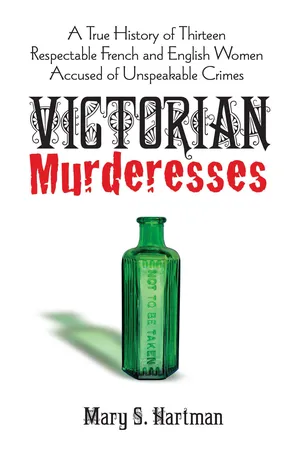
eBook - ePub
Victorian Murderesses
A True History of Thirteen Respectable French and English Women Accused of Unspeakable Crimes
- 336 pages
- English
- ePUB (mobile friendly)
- Available on iOS & Android
eBook - ePub
Victorian Murderesses
A True History of Thirteen Respectable French and English Women Accused of Unspeakable Crimes
About this book
Information
Subtopic
Social HistoryIndex
History1. ARSENIC AND MATRIMONY: The Cases of Marie Lafarge and Euphémie Lacoste
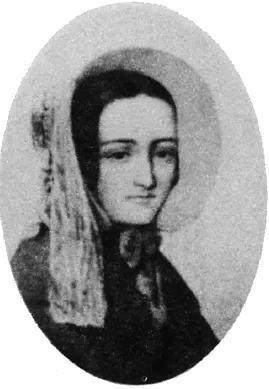
Marie Lafarge
ADJUSTMENT TO MARRIAGE may never have been a simple matter, but in nineteenth-century middle-class society the ordeal was intensified, especially for women. At no time before or since has popular self-consciousness about marriage and the “marriage market” reached such heights; and it is no wonder, since for larger numbers of people than ever before, marriage held out the great hope for bettering oneself in society. For the majority of women, whose destiny was the domestic sphere, changes in actual social roles as well as in the image of the ideal wife made initiation to marriage, even at best, an awkward and uneasy time. At worst, the new pressures of matrimony could lead to disaster, as they did in the cases of two young French women of the 1840s, Marie Lafarge and Euphémie Lacoste.1
The details of the tensions of their early married lives would have gone unrecorded, save for the fact that both their husbands died rather suddenly and under peculiar circumstances. Suspicion settled on the wives who, in the end, were tried on charges of poisoning their spouses with arsenic. The evidence against the women was circumstantial, as it is bound to be in the very private crime of poisoning, but many found that evidence to be compelling. Still, Mmes. Lafarge and Lacoste each publicly and repeatedly denied the charges, and one of them, at least, may have been telling the truth.
Marie Lafarge and Euphémie Lacoste were both members of the bourgeoisie, but each came from a distinctly different segment of the class. Mme. Lafarge, the wife of an iron manufacturer who owned a forge in the Limousin, was a Parisian with an excellent education and upper-middle-class and aristocratic connections. Mme. Lacoste, by contrast, was a provincial woman from the tiny village of Mazerolles in southwestern France. Married to a small tradesman who had retired to live off the proceeds of an inheritance, she inhabited a far more traditional world than Marie Lafarge. Yet both young women were obliged to face a variety of new experiences, many of which were peculiar to a transitional class. Their responses to the bewildering pressures of change in their lives, as well as the responses of their societies to their behavior, reveal stresses which could hardly have been unique to the two women. At a time when the bourgeois “mistress of the home” was being set up as the new class ideal of womanhood, the cases of Marie Lafarge and Euphémie Lacoste suggest some of the obstacles women were encountering as they moved toward that elusive ideal.
Of the two affairs, that of Mme. Lafarge was clearly the more sensational. By the summer of 1840 the literate public all knew at least the outlines of Mme. Lafarge’s life, and women, it was reported, talked of little else. One of the most celebrated trials of the century, the Lafarge case has continued to arouse an interest which is reflected in a steady stream of publications.2 Its central figure was an elegant, dark-haired twenty-four-year-old woman. If the male commentators (who, as was usual in the case of an accused woman, addressed themselves first to her physical appearance) disagreed over whether she was beautiful, most concurred in praising her intelligence, talent, and charm. Some observers did remark that her profile was not really good, that her forehead was too prominent, and her nose and mouth too large. But nearly everyone agreed that her eyes were extraordinary, her smile enchanting, and her soft, deep voice both appealing and seductive. The interested public learned, too, that the accused was a woman of considerable cultural achievements; she sang and played the piano, read the fiction of George Sand and Victor Hugo, and even wrote poetry. Marie Lafarge, in other words, was a recognizable romantic heroine—or so it seemed.
Born Marie Fortunée Cappelle in Paris in 1816, the young woman was the daughter of an artillery officer who had served in the Imperial Guards. She was illegitimately related to the reigning royal family, since her maternal grandmother was one of the natural daughters of the king’s father, Philippe Egalité, and Mme. de Genlis. Her father died in 1828, when Marie was twelve, and her mother, who remarried two years later, died in 1835.
Marie, at eighteen, was sent to live with her mother’s sister, who was married to the secretary-general of the Bank of France. But despite the advantages of wealth, comfort, and opportunities to develop her interest in literature and music, Marie complained with some justice that her aunt disliked her and made her painfully aware of her status as the “poor cousin.” The dowry of 90,000 francs left her by her parents was not impressive in her aunt’s social circles, and Marie soon realized that her relative regarded her as a marriage liability.
The problem of finding a husband for this orphan was first taken in hand by an aristocratic married friend of Marie’s, who arranged a meeting with the brother of her former governess. Though the man was a respectable subprefect, Marie understandably considered him beneath her and confessed her delight when a former friend of her father advised her that no marriage contract should be made with a man whose only income was his salary as a subprefect. In the meantime, however, one of Marie’s uncles had engaged the services of a matrimonial agency, which proposed an apparently more suitable candidate in one Charles Lafarge, son of an honorable justice of the peace from the Limousin. His dossier included warm letters of recommendation from his priest and the local deputy from Uzerches, as well as flattering watercolors of Le Glandier, his estate, which had originally been a Carthusian monastery. Advertised as a wealthy ironmaster with property worth at least 200,000 francs and an annual income of 30,000 from the forge alone, Lafarge was praised as the mayor of his commune and a pillar of the community.
To prevent Marie’s learning that Lafarge had been turned up by an agency, the uncle arranged a “chance” meeting with his “friend” at the opera. Marie found the twenty-eight-year-old ironmaster both boorish and ugly, but four days after their first meeting in August 1839, her aunt announced that she had published the banns. Fearful that Marie might balk, she even withheld the information that Lafarge was a widower. Within a few weeks the civil and religious ceremonies were performed and the couple set out for the Limousin.
In memoirs published after her trial Marie described the despair and illness she suffered on the trip, the terror inspired by the sexual advances of the stranger who was her husband, and the disillusionment upon arriving at her new home.3 Her in-laws seemed no more than vulgar farmers and the estate was a shambles. The vaunted ironworks, she would later learn, was bankrupt. In desperation she locked herself in their bedroom on the first evening and composed a letter to Charles, announcing that she had deceived him and that she loved another man, who had secretly followed them from Paris. She added, somewhat implausibly, that she intended either to take arsenic or to depart alone for Smyrna.4 With credulous horror Charles read the document and ordered the guns loaded and the dogs to be kept on the alert against the interloper. But after a terrible row involving family and visitors, Marie finally admitted her ruse and agreed to stay on. Charles, for his part, promised that he would not demand his “marital privileges” until he had fixed up the estate and arranged for a loan in Paris to finance operations at the forge.
In the ensuing weeks relations between Lafarge and his new wife reportedly improved. On the advice of his lawyer Charles saw to it that Marie, in deference to her Parisian background, was provided with subscriptions to newspapers, membership in the local lending library, numerous visits, and renovated surroundings. In November 1839, as remodeling proceeded at Le Glandier, Charles left for Paris with two projects: he intended to apply for a patent on a new smelting process he had developed, and he planned to negotiate a loan to perfect the process in his forge and publicize it for sale to other ironmasters. He did manage to receive the patent, but as the weeks passed, his efforts to get the loan proved fruitless. He returned home early in January 1840 complaining of an intestinal illness from which he said he had suffered ever since mid-December. Indeed, he traced the condition to the very day on which he had received a cake sent to him by his wife.
After his return home Charles’s condition worsened; he suffered constant attacks of cramps, vomiting, and nausea which kept him in bed from the evening of his arrival. Marie attentively watched over her husband, brought him food and drink, and summoned doctors, but Lafarge’s health continued to deteriorate. A friend visiting at Le Glandier a week after Charles’s return claimed to have seen Marie stirring a white powder into a drink intended for her husband. Marie insisted that the powder was merely gum arabic, a substance commonly used for intestinal complaints, but her mother-in-law confided fears of poisoning to a friend, who suggested that a local chemist examine the dregs of a now suspect eggnog. Analysis revealed the presence of arsenic, and Marie was forbidden to minister further to her husband. Charles, however, died the day after the test was conducted. His family then launched an investigation which culminated in Marie’s indictment for murder. After a trial rich in social and psychological revelations, but almost universally condemned as a travesty of justice, Marie Lafarge was found guilty with extenuating circumstances and sentenced to life imprisonment.
Four years later, in July 1844, news of another alleged arsenic poisoning of a husband by a young wife, this time in the southwestern department of Gers, prompted the press to speak of a new Lafarge affair. But the case of Euphémie Lacoste was a very different matter. True, the young Euphémie had married a man who never would have been her choice, one who had been married before and whom she found ill-mannered and difficult. She had also nursed him practically alone through a fatal gastric illness, and her suspected resentment of her husband did arouse gossip. Still, the only feature of the case which echoed the romanesque flavor of Marie Lafarge’s story was Euphémie’s disappearance after a warrant was issued to bring her in for questioning. Rumors spread that she had fled to Spain, where she had either joined a religious order or become a shepherdess, and when she finally returned voluntarily with her hair cropped short, there was much speculation that she had been masquerading as a boy. In its other particulars, however, the case was more prosaic in appearance, although no less puzzling.
The daughter of small landowners in the department of the Hautes-Pyrénées, Euphémie Vergès was twenty-two years old in May 1841 when she married her sixty-eight-year-old great-uncle, Henri Lacoste. Several years before her parents had received an offer from Lacoste, a retired shopkeeper, who had informed them that he stood to inherit a considerable amount of money and property from an elder brother who owned vineyards near the village of Riguepeu in the neighboring department of Gers. Seeing an opportunity to provide well for their daughter and to ensure their own future security, Euphémie’s parents agreed to the match and offered a dowry worth 20,000 francs. Lacoste, in turn, agreed to pay for the education of his intended bride at a convent school in Tarbes. In this instance, as in many similar ones among the wealthier peasantry and lower provincial bourgeoisie, the parents made the marriage agreement without informing the daughter; Euphémie learned of her forthcoming marriage only a few months before the wedding took place.
Mlle. Vergès, a dutiful daughter, apparently put up no resistance. As neighbors and friends subsequently testified at the trial, the marriage initially seemed to be a happy one. Admittedly, there were rumors that the young bride, in marrying an uncle more than three times her age, had sacrificed her inclinations toward a young grocer from Tarbes, but most agreed that she was very solicitous to her new husband. Even for this part of France, where bourgeois women were frequently noted to be “merely the first among their husband’s servants,”5 Euphémie stood out as especially attentive. Lacoste boasted to his friends that his new bride was perfection itself, that she shaved him, washed his feet, and even cleaned his fingernails. He promptly made out his will, leaving everything to Euphémie, and announced that he hoped soon for a son and heir.
Two years passed, however, and Euphémie failed to become pregnant. Lacoste reported his concern to his friends and began to complain that his wife had become difficult and moody. Euphémie, in turn, confided to their friend, the local schoolmaster, that her domestic life was increasingly trying. Henri, she said, was not only parsimonious, he was jealous; he refused to allow her to see friends or even to make visits alone to church. Moreover, there were rumors that Lacoste had attempted to proposition two of the maidservants, who subsequently had left service with the couple. Neighbors assumed that Euphémie had discharged them because she was worried that her husband intended to father a child and disinherit her.
Henri Lacoste was suddenly taken ill in mid-May 1843, after the couple had attended the local fair in Riguepeu. His attack, which was attributed by his wife to indigestion after a meal of beans, onions, and garlic, resulted in vomiting and weakness, but since he distrusted doctors, Lacoste allegedly refused medical help. When his condition worsened three days after his first attack, he finally had Euphémie write to a doctor and request a written diagnosis of his symptoms.6 In the meantime he was visited by a public health officer summoned by Euphémie. But the numerous plasters and purges did not avail. Lacoste died a few days later.
His widow, according to local reports, was not unduly troubled over her loss. As the maid put it, “Mada...
Table of contents
- Cover
- Title Page
- Copyright Page
- Dedication
- Contents
- Preface and Acknowledgments
- Introduction
- 1. Arsenic and Matrimony: The Cases of Marie Lafarge and Euphémie Lacoste
- 2. The Waiting Games of Brides-to-Be: The Cases of Madeleine Smith and Angélina Lemoine
- 3. The Singular Outcasts: The Cases of Célestine Doudet and Constance Kent
- 4. The New Women: The Cases of Florence Bravo and Henriette Francey
- 5. Sex and Shopkeeping: The Cases of Gabrielle Fenayrou and Adelaide Bartlett
- 6. Poison, Revolvers, and the Double Standard: The Cases of Florence Maybrick and Claire Reymond
- Conclusion: The Lady Killers
- Notes
- Selective Bibliography
- Index
Trusted by 375,005 students
Access to over 1.5 million titles for a fair monthly price.
Study more efficiently using our study tools.
Frequently asked questions
Yes, you can cancel anytime from the Subscription tab in your account settings on the Perlego website. Your subscription will stay active until the end of your current billing period. Learn how to cancel your subscription
No, books cannot be downloaded as external files, such as PDFs, for use outside of Perlego. However, you can download books within the Perlego app for offline reading on mobile or tablet. Learn how to download books offline
Perlego offers two plans: Essential and Complete
- Essential is ideal for learners and professionals who enjoy exploring a wide range of subjects. Access the Essential Library with 800,000+ trusted titles and best-sellers across business, personal growth, and the humanities. Includes unlimited reading time and Standard Read Aloud voice.
- Complete: Perfect for advanced learners and researchers needing full, unrestricted access. Unlock 1.5M+ books across hundreds of subjects, including academic and specialized titles. The Complete Plan also includes advanced features like Premium Read Aloud and Research Assistant.
We are an online textbook subscription service, where you can get access to an entire online library for less than the price of a single book per month. With over 1.5 million books across 990+ topics, we’ve got you covered! Learn about our mission
Look out for the read-aloud symbol on your next book to see if you can listen to it. The read-aloud tool reads text aloud for you, highlighting the text as it is being read. You can pause it, speed it up and slow it down. Learn more about Read Aloud
Yes! You can use the Perlego app on both iOS and Android devices to read anytime, anywhere — even offline. Perfect for commutes or when you’re on the go.
Please note we cannot support devices running on iOS 13 and Android 7 or earlier. Learn more about using the app
Please note we cannot support devices running on iOS 13 and Android 7 or earlier. Learn more about using the app
Yes, you can access Victorian Murderesses by Mary S. Hartman in PDF and/or ePUB format, as well as other popular books in History & Social History. We have over 1.5 million books available in our catalogue for you to explore.