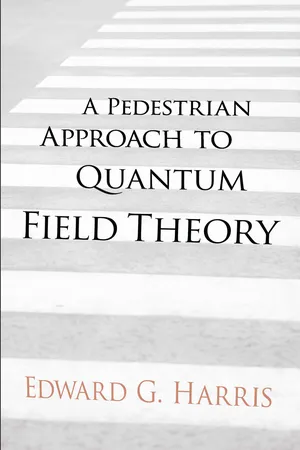
Written by a renowned professor of physics, this introductory text is geared toward graduate students taking a year-long course in quantum mechanics in which the third quarter is devoted to relativistic wave equations and field theory. Difficult concepts are introduced gradually, and the theory is applied to physically interesting problems. After an introductory chapter on the formation of quantum mechanics, the treatment advances to examinations of the quantum theory of the free electromagnetic field, the interaction of radiation and matter, second quantization, the interaction of quantized fields, and quantum electrodynamics. Additional topics include the theory of beta decay, particles that interact among themselves, quasi particles in plasmas and metals, and the problem of infinities in quantum electrodynamics. The Appendix contains selected answers to problems that appear throughout the text.
It is not an easy task to state the “rules” of quantum mechanics. Many textbooks do not even try and yet succeed in conveying to the reader a working knowledge of the subject. In this book the rules of quantum mechanics and some elementary results are collected in one place for ease of reference. In the sections that follow we give a brief account of the foundations of quantum mechanics. A more detailed discussion of the subject can be found in von Neumann5 and in the more recent book by Jauch.6 We begin by discussing the mathematical structure known as a Hilbert space and then give the rules for describing the real world in terms of this mathematical structure.
HILBERT SPACE
A Hilbert space
is an abstract set of elements called vectors
,
, and so on, having the following set of properties:
1. The space
is a linear vector space over the field of complex numbers such as λ, and μ. It has three properties. (a) For each pair of vectors there is determined a vector called the sum such that
(b) One vector
is called the ...
Table of contents
Cover
Title Page
Copyright Page
Dedication
Preface
Contents
Chapter 1 The Formalism of Quantum Mechanics
Chapter 2 Quantum Theory of the Free Electromagnetic Field
Chapter 3 Interaction of Radiation and Matter
Chapter 4 Second Quantization
Chapter 5 Interaction of Quantized Fields
Chapter 6 Quantum Electrodynamics
Chapter 7 The Theory of Beta Decay
Chapter 8 Particles that Interact Among Themselves
Chapter 9 Quasi Particles in Plasmas and Metals
Chapter 10 The Problem of Infinities in Quantum Electrodynamics
Appendix A Relativistic Wave Equations
Appendix B Details of the Calculation of the Klein-Nishina Cross Section
Appendix C Answers and Solutions to the Problems
Notes and References
Index
Trusted by 375,005 students
Access to over 1.5 million titles for a fair monthly price.
Study more efficiently using our study tools.
Frequently asked questions
Yes, you can cancel anytime from the Subscription tab in your account settings on the Perlego website. Your subscription will stay active until the end of your current billing period. Learn how to cancel your subscription
No, books cannot be downloaded as external files, such as PDFs, for use outside of Perlego. However, you can download books within the Perlego app for offline reading on mobile or tablet. Learn how to download books offline
Perlego offers two plans: Essential and Complete
Essential is ideal for learners and professionals who enjoy exploring a wide range of subjects. Access the Essential Library with 800,000+ trusted titles and best-sellers across business, personal growth, and the humanities. Includes unlimited reading time and Standard Read Aloud voice.
Complete: Perfect for advanced learners and researchers needing full, unrestricted access. Unlock 1.5M+ books across hundreds of subjects, including academic and specialized titles. The Complete Plan also includes advanced features like Premium Read Aloud and Research Assistant.
Both plans are available with monthly, semester, or annual billing cycles.
We are an online textbook subscription service, where you can get access to an entire online library for less than the price of a single book per month. With over 1.5 million books across 990+ topics, we’ve got you covered! Learn about our mission
Look out for the read-aloud symbol on your next book to see if you can listen to it. The read-aloud tool reads text aloud for you, highlighting the text as it is being read. You can pause it, speed it up and slow it down. Learn more about Read Aloud
Yes! You can use the Perlego app on both iOS and Android devices to read anytime, anywhere — even offline. Perfect for commutes or when you’re on the go. Please note we cannot support devices running on iOS 13 and Android 7 or earlier. Learn more about using the app
Yes, you can access A Pedestrian Approach to Quantum Field Theory by Edward G Harris in PDF and/or ePUB format, as well as other popular books in Physical Sciences & Quantum Theory. We have over 1.5 million books available in our catalogue for you to explore.