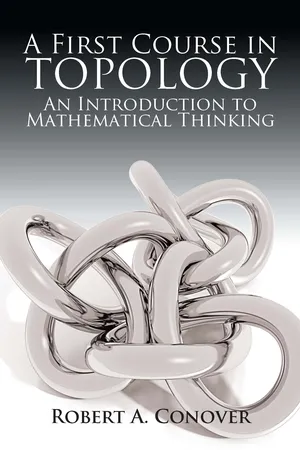
Students must prove all of the theorems in this undergraduate-level text, which features extensive outlines to assist in study and comprehension. Thorough and well-written, the treatment provides sufficient material for a one-year undergraduate course. The logical presentation anticipates students' questions, and complete definitions and expositions of topics relate new concepts to previously discussed subjects. Most of the material focuses on point-set topology with the exception of the last chapter. Topics include sets and functions, infinite sets and transfinite numbers, topological spaces and basic concepts, product spaces, connectivity, and compactness. Additional subjects include separation axioms, complete spaces, and homotopy and the fundamental group. Numerous hints and figures illuminate the text.
You have certainly had much experience by now with both of the concepts in the title of this chapter. But it is a fact that a thorough familiarity with sets and functions is essential to any understanding of modern mathematics, so the material in this chapter is of basic importance to all of your future work. You should read it carefully, do all of the exercises, and prove all of the theorems.
1. SETS
You may recall that, in Euclidean geometry, the words “point” and “line” are not defined. Instead, it is assumed that everyone has a good idea of what points and lines are, and we let it go at that. This failure to define terms is not because of laziness or sloppiness, though; the fact is that in any system of human thought we have to start somewhere, so there must always be some primitive notions that cannot be defined because we have nothing to define them in terms of.
In this course, the most basic notions that we will use are those of set, element of a set, and what it means for a given element to belong to a given set: we will not define any of these ideas. But of course it is all clear: a set is a collection of objects, an element of the set is one of these objects, and it is always clear when a given object is an element of a given set. For example, the set of all people who are now citizens of the United States is the collection of all those people, and only those people, who are now citizens of the United States. The set is the collection of all U. S. citizens, an element of the set is a U. S. citizen, and one can always determine whether a given object belongs to the set: the given object must be a person and that person must be a U. S. citizen.
Two sets are the same if and only if they have exactly the same elements. Formally,
1.1. Definition. Let A and B be sets. Then
1) A is a subset of B, written A ⊂ B, if every element of A is also an element of B.
2) A and B are equal, written A = B, if both A ⊂ B and B ⊂ A.
Notice that A ⊂ B does not imply that A and B cannot be equal. If A ⊂ B and A is not equal to B (in which case we call A a proper subset of B), we sometimes write A
B, for emphasis.
A word about definitions is in order. A definition in mathematics is always ...
Table of contents
Cover
Title Page
Copyright Page
Dedication
Preface
Introduction
Proofs in Mathematics: A Note to the Reader
Contents
Chapter 1. Sets and Functions
Chapter 2. Infinite Sets and Transfinite Numbers
Chapter 3. Some Familiar Topological Spaces and Basic Topological Concepts
Chapter 4. Topological Spaces and Basic Topological Concepts in General
Chapter 5. Product Spaces
Chapter 6. Connectivity
Chapter 7. Compactness
Chapter 8. Separation Axioms
Chapter 9. Complete Spaces
Chapter 10. Compactness Again
Chapter 11. Selected Topics in Point-Set Topology
Chapter 12. Homotopy and the Fundamental Group
Bibliography
Index
Trusted by 375,005 students
Access to over 1.5 million titles for a fair monthly price.
Study more efficiently using our study tools.
Frequently asked questions
Yes, you can cancel anytime from the Subscription tab in your account settings on the Perlego website. Your subscription will stay active until the end of your current billing period. Learn how to cancel your subscription
No, books cannot be downloaded as external files, such as PDFs, for use outside of Perlego. However, you can download books within the Perlego app for offline reading on mobile or tablet. Learn how to download books offline
Perlego offers two plans: Essential and Complete
Essential is ideal for learners and professionals who enjoy exploring a wide range of subjects. Access the Essential Library with 800,000+ trusted titles and best-sellers across business, personal growth, and the humanities. Includes unlimited reading time and Standard Read Aloud voice.
Complete: Perfect for advanced learners and researchers needing full, unrestricted access. Unlock 1.5M+ books across hundreds of subjects, including academic and specialized titles. The Complete Plan also includes advanced features like Premium Read Aloud and Research Assistant.
Both plans are available with monthly, semester, or annual billing cycles.
We are an online textbook subscription service, where you can get access to an entire online library for less than the price of a single book per month. With over 1.5 million books across 990+ topics, we’ve got you covered! Learn about our mission
Look out for the read-aloud symbol on your next book to see if you can listen to it. The read-aloud tool reads text aloud for you, highlighting the text as it is being read. You can pause it, speed it up and slow it down. Learn more about Read Aloud
Yes! You can use the Perlego app on both iOS and Android devices to read anytime, anywhere — even offline. Perfect for commutes or when you’re on the go. Please note we cannot support devices running on iOS 13 and Android 7 or earlier. Learn more about using the app
Yes, you can access A First Course in Topology by Robert A Conover in PDF and/or ePUB format, as well as other popular books in Mathematics & Topology. We have over 1.5 million books available in our catalogue for you to explore.