A towering figure in African-American history, W. E. B. Du Bois (1868–1963) created a substantial literary legacy beyond such seminal works as The Souls of Black Folk. This volume highlights his other nonfiction writings and should be of great value to students in secondary school and college as well as to other readers.
Contents include:
Strivings of the Negro People (1897); A Negro Schoolmaster in the New South (1899); The Song of the Smoke (1899); The Black North: A Social Study (1901); The Sorrow Songs (1903); The Talented Tenth (1903); Credo (1904); Address of the Niagara Movement to the Country (1906); Religion in the South (1907); The Value of Agitation (1907); The Case (1907); The Burden of Black Women (1907); Evolution of the Race Problem (1909); Politeness (1911); Jesus Christ in Georgia (1911); The Upbuilding of Black Durham: The Success of the Negroes and Their Value to a Tolerant and Helpful Southern City (1912); Intermarriage (1913); Socialism and the Negro Problem (1913); Woman Suffrage (1915); Booker T. Washington (1915); The Shadow of Years (1918); Returning Soldiers (1919); Let Us Reason Together (1919); The Souls of White Folk (1920); The Damnation of Women (1920); and Again, Social Equality (1920).
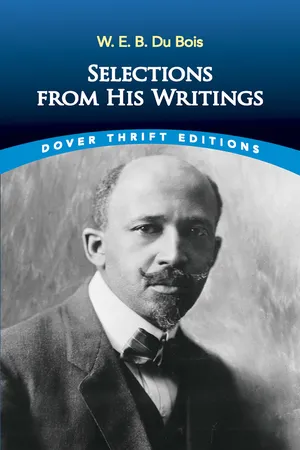
- 208 pages
- English
- ePUB (mobile friendly)
- Available on iOS & Android
eBook - ePub
W. E. B. Du Bois: Selections from His Writings
About this book
Information
Subtopic
African American HistoryIndex
LiteratureRELIGION IN THE SOUTH (1907)
In this elegant essay, Du Bois’s abilities as a social historian are on full display. The narrative summary of a cultural and historical phenomenon is focused and intense, and includes a recounting of Nat Turner’s life, a short autobiographical section of Du Bois’s own history as a member of the Episcopal church, Christianity’s role in awakening the desire for social equality and education, as well as Christian issues that had been compromised in America by economic concerns: “The Turner insurrection is so connected with the economic revolution which enthroned cotton that it marks an epoch in the history of the slave. A wave of legislation passed over the South prohibiting the slaves from learning to read and write, forbidding Negroes to preach, and interfering with Negro religious meetings.”
IT IS OFTEN a nice question as to which is of greater importance among a people—the way in which they earn their living, or their attitude toward life. As a matter of fact these two things are but two sides of the same problem, for nothing so reveals the attitude of a people toward life as the manner in which they earn their living; and on the other hand the earning of a living depends in the last analysis upon one’s estimate of what life really is. So that these two questions that I am discussing with regard to the South are intimately bound up with each other.
If we have studied the economic development of the South carefully, then we have already seen something of its attitude toward life; the history of religion in the South means a study of these same facts over which we have gone, from a different point of view. Moreover, as the economic history of the South is in effect the economics of slavery and the Negro problem, so the essence of a study of religion in the South is a study of the ethics of slavery and emancipation.
It is very difficult of course for one who has not seen the practical difficulties that surround a people at any particular time in their battle with the hard facts of this world, to interpret with sympathy their ideals of life; and this is especially difficult when the economic life of a nation has been expressed by such a discredited word as slavery. If, then, we are to study the history of religion in the South, we must first of all divest ourselves of prejudice, pro and con; we must try to put ourselves in the place of those who are seeking to read the riddle of life and grant to them about the same general charity and the same general desire to do right that we find in the average human being. On the other hand, we must not, in striving to be charitable, be false to truth and right. Slavery in the United States was an economic mistake and a moral crime. This we cannot forget. Yet it had its excuses and mitigations. These we must remember.
When in the seventeenth century there grew up in the New World a system of human slavery, it was not by any means a new thing. There were slaves and slavery in Europe, not, to be sure, to a great extent, but none the less real. The Christian religion, however, had come to regard it as wrong and unjust that those who partook of the privileges and hopes and aspirations of that religion should oppress each other to the extent of actual enslavement. The idea of human brotherhood in the seventeenth century was of a brotherhood of co-religionists. When it came to the dealing of Christian with heathen, however, the century saw nothing wrong in slavery; rather, theoretically, they saw a chance for a great act of humanity and religion. The slaves were to be brought from heathenism to Christianity, and through slavery the benighted Indian and African were to find their passport into the kingdom of God. This theory of human slavery was held by Spaniards, French, and English. It was New England in the early days that put the echo of it in her codes and recognition of it can be seen in most of the colonies.
But no sooner had people adopted this theory than there came the insistent and perplexing question as to what the status of the heathen slave was to be after he was Christianized and baptized; and even more pressing, what was to be the status of his children?
It took a great deal of bitter heart searching for the conscientious early slave-holders to settle this question. The obvious state of things was that the new convert awoke immediately to the freedom of Christ and became a freeman. But while this was the theoretical, religious answer, and indeed the answer which was given in several instances, the practice soon came into direct and perplexing conflict with the grim facts of economic life.
Here was a man who had invested his money and his labor in slaves; he had done it with dependence on the institution of property. Could he be deprived of his property simply because his slaves were baptized afterward into a Christian church? Very soon such economic reasoning swept away the theological dogma and it was expressly declared in colony after colony that baptism did not free the slaves. This, of course, put an end to the old doctrine of the heathen slave and it was necessary for the church to arrange for itself a new theory by which it could ameliorate, if not excuse, the position of the slave. The next question was naturally that of the children of slaves born in Christianity and the church for a time hedged unworthily on the subject by consigning to perpetual slavery the children of heathen but not those born of Christian parents; this was satisfactory for the first generation but it fell short of the logic of slavery later, and a new adjustment was demanded.
Here again this was not found difficult. In Virginia there had been built up the beginnings of a feudal aristocracy. Men saw nothing wrong or unthinkable in the situation as it began to develop, but rather something familiar. At the head of the feudal manor was the lord, or master, beneath him the under-lord or overseers and then the artisans, retainers, the free working men and lastly the serfs, slaves or servants as they were called. The servant was not free and yet he was not theoretically exactly a slave, and the laws of Virginia were rather careful to speak very little of slaves.
Serfdom in America as in Europe was to be a matter of status or position and not of race or blood, and the law of the South in the seventeenth and early eighteenth centuries made little or no distinction between black and white bondservants save in the time of their service. The idea, felt rather than expressed, was that here in America we were to have a new feudalism suited to the new country. At the top was the governor of the colony representing the majesty of the English king, at the bottom the serfs or slaves, some white, most of them black.
Slavery therefore was gradually transformed in the seventeenth and eighteenth centuries into a social status out of which a man, even a black man, could escape and did escape; and, no matter what his color was, when he became free, he became free in the same sense that other people were. Thus it was that there were free black voters in the southern colonies (Virginia and the Carolinas) in the early days concerning whose right to vote there was less question than there is concerning my right to vote now in Georgia.
The church recognized the situation and the Episcopal church especially gave itself easily to this new conception. This church recognized the social gradation of men; all souls were equal in the sight of God, but there were differences in worldly consideration and respect, and consequently it was perfectly natural that there should be an aristocracy at the top and a group of serfs at the bottom.
Meantime, however, America began to be stirred by a new democratic ideal; there came the reign of that ruler of men, Andrew Jackson; there came the spread of the democratic churches, Methodist and Baptist, and the democratization of other churches. Now when America became to be looked upon more and more as the dwelling place of free and equal men and when the Methodist and, particularly, the Baptist churches went down into the fields and proselytized among the slaves, a thing which the more aristocratic Episcopal church had never done, there came new questions and new heart-searchings among those who wanted to explain the difficulties and to think and speak clearly in the midst of their religious convictions.
As such people began to look round them the condition of the slaves appalled them. The Presbyterian Synod of South Carolina and Georgia declared in 1833: “There are over two millions of human beings in the condition of heathen and some of them in a worse condition. They may be justly considered the heathen of this country, and will bear a comparison with heathen in any country in the world. The Negroes are destitute of the gospel, and ever will be under the present state of things. In the vast field extending from an entire state beyond the Potomac (i.e., Maryland) to the Sabine River (at the time our southwestern boundary) and from the Atlantic to the Ohio, there are, to the best of our knowledge, not twelve men exclusively devoted to the religious instruction of the Negroes. In the present state of feeling in the South, a ministry of their own color could neither be obtained nor tolerated.
“But do not the Negroes have access to the gospel through the stated ministry of the whites? We answer, no. The Negroes have no regular and efficient ministry; as a matter of course, no churches; neither is there sufficient room in the white churches for their accommodation. We know of but five churches in the slave-holding states built expressly for their use. These are all in the state of Georgia. We may now inquire whether they enjoy the privileges of the gospel in their own houses, and on our plantations? Again we return a negative answer. They have no Bibles to read by their own firesides. They have no family altars; and when in affliction, sickness, or death, they have no minister to address to them the consolations of the gospel, nor to bury them with appropriate services.”
The same synod said in 1834: “The gospel, as things now are, can never be preached to the two classes (whites and blacks) successfully in conjunction. The galleries or back seats on the lower floor of white churches are generally appropriated to the Negroes, when it can be done without inconvenience to the whites. When it cannot be done conveniently, the Negroes must catch the gospel as it escapes through the doors and windows. If the master is pious, the house servants alone attend family worship, and frequently few of them, while the field hands have no attention at all. So far as masters are engaged in the work (of religious instruction of slaves), an almost unbroken silence reigns on this vast field.”
The Rev. C. C. Jones, a Georgian and ardent defender of slavery says of the period 1790–1820: “It is not too much to say that the religious and physical condition of the Negroes were both improved during this period. Their increase was natural and regular, ranging every ten years between thirty-four and thirty-six percent. As the old stock from Africa died out of the country, the grosser customs, ignorance, and paganism of Africa died with them. Their descendants, the country-born, were better looking, more intelligent, more civilized, more susceptible of religious impressions.
“On the whole, however, but a minority of the Negroes, and that a small one, attended regularly the house of God, and taking them as a class, their religious instruction was extensively and most seriously neglected.”
And of the decade 1830-40, he insists: “We cannot cry out against the Papists for withholding the Scriptures from the common people and keeping them in ignorance of the way of life, for we withhold the Bible from our servants, and keep them in ignorance of it, while we will not use the means to have it read and explained to them.”
Such condition stirred the more radical-minded toward abolition sentiments and the more conservative toward renewed effort to evangelize and better the condition of the slaves. This condition was deplorable as Jones pictures it. “Persons live and die in the midst of Negroes and know comparatively little of their real character. They have not the immediate management of them. They have to do with them in the ordinary discharge of their duty as servants, further than this they institute no inquiries; they give themselves no trouble.
“The Negroes are a distinct class in the community, and keep themselves very much to themselves. They are one thing before the whites and another before their own color. Deception before the former is characteristic of them, whether bond or free, throughout the whole United States. It is habit, a long established custom, which descends from generation to generation. There is an upper and an under current. Some are contented with the appearance on the surface; others dive beneath. Hence the diversity of impressions and representations of the moral and religious condition of the Negroes. Hence the disposition of some to deny the darker pictures of their more searching and knowing friends.”
He then enumerates the vice of the slaves: “The divine institution of marriage depends for its perpetuity, sacredness, and value, largely upon the protection given it by the law of the land. Negro marriages are neither recognized nor protected by law. The Negroes receive no instruction on the nature, sacredness, and perpetuity of the institution; at any rate they are far from being duly impressed with these things. They are not required to be married in any particular form, nor by any particular persons.”
He continues: “Hence, as may well be imagined, the marriage relation loses much of the sacredness and perpetuity of its character. It is a contract of convenience, profit, or pleasure, that may be entered into and dissolved at the will of the parties, and that without heinous sin, or the injury of the property or interests of any one. That which they possess in common is speedily divided, and the support of the wife and children falls not upon the husband, but upon the master. Protracted sickness, want of industrial habits, of congeniality of disposition, or disparity of age, are sufficient grounds for a separation.”
Under such circumstances, “polygamy is practiced both secretly and openly.” Uncleanness, infanticide, theft, lying, quarreling, and fighting are noted, and the words of Charles Cotesworth Pinckney in 1829 are recalled: “There needs no stronger illustration of the doctrine of human depravity than the state of morals on plantations in general. Besides the mischievous tendency of bad example in parents and elders, the little Negro is often taught by these natural instructors that he may commit any vice that he can conceal from his superiors, and thus falsehood and deception are among the earliest lessons they imbibe. Their advance in years is but a progression to the higher grades of iniquity. The violation of the Seventh Commandment is viewed in a more venial light than in fashionable European circles. Their depredations of rice have been estimated to amount to twenty-five percent of the gross average of crops.”
John Randolph of Roanoke once visited a lady and “found her surrounded with her seamstresses, making up a quantity of clothing. ‘What work have you in hand?’ ‘O sir, I am preparing this clothing to send to the poor Greeks.’ On taking leave at the steps of her mansion, he saw some of her servants in need of the very clothing which their tender-hearted mistress was sending abroad. He exclaimed, ‘Madam, madam, the Greeks are at your door!’ ”
One natural solution of this difficulty was to train teachers and preachers for the slaves from among their own number. The old Voodoo priests were passing away and already here and there new spiritual leaders of the Negroes began to arise. Accounts of several of these, taken from “The Negro Church,” will be given.
Among the earliest was Harry Hosier who traveled with the Methodist Bishop Asbury and often filled appointments for him. George Leile and Andrew Bryan were preachers whose life history is of intense interest. “George Leile or Lisle, sometimes called George Sharp, was born in Virginia about 1750. His master (Mr. Sharp) some time before the American war removed and settled in Burke County, Georgia. Mr. Sharp was a Baptist and a deacon in a Baptist church, of which Rev. Matthew Moore was pastor. George was converted and baptized under Mr. Moore’s ministry. The church gave him liberty to preach.
“About nine months after George Leile left Georgia, Andrew, surnamed Bryan, a man of good sense, great zeal, and some natural elocution, began to exhort his black brethren and friends. He and his followers were reprimanded and forbidden to engage further in religious exercises. He would, however, pray, sing, and encourage his fellow worshipers to seek the Lord.
“Their persecution was carried to an inhuman extent. Their evening assemblies were broken up and those found present were punished with stripes. Andrew Bryan and Sampson, his brother, converted about a year after him, were twice imprisoned, and they with about fifty others were whipped. When publicly whipped, and bleeding under his wounds, Andrew declared that he not only rejoiced to be whipped, but would gladly suffer death for the cause of Jesus Christ, and that while he had life and opportunity he would continue to preach Christ. He was faithful to his vow and, by patient continuance in well-doing, he put to silence and shamed his adversaries, and influential advocates and patrons were raised up for him. Liberty was given Andrew by the civil authority to continue his religious meetings under certain regulations. His master gave him the use of his barn at Brampton, three miles from Savannah, where he preached for two years with little interruption.”
Lott Carey a free Virginia Negro “was evidently a man of superior intellect and force of character, as is evidenced from the fact that his reading took a wide range—from political economy, in Adam Smith’s Wealth of Nations, to the voyage of Captain Cook. That he was a worker as well as a preacher is true, for when he decided to go to Africa his employers offered to raise his salary from $800 to $1,000 a year. Remember that this was over eighty years ago. Carey was not seduced by such a flattering offer, for he was determined.
“His last sermon in the old First Church in Richmond must have been exceedingly powerful, for it was compared by an eyewitness, a resident of another state, to the burning, eloquent appeals of George Whitfield. Fancy him as he stands there in that historic building ringing the changes on the word ‘freely,’ depicting the willingness with which he was ready to give up his life for service in Africa.
“He, as you may already know, was the leader of the pioneer colony to Liberia, where he arrived even before the agent of the Colonization Society. In his new home his abilities were recognized, for he was made vice governor, and became governor in fact while Governor Ashmun was absent from the colony in this country. Carey did not allow his position to betray the cause of his people, for he did not hesitate to expose the duplicity of the Colonization Society and even to defy their authority, it would seem, in the interests of the people.
“While casting cartridges to defend the colonists against the natives in 1828, the accidental upsetting of a candle caused an explosion that resulted in his death.
“Carey is described as a typical Negro, six feet in height, of massive and erect frame, with the sinews of a Titan. He had a square face, keen eyes, and a grave countenance. His movemen...
Table of contents
- Cover
- Title Page
- Copyright Page
- Contents
- Note
- Bibliography
- Strivings of the Negro People (1897)
- A Negro Schoolmaster in the New South (1899)
- The Song of the Smoke (1899)
- The Black North: A Social Study (1901)
- The Sorrow Songs (1903)
- The Talented Tenth (1903)
- Credo (1904)
- Address of the Niagara Movement to the Country (1906)
- Religion in the South (1907)
- The Value of Agitation (1907)
- The Case (1907)
- The Burden of Black Women (1907)
- Evolution of the Race Problem (1909)
- Politeness (1911)
- Jesus Christ in Georgia (1911)
- The Upbuilding of Black Durham: The Success of the Negroes and Their Value to a Tolerant and Helpful Southern City (1912)
- Intermarriage (1913)
- Socialism and the Negro Problem (1913)
- Woman Suffrage (1915)
- Booker T. Washington (1915)
- The Shadow of Years (1918)
- Returning Soldiers (1919)
- Let Us Reason Together (1919)
- The Souls of White Folk (1920)
- The Damnation of Women (1920)
- Again, Social Equality (1920)
Trusted by 375,005 students
Access to over 1.5 million titles for a fair monthly price.
Study more efficiently using our study tools.
Frequently asked questions
Yes, you can cancel anytime from the Subscription tab in your account settings on the Perlego website. Your subscription will stay active until the end of your current billing period. Learn how to cancel your subscription
No, books cannot be downloaded as external files, such as PDFs, for use outside of Perlego. However, you can download books within the Perlego app for offline reading on mobile or tablet. Learn how to download books offline
Perlego offers two plans: Essential and Complete
- Essential is ideal for learners and professionals who enjoy exploring a wide range of subjects. Access the Essential Library with 800,000+ trusted titles and best-sellers across business, personal growth, and the humanities. Includes unlimited reading time and Standard Read Aloud voice.
- Complete: Perfect for advanced learners and researchers needing full, unrestricted access. Unlock 1.5M+ books across hundreds of subjects, including academic and specialized titles. The Complete Plan also includes advanced features like Premium Read Aloud and Research Assistant.
We are an online textbook subscription service, where you can get access to an entire online library for less than the price of a single book per month. With over 1.5 million books across 990+ topics, we’ve got you covered! Learn about our mission
Look out for the read-aloud symbol on your next book to see if you can listen to it. The read-aloud tool reads text aloud for you, highlighting the text as it is being read. You can pause it, speed it up and slow it down. Learn more about Read Aloud
Yes! You can use the Perlego app on both iOS and Android devices to read anytime, anywhere — even offline. Perfect for commutes or when you’re on the go.
Please note we cannot support devices running on iOS 13 and Android 7 or earlier. Learn more about using the app
Please note we cannot support devices running on iOS 13 and Android 7 or earlier. Learn more about using the app
Yes, you can access W. E. B. Du Bois: Selections from His Writings by W.E.B. Du Bois, Bob Blaisdell in PDF and/or ePUB format, as well as other popular books in Literature & African American History. We have over 1.5 million books available in our catalogue for you to explore.