- 96 pages
- English
- ePUB (mobile friendly)
- Available on iOS & Android
eBook - ePub
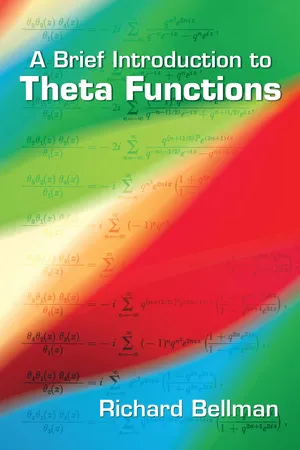
A Brief Introduction to Theta Functions
About this book
Brief but intriguing, this monograph on the theory of elliptic functions was written by one of America's most prominent and widely read mathematicians. Richard Bellman encompasses a wealth of material in a succession of short chapters, spotlighting high points of the fundamental regions of elliptic functions and illustrating powerful and versatile analytic methods.
Suitable for advanced undergraduates and graduate students in mathematics, this introductory treatment is largely self-contained. Topics include Fourier series, sufficient conditions, the Laplace transform, results of Doetsch and Kober-Erdelyi, Gaussian sums, and Euler's formulas and functional equations. Additional subjects include partial fractions, mock theta functions, Hermite's method, convergence proof, elementary functional relations, multidimensional Poisson summation formula, the modular transformation, and many other areas.


Frequently asked questions
Yes, you can cancel anytime from the Subscription tab in your account settings on the Perlego website. Your subscription will stay active until the end of your current billing period. Learn how to cancel your subscription.
No, books cannot be downloaded as external files, such as PDFs, for use outside of Perlego. However, you can download books within the Perlego app for offline reading on mobile or tablet. Learn more here.
Perlego offers two plans: Essential and Complete
- Essential is ideal for learners and professionals who enjoy exploring a wide range of subjects. Access the Essential Library with 800,000+ trusted titles and best-sellers across business, personal growth, and the humanities. Includes unlimited reading time and Standard Read Aloud voice.
- Complete: Perfect for advanced learners and researchers needing full, unrestricted access. Unlock 1.4M+ books across hundreds of subjects, including academic and specialized titles. The Complete Plan also includes advanced features like Premium Read Aloud and Research Assistant.
We are an online textbook subscription service, where you can get access to an entire online library for less than the price of a single book per month. With over 1 million books across 1000+ topics, we’ve got you covered! Learn more here.
Look out for the read-aloud symbol on your next book to see if you can listen to it. The read-aloud tool reads text aloud for you, highlighting the text as it is being read. You can pause it, speed it up and slow it down. Learn more here.
Yes! You can use the Perlego app on both iOS or Android devices to read anytime, anywhere — even offline. Perfect for commutes or when you’re on the go.
Please note we cannot support devices running on iOS 13 and Android 7 or earlier. Learn more about using the app.
Yes, you can access A Brief Introduction to Theta Functions by Richard Bellman in PDF and/or ePUB format, as well as other popular books in Mathematics & Applied Mathematics. We have over one million books available in our catalogue for you to explore.
Information
1. Introduction
Let us begin by introducing the functions whose many properties we shall study. Consider the function of z defined by the infinite series

Here z is a complex variable, permitted to assume any value, while t is a complex parameter satisfying the condition Re(t) > 0. It is easy to see that the series converges absolutely and uniformly in any bounded region of the z plane, and thus that f(z) is an entire function of z. It is clear, furthermore, that f(z) is periodic with period π,

Despite its rather special form, f(z) is no artificially concocted function. On the contrary, it is one of the basic functions of analysis, a theta function. It occurs in a crucial role in the development of the theory of linear partial differential equations of parabolic type, in the study of the Riemann zeta function and in connection with the representation of numbers as sums of squares, thus occupying a major position in the analytic theory of numbers, and, in its most fundamental role, it is a keystone of the theory of elliptic functions.
Jacobi, in his magnum opus, Fundamenta Nova. . ., was the first mathematician to study these functions in a thorough fashion. True to the spirit of his time, a spirit compounded of equal parts of faith and nearly incredible ingenuity, he derived his many elegant and intricate results by means of the algebraic manipulations familiar to Euler and Gauss. Once exhibited, the results are readily verified by means of the theory of functions of a complex variable, using Liouville’s theorem. Moreover, as we shall see, we now possess a number of powerful techniques for deriving results of this nature. Some are valid only for functions of one complex variable, while others can be used for functions of many variables.
Despite our unqualified title, our aim is not so ambitious as to present any complete, or even partially complete theory of theta functions. This domain is of such magnitude and extent that it cannot be mapped in any brief or simple fashion. Instead, we wish to use three principal results in the theory of elliptic functions, all expressible in terms of theta functions, as a stage upon which to parade some of the general factota of analysis, and as an excuse to discuss some intimately related results of great mathematical elegance. Our aim is to indicate the applicability and versatility of analytic techniques that should be part of the hope chest of every young mathematician.
Consequently, we shall neither follow the ingenious derivations...
Table of contents
- Cover
- Title Page
- Copyright Page
- Didication
- Foreword
- Contents
- 1. Introduction
- Index