The story of how Arab editors of the late nineteenth and early twentieth centuries revolutionized Islamic literature
Islamic book culture dates back to late antiquity, when Muslim scholars began to write down their doctrines on parchment, papyrus, and paper and then to compose increasingly elaborate analyses of, and commentaries on, these ideas. Movable type was adopted in the Middle East only in the early nineteenth century, and it wasn't until the second half of the century that the first works of classical Islamic religious scholarship were printed there. But from that moment on, Ahmed El Shamsy reveals, the technology of print transformed Islamic scholarship and Arabic literature.
In the first wide-ranging account of the effects of print and the publishing industry on Islamic scholarship, El Shamsy tells the fascinating story of how a small group of editors and intellectuals brought forgotten works of Islamic literature into print and defined what became the classical canon of Islamic thought. Through the lens of the literary culture of nineteenth- and twentieth-century Arab cities—especially Cairo, a hot spot of the nascent publishing business—he explores the contributions of these individuals, who included some of the most important thinkers of the time. Through their efforts to find and publish classical literature, El Shamsy shows, many nearly lost works were recovered, disseminated, and harnessed for agendas of linguistic, ethical, and religious reform.
Bringing to light the agents and events of the Islamic print revolution, Rediscovering the Islamic Classics is an absorbing examination of the central role printing and its advocates played in the intellectual history of the modern Arab world.
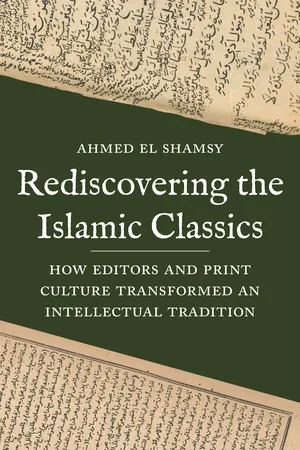
eBook - ePub
Rediscovering the Islamic Classics
How Editors and Print Culture Transformed an Intellectual Tradition
- English
- ePUB (mobile friendly)
- Available on iOS & Android
eBook - ePub
Rediscovering the Islamic Classics
How Editors and Print Culture Transformed an Intellectual Tradition
About this book
Information
Publisher
Princeton University PressYear
2020Print ISBN
9780691241913
9780691174563
eBook ISBN
9780691201245
Topic
Theology & ReligionSubtopic
Middle Eastern HistoryTable of contents
- Cover
- Title Page
- Copyright
- Dedication
- Epigraph
- Contents
- List of Illustrations
- Acknowledgments
- Introduction
- Chapter 1. The Disappearing Books
- Chapter 2. Postclassical Book Culture
- Chapter 3. The Beginnings of Print
- Chapter 4. A New Generation of Book Lovers
- Chapter 5. The Rise of the Editor
- Chapter 6. Reform through Books
- Chapter 7. The Backlash against Postclassicism
- Chapter 8. Critique and Philology
- Conclusion
- Bibliography
- Index
Trusted by 375,005 students
Access to over 1.5 million titles for a fair monthly price.
Study more efficiently using our study tools.
Frequently asked questions
Yes, you can cancel anytime from the Subscription tab in your account settings on the Perlego website. Your subscription will stay active until the end of your current billing period. Learn how to cancel your subscription
No, books cannot be downloaded as external files, such as PDFs, for use outside of Perlego. However, you can download books within the Perlego app for offline reading on mobile or tablet. Learn how to download books offline
Perlego offers two plans: Essential and Complete
- Essential is ideal for learners and professionals who enjoy exploring a wide range of subjects. Access the Essential Library with 800,000+ trusted titles and best-sellers across business, personal growth, and the humanities. Includes unlimited reading time and Standard Read Aloud voice.
- Complete: Perfect for advanced learners and researchers needing full, unrestricted access. Unlock 1.5M+ books across hundreds of subjects, including academic and specialized titles. The Complete Plan also includes advanced features like Premium Read Aloud and Research Assistant.
We are an online textbook subscription service, where you can get access to an entire online library for less than the price of a single book per month. With over 1.5 million books across 990+ topics, we’ve got you covered! Learn about our mission
Look out for the read-aloud symbol on your next book to see if you can listen to it. The read-aloud tool reads text aloud for you, highlighting the text as it is being read. You can pause it, speed it up and slow it down. Learn more about Read Aloud
Yes! You can use the Perlego app on both iOS and Android devices to read anytime, anywhere — even offline. Perfect for commutes or when you’re on the go.
Please note we cannot support devices running on iOS 13 and Android 7 or earlier. Learn more about using the app
Please note we cannot support devices running on iOS 13 and Android 7 or earlier. Learn more about using the app
Yes, you can access Rediscovering the Islamic Classics by Ahmed El Shamsy in PDF and/or ePUB format, as well as other popular books in Theology & Religion & Middle Eastern History. We have over 1.5 million books available in our catalogue for you to explore.