A history of opium's dramatic fall from favor in colonial Southeast Asia
During the late nineteenth century, opium was integral to European colonial rule in Southeast Asia. The taxation of opium was a major source of revenue for British and French colonizers, who also derived moral authority from imposing a tax on a peculiar vice of their non-European subjects. Yet between the 1890s and the 1940s, colonial states began to ban opium, upsetting the very foundations of overseas rule—how did this happen? Empires of Vice traces the history of this dramatic reversal, revealing the colonial legacies that set the stage for the region's drug problems today.
Diana Kim challenges the conventional wisdom about opium prohibition—that it came about because doctors awoke to the dangers of drug addiction or that it was a response to moral crusaders—uncovering a more complex story deep within the colonial bureaucracy. Drawing on a wealth of archival evidence across Southeast Asia and Europe, she shows how prohibition was made possible by the pivotal contributions of seemingly weak bureaucratic officials. Comparing British and French experiences across today's Burma, Cambodia, Laos, Malaysia, Singapore, and Vietnam, Kim examines how the everyday work of local administrators delegitimized the taxing of opium, which in turn made major anti-opium reforms possible.
Empires of Vice reveals the inner life of colonial bureaucracy, illuminating how European rulers reconfigured their opium-entangled foundations of governance and shaped Southeast Asia's political economy of illicit drugs and the punitive state.
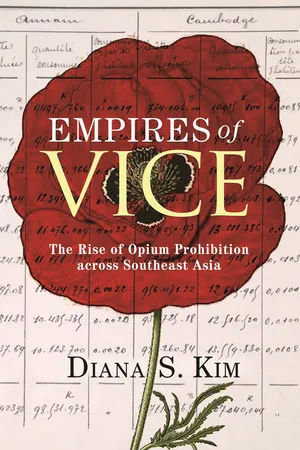
eBook - ePub
Empires of Vice
The Rise of Opium Prohibition across Southeast Asia
- English
- ePUB (mobile friendly)
- Available on iOS & Android
eBook - ePub
About this book
Information
Publisher
Princeton University PressYear
2020Print ISBN
9780691199702
9780691172408
eBook ISBN
9780691199696
Part I
1
Introduction
UNTIL THE LATE NINETEENTH CENTURY, European powers defended opium as integral to managing an empire. “Opium was one of those things,” declared one imperial politician in 1875, “which enabled us to serve God and Mammon at the same time.”1 Colonial states in Southeast Asia taxed opium consumption as a vice, at once collecting revenue and claiming just reasons for doing so. During peak years, the British and French collected more than 50 percent of colonial taxes from opium sales to local inhabitants, while other European rulers across the region reported smaller yet still significant shares sustaining the public coffers.2 It was possible, an administrator stationed in Burma wrote, that this drug could “raise for the public benefit, the greatest amount of revenue with the smallest possible consumption.”3
Into the first half of the twentieth century, however, the same powers were disavowing opium as a proper source of revenue and reconfiguring rationales that had once aligned the fiscal might and moral right of imperial rule. Before Parliament, John Morley referred to the British Empire’s anti-opium resolve as “that civilizing mission of the regeneration of the East,” while the French senator Édouard Néron wrote approvingly that “[o]ur commitment to ending the consumption of opium in Indochina has been made unambiguously clear” at an international conference in Geneva organized to combat dangerous drugs.4 By the 1940s, all major beneficiaries of colonial opium were restricting once permissible habits of opium consumption, closing down opium shops and punishing violators of these new interdictions.
The prohibition of opium altered the foundations of colonial government and justifications for European rule across Southeast Asia. It involved reconfiguring old fiscal arrangements and fashioning new claims to authority, as opium went from being a significant source of public revenue to an official danger that states condemned. This remarkable transformation is the subject of this book.
Specifically, Empires of Vice puzzles over this historical process in two respects. First, prohibiting opium entailed abandoning a key source of revenue for colonial states. Thus, it sits uneasily against influential theories that view modern states as guided by efforts to maximize revenue.5 Second, a shared turn against opium unfolded unevenly across Southeast Asia under European rule. There were diverse experiences, with the timing and tenor of opium-related reforms differing not only between empires but also among colonies of the same empire. Such variations complicate conventional understandings of colonial opium policies as following metropolitan regimes that medicalized drug control or as a response to religious actors and transnational activists who altered the moral conscience of the world.6
How did colonial states come to prohibit opium in such different ways? This book addresses the question, focusing on the British and French Empires—two powers that relied especially heavily on opium revenue collected from vice taxes—and tracing how they restricted opium sales and consumption in Burma, Malaya, and Indochina from the 1890s to 1940s. I argue that local administrators stationed in each colony are key to understanding when and how such reforms were possible. Prohibition involved unraveling a state’s deep-seated opium entanglements, a process enabled by a loss of confidence deep within the bureaucracy about the drug’s contributions to colonial government. Local administrators played a pivotal role in constructing official problems, which internally eroded the legitimacy of opium’s commercial life for European colonial states across Southeast Asia.
Local administrators were minor agents of imperial rule, far removed from greater intellectual debates of their times and seldom directly involved in the high decision-making of empires. Yet, these actors exercised surprisingly strong powers, as they produced official knowledge about opium in overseas colonies that provided evidentiary bases for major legal administrative reforms. They were poor theorists but rich empiricists of colonial reality. By way of doing what lowly administrators do on a day-to-day basis—implementing policies and keeping records—they developed commonplace philosophies about opium consumption as a colonial vice and forceful opinions about profits gained from the ills of others, while generating copious records that described and explained what challenges, what dangers, what wickedness seemed to mar local order. Seemingly radical reversals to Empire’s approach to opium in each colony were the sum of accumulated tensions arising from longstanding efforts to manage opium markets. Anti-opium reforms occurred at different times for different reasons, depending on the ways in which local administrators defined opium problems and affirmed them as politically actionable causes. But commonly, prohibiting opium was made possible through the work of anxious overseas bureaucracies.
The power of a state is felt intimately when it declares new interdictions. In the case of Southeast Asia, opium had long been a part of both the public and private lives of people. When nineteenth-century colonial rule began, opium was sold openly in the busy ports of Singapore under British rule and French Saigon to sailors and dockhands, in tin mines of Malaya where Chinese and Indian migrant workers toiled, as well as at opium shops in bustling bazaars throughout the region. The ones in Rangoon “are like gin shops in London with conspicuous signboards and often attractive in appearance particularly at night,” described one British official living in Burma in the 1880s.7 A French doctor named Angélo Hesnard remembered the Saigon opium manufacturing factory where “busy Chinese, half naked, covered in sweat, labored in a vast hall … filled with the infamous odor of ‘boiled chocolate.’ ”8 As a sumptuary practice, consuming opium touched the lives of both the rich and the poor, the pious and the profane, as a habit associated with the highest of pleasures and the lowest of pains. For those who smoked, ate, or otherwise ingested it, opium was a drug “at once bountiful and all devouring, merciful and destructive, sustaining and vengeful,” in the words of the novelist Amitav Ghosh.9
This everyday world changed under prohibition. Vendors faced restrictions on who they could sell opium to, at what price, and at what times of the day, while some saw their businesses taken over altogether by the same authorities who had issued sales licenses. In turn, people changed how they acquired and consumed a good that disappeared from respectable markets, from well-off merchants in Saigon to impoverished rickshaw pullers in Singapore who smoked opium excessively in pursuit of brief reprieves from the physical hardship, disease, and profound loneliness that came with working as a migrant away from home.10 Some individuals were summoned before authorities to register as opium addicts and avow the state’s way of defining their experiences. Others did not and became labeled as illicit, illegal, and indeed criminal actors. By demonstrating how this shift was made possible through the nitty-gritty work of local administrators, this book tells a larger story about how states transform themselves.
The Underbelly of Bureaucracies
The bureaucracy holds a privileged place for understanding modern states. It enforces laws, oversees taxation, provides public services, and allocates resources to people. Such administrative activities can introduce and naturalize fundamental categories through which individuals understand their place in groups, society, and a nation, while inculcating a sense of the inevitable presence or self-evident utility of the state. Bureaucracies have and continue to assume a powerful role organizing the exercise of physical and symbolic forms of state power.
While many scholars now agree that the state is not a monolithic entity with a unified purpose, we have been slower to acknowledge the bureaucracy in a similar way.11 In the shadow of Max Weber’s ideal type of the professional bureaucracy—an organization ordered by hierarchy, routinized tasks and rules, internal meritocracy, and the triumph of rational-legal authority—many conceive of administrative activity as first and foremost a rule-bound process of executing top-down directives.12 Public choice theorists also favor a minimalist view of bureaucracies comprising principal–agent relationships, hampered by frictions that arise from misaligned interests between implementing administrators and the ministers, regulators, and technocrats who formulate policies.13 Both perspectives posit a general logic to bureaucracies as pursuing goals set by upper echelons of the organization, seeking to efficiently implement policies formed from above.
This conventional wisdom tends to pathologize the discretion of low-level officials. From a high vantage point at the center, low-ranking administrators who act by their own volition are sources of bureaucratic inefficiency. From a Weberian perspective, these actors defy the rules of an organization and thwart its ability to realize goals. Everyday administrators who implement policies imperfectly and produce imprecise paperwork, vague records, as well as gaps between professed objectives and achieved results are suspect agents who exploit their principal’s relative lack of information and difficulty monitoring in order to implement alternative polices or pursue private ends. Discretionary power within bureaucracies often has a negative connotation, from misleading superiors and shirking responsibilities to rent-seeking behaviors and outright corruption14: The desk officer who sidesteps procedure. The tax collector who reports ambiguous numbers. The financial officer who misreports funds and blurs entries in the budget. The wayward official who alters, contradicts, or even challenges given directives. Typically, all are familiar as willful figures who distort the rational workings of a bureaucracy.
But when we actually look within a bureaucracy, these administrators are no longer so familiar. This book argues that the discretion they exercise represents commonsense acts in the contexts in which they work, as solutions to problems with perceived urgency. They acquire felt imperatives to act, which vary widely depending on the history and inherited precedents for their particular realm of administrative activity. More than mere disobedience or corruption, the ways that low-ranking administrators behave differently from the bidding of superiors reflect their own reasons for easing tensions, making accommodations, and exercising authority on a day-to-day level of work.15 Thus, to understand discretionary power within bureaucracies, it is necessary to understand what problems fueled the everyday work of minor officials. From the perspective of these insiders, the bureaucracy was not a coherent organization but a messy structure defined by multiple logics of operation, shifting objectives, as well as contradictory reasons for action. Political scientists have long stressed that bureaucracies are mired in politics, arising from external ties to elected politicians and legislators, business interests, professional communities, intellectuals, and activists, as well as through interactions with everyday citizens. I tell the lesser known story of micropolitics within bureaucracies. This requires exploring the concrete and granular workings of administrative governance, focusing on what actors deep within the underbelly of a bureaucracy actually did and wrote.
Contributions
This book’s approach to bureaucracies and opium in colonial Southeast Asia offers several interpretive and theoretical contributions. First, for scholarship in political science and sociology on the modern state, it places the everyday bureaucracy and power of ideas at the center of how we think about states and their claims to govern. A growing literature on symbolic dimensions of state capacity recognizes the ways that seemingly banal administrative categories, labels, classifications, and regulatory rubrics can profoundly order and organize socioeconomic life.16 When explaining how bureaucrats develop and implement such administrative schemes, most studies focus on external interactions with political actors and social forces. But less sustained attention has been paid to the interpretive work that actors within bureaucracies do: how they choose and puzzle over objects of regulation, how they define the meaning of their own work, and how they develop narratives about the necessity and viability of official action. This inner world of bureaucratic activity is important for understanding how states govern concretely and claim authority to rule.
For comparative historical studies of colonialism and state building, this book’s focus on opium illuminates an often overlooked realm of fiscal capacity and authority for European colonial states: the vices of subject populations. Taxing colonial vices enabled rulers to exercise social control, collect revenue, and assert moral claims to govern. It simultaneously gave institutional expression to imperial logics of domination based on difference, while instantiating Empire’s ambivalence about the terms on which to articulate reasons for differentiating among and dominating presumed others. Yet, few studies have treated colonial vice taxes as a central subject of inquiry or been curious about how exactly this system operated.17 Empires of Vice does both. It situates the regulation of vice at the heart of European colonial state building, focusing on policies and arguments for regulating opium consumption as a peculiar vice among non-European subjects through excise taxation.
Finally, for histories of opium and empire, this book gives reason to be more puzzled about how opium prohibition happened across Southeast Asia under European rule since the late nineteenth century. The anti-opium turn of empires has been best understood from global perspectives that center on the political economy of China and India, transnational forces b...
Table of contents
- Cover Page
- Series Page
- Title Page
- Copyright Page
- Dedication
- Contents
- List of Figures
- List of Tables
- Acknowledgments
- Note on Terms Used
- Part I
- Part II
- Part III
- Appendix
- Abbreviations
- Notes
- Sources and Bibliography
- Index
Trusted by 375,005 students
Access to over 1.5 million titles for a fair monthly price.
Study more efficiently using our study tools.
Frequently asked questions
Yes, you can cancel anytime from the Subscription tab in your account settings on the Perlego website. Your subscription will stay active until the end of your current billing period. Learn how to cancel your subscription
No, books cannot be downloaded as external files, such as PDFs, for use outside of Perlego. However, you can download books within the Perlego app for offline reading on mobile or tablet. Learn how to download books offline
Perlego offers two plans: Essential and Complete
- Essential is ideal for learners and professionals who enjoy exploring a wide range of subjects. Access the Essential Library with 800,000+ trusted titles and best-sellers across business, personal growth, and the humanities. Includes unlimited reading time and Standard Read Aloud voice.
- Complete: Perfect for advanced learners and researchers needing full, unrestricted access. Unlock 1.5M+ books across hundreds of subjects, including academic and specialized titles. The Complete Plan also includes advanced features like Premium Read Aloud and Research Assistant.
We are an online textbook subscription service, where you can get access to an entire online library for less than the price of a single book per month. With over 1.5 million books across 990+ topics, we’ve got you covered! Learn about our mission
Look out for the read-aloud symbol on your next book to see if you can listen to it. The read-aloud tool reads text aloud for you, highlighting the text as it is being read. You can pause it, speed it up and slow it down. Learn more about Read Aloud
Yes! You can use the Perlego app on both iOS and Android devices to read anytime, anywhere — even offline. Perfect for commutes or when you’re on the go.
Please note we cannot support devices running on iOS 13 and Android 7 or earlier. Learn more about using the app
Please note we cannot support devices running on iOS 13 and Android 7 or earlier. Learn more about using the app
Yes, you can access Empires of Vice by Diana S. Kim,Diana Kim in PDF and/or ePUB format, as well as other popular books in History & Economic History. We have over 1.5 million books available in our catalogue for you to explore.