This text introduces computational tools for solving differential equation models that arise in chemical engineering: diffusion-reactions, mass-heat transfer, and fluid flow. Geared toward advanced undergraduates or graduate students of chemical engineering studying applied mathematics, the treatment focuses on numerical methods and modeling implemented in commercial mathematical software available at the time of its initial publication in 1984. The introductory-level approach outlines numerical techniques for differential equations that either illustrate a computation property of interest or form the underlying methods of a computer software package. Readers are assumed to have a basic knowledge of mathematics, and results requiring further background feature appropriate references. Each chapter includes illustrative examples, and problems at the chapter's end simulate industrial mathematics projects and form extensions of the examples. Helpful appendixes supplement the text.

Frequently asked questions
Yes, you can cancel anytime from the Subscription tab in your account settings on the Perlego website. Your subscription will stay active until the end of your current billing period. Learn how to cancel your subscription.
No, books cannot be downloaded as external files, such as PDFs, for use outside of Perlego. However, you can download books within the Perlego app for offline reading on mobile or tablet. Learn more here.
Perlego offers two plans: Essential and Complete
Essential is ideal for learners and professionals who enjoy exploring a wide range of subjects. Access the Essential Library with 800,000+ trusted titles and best-sellers across business, personal growth, and the humanities. Includes unlimited reading time and Standard Read Aloud voice.
Complete: Perfect for advanced learners and researchers needing full, unrestricted access. Unlock 1.4M+ books across hundreds of subjects, including academic and specialized titles. The Complete Plan also includes advanced features like Premium Read Aloud and Research Assistant.
Both plans are available with monthly, semester, or annual billing cycles.
We are an online textbook subscription service, where you can get access to an entire online library for less than the price of a single book per month. With over 1 million books across 1000+ topics, we’ve got you covered! Learn more here.
Look out for the read-aloud symbol on your next book to see if you can listen to it. The read-aloud tool reads text aloud for you, highlighting the text as it is being read. You can pause it, speed it up and slow it down. Learn more here.
Yes! You can use the Perlego app on both iOS or Android devices to read anytime, anywhere — even offline. Perfect for commutes or when you’re on the go. Please note we cannot support devices running on iOS 13 and Android 7 or earlier. Learn more about using the app.
Yes, you can access Numerical Methods and Modeling for Chemical Engineers by Mark E. Davis in PDF and/or ePUB format, as well as other popular books in Technology & Engineering & Chemical & Biochemical Engineering. We have over one million books available in our catalogue for you to explore.
Initial-Value Problems for Ordinary Differential Equations
INTRODUCTION
The goal of this book is to expose the reader to modern computational tools for solving differential equation models that arise in chemical engineering, e.g., diffusion-reaction, mass-heat transfer, and fluid flow. The emphasis is placed on the understanding and proper use of software packages. In each chapter we outline numerical techniques that either illustrate a computational property of interest or are the underlying methods of a computer package. At the close of each chapter a survey of computer packages is accompanied by examples of their use.
BACKGROUND
Many problems in engineering and science can be formulated in terms of differential equations. A differential equation is an equation involving a relation between an unknown function and one or more of its derivatives. Equations involving derivatives of only one independent variable are called ordinary differential equations and may be classified as either initial-value problems (IVP) or boundary-value problems (BVP). Examples of the two types are:
where the prime denotes differentiation with respect to x. The distinction between the two classifications lies in the location where the extra conditions [Eqs. (1.1b) and (1.2b)] are specified. For an IVP, the conditions are given at the same value of x, whereas in the case of the BVP, they are prescribed at two different values of x.
Since there are relatively few differential equations arising from practical problems for which analytical solutions are known, one must resort to numerical methods. In this situation it turns out that the numerical methods for each type of problem, IVP or BVP, are quite different and require separate treatment. In this chapter we discuss IVPs, leaving BVPs to Chapters 2 and 3.
Consider the problem of solving the mth-order differential equation
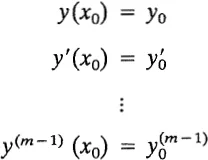
with initial conditions
where f is a known function and y0,
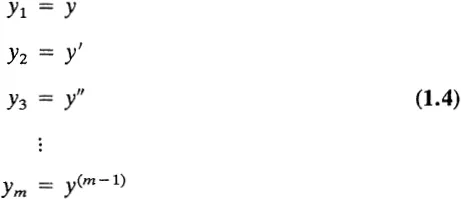
are constants. It is customary to rewrite (1.3) as an equivalent system of m first-order equations. To do so, we define a new set of dependent variables y1(x), y2(x), . . . , ym(x) by
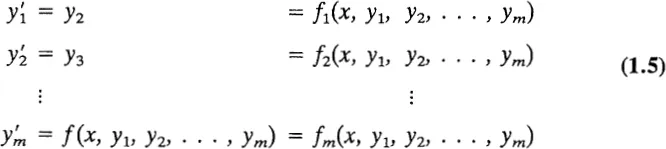
and transform (1.3) into
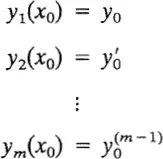
with
In vector notation (1.5) becomes
where
It is easy to see that (1.6) can represent either an mth-order differential equation, a system of equations of mixed order but with total order of m, or a system of m first-order equations. In general, subroutines for solving IVPs assume that the problem is in the form (1.6). In order to simplify the analysis, we begin by examining a single first-order IVP, aft...
Table of contents
Cover
Title Page
Copyright Page
Contents
Chapter 1 Initial-Value Problems for Ordinary Differential Equations