Would well repay study by most theoretical physicists." — Physics Today "An overwhelming influence on subsequent work on the wave equation." — Science Progress "One of the classical treatises on hyperbolic equations." — Royal Naval Scientific Service Delivered at Columbia University and the Universities of Rome and Zürich, these lectures represent a pioneering investigation. Jacques Hadamard based his research on prior studies by Riemann, Kirchhoff, and Volterra. He extended and improved Volterra's work, applying its theories relating to spherical and cylindrical waves to all normal hyperbolic equations instead of only to one. Topics include the general properties of Cauchy's problem, the fundamental formula and the elementary solution, equations with an odd number of independent variables, and equations with an even number of independent variables and the method of descent.
Frequently asked questions
Yes, you can cancel anytime from the Subscription tab in your account settings on the Perlego website. Your subscription will stay active until the end of your current billing period. Learn how to cancel your subscription.
No, books cannot be downloaded as external files, such as PDFs, for use outside of Perlego. However, you can download books within the Perlego app for offline reading on mobile or tablet. Learn more here.
Perlego offers two plans: Essential and Complete
Essential is ideal for learners and professionals who enjoy exploring a wide range of subjects. Access the Essential Library with 800,000+ trusted titles and best-sellers across business, personal growth, and the humanities. Includes unlimited reading time and Standard Read Aloud voice.
Complete: Perfect for advanced learners and researchers needing full, unrestricted access. Unlock 1.4M+ books across hundreds of subjects, including academic and specialized titles. The Complete Plan also includes advanced features like Premium Read Aloud and Research Assistant.
Both plans are available with monthly, semester, or annual billing cycles.
We are an online textbook subscription service, where you can get access to an entire online library for less than the price of a single book per month. With over 1 million books across 1000+ topics, we’ve got you covered! Learn more here.
Look out for the read-aloud symbol on your next book to see if you can listen to it. The read-aloud tool reads text aloud for you, highlighting the text as it is being read. You can pause it, speed it up and slow it down. Learn more here.
Yes! You can use the Perlego app on both iOS or Android devices to read anytime, anywhere — even offline. Perfect for commutes or when you’re on the go. Please note we cannot support devices running on iOS 13 and Android 7 or earlier. Learn more about using the app.
Yes, you can access Lectures on Cauchy's Problem in Linear Partial Differential Equations by Jacques Hadamard in PDF and/or ePUB format, as well as other popular books in Mathematics & Mathematics General. We have over one million books available in our catalogue for you to explore.
THE EQUATIONS WITH AN EVEN NUMBER OF INDEPENDENT VARIABLES AND THE METHOD OF DESCENT
CHAPTER I
INTEGRATION OF THE EQUATION IN 2m1 VARIABLES
1. GENERAL FORMULÆ
134. The first cases in which the solution of Cauchy’s problem was known in Analysis do not, as we have seen, belong to the above treated class: Riemann’s and Kirchhoff’s methods correspond respectively to m = 2 and m = 4.
We shall presently see that, in such cases, singularities such as we met with in the preceding Book no longer occur, every improper integral being even eliminated. This explains why the above-mentioned solutions were found first.
In the general case, nevertheless, even values of m must be considered as bringing in new difficulties. The above methods are no longer valid, and this for two reasons :
First, the elementary solution is no longer well determined (§ 65).
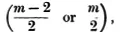
Next, we can no longer introduce the finite part of the integrals which we shall be led to use, as the exponent
with which Γ will appear in the denominator of the elementary solution or its derivatives, will be an integer.
It will actually follow from the very form of the expressions which we shall find, that they could not have been obtained by mere imitation of our former method.
But, as we have already mastered the case of 2m1 + 1 independent variables, this will enable us to reach the same result when the number of variables is 2m1 by using our method of descent (§ 29). The solution of the equation
m being equal to 2m1, will be deduced from the corresponding one for the equation in 2m1 + 1 variables
denoting by z an (m + l)th auxiliary variable.
If, as we still assume, the characteristic form
of (E) contains one positive and (m – 1) negative squares, the corresponding form
relating to (E′) will consist of one positive and m negative squares. We have already seen that the quantity Γ′, analogous to Γ and relating to (E′), is
denoting by (x1, x2, ... xm, z) and (a1, a2, ... am, c) two points of the (m + 1)-dimensional space. We have also found, in § 70, what relations exist between the elementary solutions of both equations: we have seen that the coefficients of the successive powers of Γ in one of them differ by numerical factors from the coefficients of the corresponding powers of Γ′ in the other.
Considering the adjoint equations
of (E) and (E′), the formulæ of § 70 express that, if
be the elementary solution of
, with
then the elementary solution of
will be
(w being a regular function); and, if we use the coefficients Cn of
§ 95, formulæ (62), (62 b) of § 70, applied to the adjoint equation, can be written
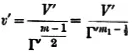
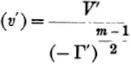
Now, this can be obtained directly by operating on ν′, or rather on the similar quantity
which relates to Γ′ < 0, as said in § 73. We form the expression (again a so...
Table of contents
Cover
Title Page
Copyright Page
Contents Page
Preface
Book I. General Properties of Cauchy’s Problem
Book II. The Fundamental Formula and The Elementary Solution
Book III. The Equations With An Odd Number of Independent Variables
BOOK IV. The Equations With An Even Number of Independent Variables And The Method of Descent