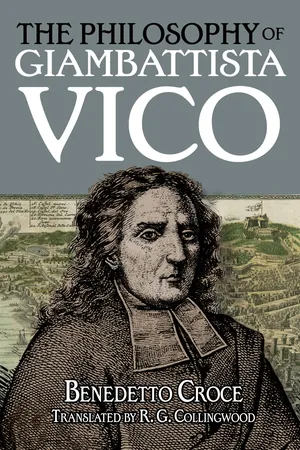
Credited as the inventor of the philosophy of history, Vico's influential pre-Enlightenment theories about knowledge, metaphysics, and moral consciousness gained a wider audience with this acclaimed 20th-century exposition.
- 330 pages
- English
- ePUB (mobile friendly)
- Available on iOS & Android
eBook - ePub
The Philosophy of Giambattista Vico
About this book
Information
Topic
PhilosophySubtopic
Epistemology in PhilosophyAPPENDIX I
ON THE LIFE AND CHARACTER OF G. B. VICO1
THE transformation, half rhetorical, half mythical, which the heat of the national reawakening effected in poets, philosophers, and almost every character of any importance in Italian history, representing them as patriots, liberals, and in open rebellion or secret revolt against the throne and the altar, tried for a time to touch with its magic wand and to work its will upon Giambattista Vico. It was said, among other things, that Vico, conscious of the severe blow dealt by his thought to the traditional beliefs of religion, and warned by his friends, took pains to plunge the New Science into such obscurity that only the finest intellects could perceive its tendencies. But though this legend, energetically spread as it was by the patriots and republicans of 1799, was believed here and there, it could not long stand out against criticism or even against common sense; and Cataldo Iannelli was right to pass over it with a few words of contemptuous irony.2
It is certain from an objective point of view that Vico’s doctrines implicitly contained a criticism of Christian transcendence and theology as well as of the history of Christianity. From the subjective point of view it may be that Vico during his youth (of which we know very little) was the victim of religious doubts. Such doubts may have been suggested to him not only by his reading, but by the society of young men of his own age, among whom “libertines,” or as contemporary literature still called them “epicureans” or “atheists,” were not uncommon.3
In a letter of 1720 to Father Giacchi, he says that at Naples the “weaknesses and errors dating from his early youth” are remembered against him, and that these, fixed in the memory, became as often happens “eternal criteria for the judgment of everything beautiful and complete which he subsequently succeeded in doing.”4 What can these errors and weaknesses have been ?
Again when the De universi iuris uno principio et fine uno appeared, or rather the “Synopsis” which announced its programme, “the first voices” which Vico heard raised against him “were tinged with an assumed piety.” He found protection and consolation in the face of such criticism in religion itself, that is to say in the approval of Giacchi, “the leading light of the strictest and most holy order of religious.”5 But just as we possess no detailed information as to the criticisms levelled against him on this head, so we have no certain knowledge even of the most general kind as to the religious doubts that may have troubled him. All Vico’s writings show the Catholic religion established in his heart, grave, solid and immovable as a pillar of adamant; so solid and so strong that it remained absolutely untouched by the criticism of mythology inaugurated by himself. Nor was Vico an irreproachable Catholic in external demonstration only. He not only submitted every word he ever printed to the double censorship, public and private, of ecclesiastical friends, and led his life as a philosopher and writer among priestly vestments and monastic cowls no less than among legal gowns; he was even scrupulous enough to desist from his commentary on Grotius, thinking it unseemly that a Catholic should annotate a Protestant writer;6 and so delicate was his sense of Catholic honour that he refused to admit polemic upon matters of religious feeling. “As to this difficulty.” he says to his critics of the Giomale dei letter ati, “like that which you propound to me concerning the immortality of the soul, where it appears that you have in hand seven distinct arguments, if they had not been prepared for me by you, I should judge that they go deeper and penetrate to a region which is not only protected and secured by my life and conduct, but which to defend is to outrage. But let us return to our subject.”7 His Catholicism was untainted by the superstition so general and so deeply rooted at the time, especially at Naples, where St. Januarius intervened as an actor and director in every event of public and private life. It was the Catholicism of a lofty soul and mind, not the faith of a charcoal-burner. But Vico never assumed the part of censor of superstitions. He was content with not speaking of them, as one keeps silence concerning the failings of persons or institutions which command one’s respect.
II
Vico’s attitude towards social and political life resembles in more than one respect his attitude towards religion. There is in him no trace of the missionary, the propagandist, the agitator or the conspirator as there was in some of the Renaissance philosophers, notably Giordano Bruno and Campanella, whom although—perhaps because—a Neapolitan, Vico never mentions. Certainly, his age and his country were not the time or place for heroes; there was none of that rapid social change and revolution from which heroes spring. Political parties however were active in favour of Austria and France, and men were arising who devoted their labours and their lives to one or other of these parties, or were persecuted and fled into exile: and above all this was the period in which culminated the struggle between Church and State, between Naples and Rome, in the person of Pietro Giannone, a man of whom Vico never speaks, just as he never mentions and in fact seems to ignore the entire movement. Political life rolled past over his head, like the sky and its stars, and he never wasted his strength in a vain attempt to reach it. Political and social controversy, like religious, was outside the sphere of his activity. He was indeed a non-political person. We cannot describe it as a fault or a weakness, for every one has his limitations; one struggle excludes another, and one labour makes others impossible.
Not that he avoided all contact with political life and its representatives. Only too often he was compelled to pay his respects to both, in the form of histories, speeches, verses and epigrams in Latin and Italian; and these alone would be sufficient material for the reconstruction of Neapolitan history in all its vicissitudes from the end of the seventeenth century to the middle of th°. eighteenth: the Spanish viceregency, the conspiracy and revolution attempted by the partisans of Austria, the reaction and re-establishment of the Spanish viceregency, the Austrian conquest, the Austrian viceregency, the Spanish reconquest and the reign of Charles Bourbon. But Vico, “very pliant because of his necessity”8 and as professor of eloquence in the royal university, was compelled to supply the literary compositions required by the solemnities of the day, just as the draper supplied hangings and the plasterer volutes and arabesques. And what hangings and arabesques he produced ! The Spanish style of the seventeenth century was still predominant in literature; and this fact is alone almost enough to explain the extravagance and ornate-ness, as it seems to us, of Vico’s flood of panegyrics. The indifference and innocence of his own attitude may be illustrated by the passage in his autobiography where after mentioning the Panegyricus Philippo V inscriptus composed by himself to the order of the Spanish viceroy, the Duke of Ascalona, he goes on as if it was a mere nothing, with no connexion but a simple “soon after”: “soon after, this kingdom having passed under the rule of Austria, the lord Count Wirrigo of Daun, at that time governor of the imperial armies in this country, ordered me” to compose inscriptions for the expiatory monuments to Guiseppe Capece and Carlo di Sangro,9 the two rebels against Philip V. executed by the previous government some years before in the suppression of the conspiracy of Macchia described by Vico from the Bourbon point of view in his De Parthenopea coniuratione.
But this implies no baseness of character on Vico’s part. It must be said that in these writings of his, orator and panegyrist though he is, he can never be called a flatterer. The flatterer, the man without a conscience, reviles and calumniates the enemies of the man he is praising, or even strikes the conquered: and this is servility. But Vico, who though he knew who the Italian or Neapolitan was that sent to the Acta Lipsiensia the note injurious to himself, and might easily have ruined him, since the note was anti-Catholic in tendency, generously refused to reveal his name,10 gave no doubt his services as professor of eloquence but refrained from trafficking in the interests of the patrons whom he praised. Of the Life of Antonio Carafa which he composed for a commission and married one of his daughters on the proceeds, he says that the work was “tempered by honour towards the subject, reverence towards princes and the just claims of truth.”11 And to return to the case of Capece and Sangro mentioned above, when he spoke in the De Parthenopea coniuratione of the death of these two enemies to the triumphant party, he shows here too in various details the nobility of his spirit: of Capece, who refused to surrender to the Spanish soldiers, he writes “exposing his breast to death, and demanding death with his warlike arms, he fell unrepentant, a most valiant manner of death, were it only honoured in its cause” (ostentans pectus neci eamque infensis armis efflagitans, inexo-ratus occubuit, fortissimum mortis genus si causa cohonestasset). Of Sangro too, having reported the rumour that Louis XIV. sent him a reprieve which arrived too late, he adds: “whence the condemned man, who had already suffered the penalty, is the more to be pitied” (unde maior damnati qui iam poenas per solver at, miseratio).12
He must have known, and doubtless did know, that most of the persons whose praises he composed were of very little worth. To read his panegyrics, one would suppose that Naples was adorned with a nobility resplendent in its virtue, cultivation and learning: and yet, in giving Father De Vitry the information he desired upon the condition of studies in Naples, Vico did not conceal the facts: “the nobles slumber amid the enjoyments of a life of pleasure.”13 His pupil Antonio Genovesi has preserved to us one of his satirical expressions upon this nobility, often in extreme poverty but always proud and ready to go hungry at home in order to drive abroad in coaches sumptuously dressed.14 With reference to the literary duke of Laurenzano, he formulated the theory that “noble” writers could not fail of excellence:15 and yet I have discovered among his papers the manuscript of a book by this duke, rewritten from end to end by the same Vico.16 Such are the contradictions and the transactions into which a poor man falls when the pressure of want has made him timid and cautious; so that it is not easy to determine how far his admiration was merely assumed at command or by complaisance, or how far his feeling of social inferiority developed into a real admiration for those above him in the scale, who possessed riches and dignity and everything he lacked and were the “seigneurs.”
III
For, as is well known, his financial state was always of the gloomiest. The son of a small Neapolitan bookseller, he was at first compelled to go as a private tutor to a wild town of the Cilento; later, returning to Naples, he tried in vain to obtain the position of secretary of the city, and having in 1699 been elected to the chair of rhetoric, he held that position for thirty-six years at an annual stipend of a hundred ducats (£17). His attempt to pass to a chair of greater importance in 1723 failed, whether owing to ill-luck or to inability—he recognised that he was a “man of little spirit in matters of utility,”17—he was compelled to give up hopes of academic advancement. He was therefore obliged to eke out his resources by literary work such as we have mentioned, and still more by private lessons; he not only kept school at his own house as well as at the university, but he went up and down other men’s steps to teach grammar to youths or even to children. His family life was not a happy one. His wife was illiterate, and had not the qualities with which her sex sometimes compensates the defect; she was incapable of any domestic employment whatever, so that her husband had to take her place. Of his children, one girl died after a long illness and the heavy expenses which embitter the diseases of the poor; one boy showed such strong vicious tendencies that the father was compelled to seek the intervention of the police and place him in a house of correction. So sublimely irrational was his fatherly affection that upon this occasion when he saw from the window the police officers he had called in, coming to t...
Table of contents
- Cover
- Title Page
- Copyright Page
- Dedication
- Preface
- Translator’s Note
- Contents
- I. Vico’s Theory of Knowledge : First Phase
- II. Vico’s Theory of Knowledge : Second Phase
- III. Internal Structure of the New Science
- IV. The Imaginative Form of Knowledge (Poetry and Language)
- V. The Semi-Imaginative Form of Knowledge (Myth and Religion)
- VI. The Moral Consciousness
- VII. Morality and Religion
- VIII. Morality and Law
- IX. The Historical Aspect of Law
- X. Providence
- XI. The Law of Reflux
- XII. Metaphysics
- XIII. Transition to History : General Character of Vico’s Treatment of History
- XIV. New Principles for the History of Obscure and Legendary Periods
- XV. Heroic Society
- XVI. Homer and Primitive Poetry
- XVII. The History of Rome and the Rise of Democracy
- XVIII. The Return of Barbarism : The Middle Ages
- XIX. Vico and the Tendencies of Contemporary Culture
- XX. Conclusion : Vico and Later Thought, Philosophical and Historical
- Appendices
- Note.—Passages of Vico’s Works to which Especial Reference is made in the Course of the Exposition
- Index of Names
Trusted by 375,005 students
Access to over 1.5 million titles for a fair monthly price.
Study more efficiently using our study tools.
Frequently asked questions
Yes, you can cancel anytime from the Subscription tab in your account settings on the Perlego website. Your subscription will stay active until the end of your current billing period. Learn how to cancel your subscription
No, books cannot be downloaded as external files, such as PDFs, for use outside of Perlego. However, you can download books within the Perlego app for offline reading on mobile or tablet. Learn how to download books offline
We are an online textbook subscription service, where you can get access to an entire online library for less than the price of a single book per month. With over 1.5 million books across 990+ topics, we’ve got you covered! Learn about our mission
Look out for the read-aloud symbol on your next book to see if you can listen to it. The read-aloud tool reads text aloud for you, highlighting the text as it is being read. You can pause it, speed it up and slow it down. Learn more about Read Aloud
Yes! You can use the Perlego app on both iOS and Android devices to read anytime, anywhere — even offline. Perfect for commutes or when you’re on the go.
Please note we cannot support devices running on iOS 13 and Android 7 or earlier. Learn more about using the app
Please note we cannot support devices running on iOS 13 and Android 7 or earlier. Learn more about using the app
Yes, you can access The Philosophy of Giambattista Vico by Benedetto Croce, R. G. Collingwood in PDF and/or ePUB format, as well as other popular books in Philosophy & Epistemology in Philosophy. We have over 1.5 million books available in our catalogue for you to explore.