Theorising Media and Conflict brings together anthropologists as well as media and communication scholars to collectively address the elusive and complex relationship between media and conflict. Through epistemological and methodological reflections and the analyses of various case studies from around the globe, this volume provides evidence for the co-constitutiveness of media and conflict and contributes to their consolidation as a distinct area of scholarship. Practitioners, policymakers, students and scholars who wish to understand the lived realities and dynamics of contemporary conflicts will find this book invaluable.
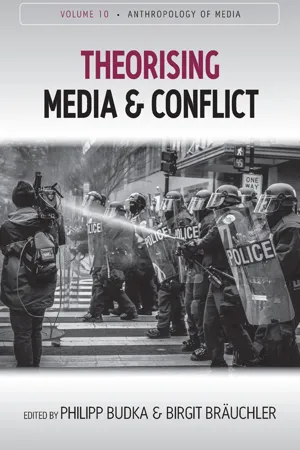
- 340 pages
- English
- ePUB (mobile friendly)
- Available on iOS & Android
eBook - ePub
Theorising Media and Conflict
About this book
Trusted by 375,005 students
Access to over 1.5 million titles for a fair monthly price.
Study more efficiently using our study tools.
Information
PART I
Key Debates
Introduction
Anthropological Perspectives on Theorising Media and Conflict
Birgit Bräuchler and Philipp Budka
The relationship between media and conflict is highly elusive and complex. Conflict dynamics in one of the largest island states, where media have been contributing decisively to a feeling of national belonging (Anderson 1983), illustrate this. In 1999, the outbreak of the Moluccan conflict in Eastern Indonesia destroyed the existing media landscape, in which journalists and media workers collaborated irrespective of their religious affiliation. The conflict was mainly fought along religious lines and triggered the re-emergence of a totally different media landscape: a broad range of media – from newspapers, to the internet, to radio and graffiti – was now divided along religious lines, fuelling religious hatred and propelling the conflict to new levels. Such escalation and years of violence in turn made Moluccan people wake up and promote the transformation of society to peace through, among other things, social media, newspapers, theatre performances and poetry. Thus, media became a tool to provoke peace and to resist social injustices underlying the physical violence in Maluku. It was only through long-term ethnographic research that this intimate relationship between media, conflict and societal transformation revealed itself (see also Bräuchler, this volume). This example reminds us that asking about the impact or effect of media on conflict and violence – a question that continues to preoccupy media scholars, psychologists, sociologists and political scientists – is in fact a ‘methodological error’ that tries to build ‘discussion about human values around a mathematical metaphor’ (Smith 1978: 129–30).
Instead of looking at media and conflict as two separate spheres or at unidirectional causality, this edited volume brings together anthropologists as well as media and communication scholars to collectively look at the interpenetration and the co-constitutiveness of media and conflict. In doing so, it cannot possibly cover all variations of conflict and media. Instead, it puts forward the notion of mediation to focus upon wider media-related processes and practices in everyday contexts and of conflicts as social processes and culturally constructed. While the analyses in this book are embedded in a broader discourse on conflict as an inherent part and a central organising principle of social life, they mainly focus on conflicts involving extraordinary forms of violence that have become part of the everyday. In seven parts, the authors theorise on central aspects of the relationship between media and conflict: (I) key debates and anthropological approaches, (II) witnessing and (III) experiencing conflict, (IV) language and (V) sites of conflict, as well as (VI) cross-border conflict and (VII) conflict transformation. Through epistemological and methodological reflections and the analyses of various case studies from around the globe, this volume contributes to the consolidation of media and conflict as a distinct area of scholarship.
No matter whether through war propaganda, news media and embedded journalists, pictures and videos of drones and gun cameras, media activism and citizen journalism, social media use or video games, we are all becoming increasingly entangled in violent conflicts worldwide (e.g. Karmasin et al. 2013: xi; Mortensen 2015: 2; Seib 2013: 7). Scholars are grappling with the variety and increasing mediation of conflict experiences and the extents of conflict immersion in people’s everyday mediated life. In a recent literature survey on media and conflict, for instance, Schoemaker and Stremlau (2014) found that a majority of studies display Western biases, normative assumptions and unsubstantiated claims about the so-called ‘impact of media’ in conflict situations. This is characteristic of research that aims to identify the effect or the impact of media, rather than looking into the complex relationship between media and, in our case, conflict. Moreover, there are only limited efforts in media and conflict studies to correlate, for instance, media framing results with on-the-ground research findings (Vladisavljevic´ 2015: 1). In her chapter in this volume, Nicole Stremlau criticises how technology companies, such as Facebook and Google, attempt to connect the unconnected in developing regions and in conflict situations. These internet giants, she notes, focus on what international, industry-led interventions can do to regulate inflammatory (dis)information and media communication rather than looking into local agency and the lived reality of conflicts.
With its cross-cultural and context-sensitive approach, its ethnographic methods and ground-up theorising, anthropologically informed media research is well placed to make a strong contribution to the advancement of research into media and conflict (see Sumera, Marshall, Mollerup, Kummels, Pype, Oldenburg, and Bräuchler, this volume). The same goes for qualitative media and communication studies that emphasise contextualisation and critical theorising (see Sumiala, Tikka and Valaskivi, Meis, Markham, Livio, Adriaans, and Soberon, Smets and Biltereyst, this volume). This book thus goes beyond the search for media effects and also sets a counterpoint to the predominance of quantitative studies that frequently fail to take into account people’s lived experiences in the understanding of conflict dynamics (Bräuchler 2015: 209).
To explore these lived experiences of people in relation to media practices in a range of contexts requires knowledge of and training in relevant methods and methodologies, such as ethnographic fieldwork, participant observation and qualitative interviewing (Bräuchler 2018b; Carayannis 2018). However, this is something some disciplines in this field of research are lacking. They tend to look into violence, conflict and media by building on media content and quantitative data sets, generated through statistics, modelling or geographic information systems, to pin down the effects of media on conflict occurrence and dynamics (see e.g. a special issue of the Journal of Peace Research, a flagship journal of peace and conflict studies, on ‘Communication, Technology, and Political Conflict’; Weidmann 2015). While some projects dedicated to the study of conflict in an increasingly mediated world, such as the journal Media, War & Conflict (Hoskins, Richards and Seib 2008), do promote a diversity of theoretical and methodological approaches in exploring the relationship between media and conflict, anthropologically informed and ethnographically grounded research is still under-represented.
Nevertheless, a growing number of anthropologists have begun to study media in conflict and post-conflict contexts – working on topics such as news reporting (e.g. Arno 2009; Pedelty 1995), war (e.g. Bräuchler 2013; Stroeken 2012), digital activism (e.g. Barassi 2015), social protest and political change (e.g. Juris and Khasnabish 2013; Postill 2018), media use in diasporic networks (e.g. Bernal 2014), video-making (e.g. Kummels 2017), radio propaganda (e.g. Li 2007), conflict transformation (e.g. Bräuchler 2011) or spiritual and religious struggles (e.g. Pype 2012) – but so far they have done so in relative isolation from one another. This volume helps to overcome this fragmentation of the field by bringing together, in a synergetic effort, media anthropologists and media and communication scholars researching the multiple ways in which different kinds of media and conflict interpenetrate in a number of regional settings. In doing so, this book sets the field’s theoretical and empirical agenda for students, scholars, activists and civil society groups alike.
In this introductory chapter, we continue outlining the specifics of our approach to theorise on media and conflict. To do so, it is necessary to reconsider two established anthropological fields of research: the anthropology of media and the anthropology of conflict. We argue that considerable societal and media-related transformation processes and changes have brought these research fields closer together, even suggesting an inevitable and synergetic merging on a conceptual level. Thus, we outline in a first section how to approach media and conflict from an anthropological perspective. In a second section, we develop the various aspects of how the volume’s chapters and an anthropological approach contribute to the theorising of media and conflict. Whereas references to the individual contributions are included throughout, a brief outline of the book’s structure concludes the chapter.
Approaching Media and Conflict from an Anthropological Perspective
We promote an anthropologically informed, non-media-centric and contextualised approach to conflict and media that accentuates: (a) the deconstruction of deterministic notions of media effects and of simplistic categorisations of media-conflict relations; (b) a focus on the lived realities of conflicts through cross-cultural comparison and ethnographic methodology; and (c) the co-constitution of media and conflict and therefore the necessary linking of conceptual approaches that have been shaping the anthropology of conflict and media.
Beyond Media Effects
In the late 1970s and the 1980s, media studies experienced an ethnographic turn. Inspired by anthropology and particularly cultural studies, scholars started to research media as embedded in everyday contexts, not as something set apart from it. They began to challenge and deconstruct prevailing communication models and ‘the power of the media texts that shape attitudes and ideas’ of a passive, homogeneous audience (Askew 2002: 5). This new wave of media scholars promoted ideas of an active audience or audiences who interpret, attribute and produce heterogeneous meanings (e.g. Morley 1980, 1992) in relation to wider social, cultural and political settings, fields and practices, including power hierarchies or gender relations (Dracklé 2005: 189–90). Longstanding perceptions of boundaries between media production and media reception started to dissolve (Ginsburg, Abu-Lughod and Larkin 2002b: 1). Such developments have been pushed further by interactive digital media technologies, internet platforms and particularly social media, where media users are – or can be – audience and producer at the same time (e.g. Bruns 2008; Sumiala and Tikka 2011). Despite this turn, questions about media effects and the impact of media use and coverage still seem to preoccupy scholars who are looking, for instance, at the role of media in conflict and post-conflict scenarios (Schoemaker and Stremlau 2014: 185; Zeitzoff 2017: 1971), the effects that media coverage has on terrorist attacks (Asal and Hoffmann 2016) or the impact of information wars (Allagui and Akdenizli 2019).
However, as, for instance, Igreja’s (2015) ethnography on violence glorifying films in conflict zones in Mozambique, and Straus’ (2007) study on the relationship between hate radio and violence during the Rwandan Civil War illustrate, one has to be very careful in identifying a causal relationship between media content and violent actions (see also Oldenburg, this volume). Both authors challenge linear media approaches and argue for a more nuanced understanding of the complexity of violence, and the culturally and historically situated experiences and interpretations of people exposed to it. Igreja questions simplifying notions of the negative effects film violence has on young viewers in post-war and conflict settings by analysing the ambivalent responses of local residents. He argues that film violence can ‘enhance ongoing processes of self-assertion among young people in unpredictable ways’, leading to either the incitement or containment of violence, ‘while stimulating the consciousness of existing … languages and mechanisms of mediation’ (Igreja 2015: 678, 679). Straus, in turn, counters the prevailing scholarly opinions that radio broadcasts ‘were a primary determinant of genocide’ (2007: 609) by sparking extreme violence, thus invoking the image of passive listeners with little or no agency (2007: 615). Rather, he found that Rwandan radio did not trigger the violence, but ‘emboldened hard-liners [and not the general audience] and reinforced face-to-face mobilization, which helped those who advocated violence [in particular elites] assert dominance and carry out the genocide’ (Straus 2007: 631). Both studies emphasize the need to go beyond simplistic frameworks and look into the ‘less obvious and more tense and negotiated process of social change’ (Igreja 2015: 689) and the ‘complex issues of agency, context, institutions, and history’ (Straus 2007: 632) – something contributions to this volume do. Stremlau, for example, puts forward the importance of considering regional and national political ideologies as well as their historical and sociocultural contextualisation for understanding the complex relationship of media and conflict at the Horn of Africa. Such complexities render it futile, or at least limiting the research perspective, to ask about the effects or impact of media on conflict or war (see also Couldry and Hepp 2013).
We aim for a non-media-centric, non-media-deterministic approach – a constitutive quality of media anthropology (e.g. Peterson 2003) – that focuses on the contexts of both conflict and media. The challenge here is to avoid media-centrism (e.g. Moores 2018) – even when most contributions to this book take media as a window to look at certain conflict and peace dynamics – in order to ensure a proper contextualisation of our media perspectives on conflicts. We counter, for example, views that reduce digital media platforms to ‘archives of [decontextualised] online behavior’ that ‘have opened up unrivaled amounts of data that are now available for analysis’ (Gohdes 2018: 100), neglecting the lived experience of people involved in producing, communicating, receiving, digesting, interpreting or manipulating those ‘data’. A non-media-centric approach to mediated conflict makes it possible to deconstruct normative views of technology that either celebrate media as a democratising and liberating force (Schoemaker and Stremlau 2014: 187) or promote overly technical notions of media and conflict alliances such as media war, cyberwar, hacktivism, cyberattacks, cybersecurity or cybercrime (e.g. Ghosh and Turrini 2010; Jordan and Taylor 2004) (for a critique, see also Stremlau, this volume). What has become known as the ‘first war in cyberspace’ in April–May 2007 in Estonia feeds into this (Landler and Markoff 2007).1 Waves of denial-of-service attacks that ‘brought down the Websites of the Estonian President, Parliament, a series of government agencies, the news media, [and] the two largest banks’ (Hansen and Nissenbaum 2009: 1168) triggered a response by the Estonian government that blocked all international web traffic, ‘effectively shutting off the “most wired country in Europe” from the rest of the world’ (Richards 2009). Incidents like this and publicly mediated concerns over the use of the internet by terrorist and extremist groups feed well into security policies of well-armed states, such as the United States and Singapore, as well as into global risks models developed by international organisations (e.g. Conway 2006; World Economic Forum 2019). As various case studies in this volume show, it is not easy to categorise online conflicts due to the ambivalent nature of the internet (see also Bräuchler 2007).
A non-media-centric approach helps to avoid and deconstruct overly reifying and constraining conflict categories and, instead, look at conflict realities as embedded social practices and actions (see also Arno 2009; Smets 2017). The expansion of contemporary warfare into cyberspace and onto digital platforms does get scholarly attention, but ethnographic research that follows a particular conflict for an extended period of time is still the exception (e.g. Bräuchler 2013). The field is still dominated by political scientists, international relations and communication scholars who tend to focus on state security and so-called ‘cyber security’ (e.g. Karatzogianni 2009; Latham 2003). Given current technological developments, anthropologists working on conflict issues need to join hands with media anthropologists even more in order to grasp the complexity of how media technologies, sensory perceptions and social life are interrelated (e.g. Robben 2016). It is obvious that people engage with media in different ways and under ch...
Table of contents
- Cover
- Title Page
- Copyright Page
- Contents
- Preface
- PART I. KEY DEBATES
- PART II. WITNESSING CONFLICT
- PART III. EXPERIENCING CONFLICT
- PART IV. MEDIATED CONFLICT LANGUAGE
- PART V. SITES OF CONFLICT
- PART VI. CONFLICT ACROSS BORDERS
- PART VII. AFTER CONFLICT
- Afterword
- Index
Frequently asked questions
Yes, you can cancel anytime from the Subscription tab in your account settings on the Perlego website. Your subscription will stay active until the end of your current billing period. Learn how to cancel your subscription
No, books cannot be downloaded as external files, such as PDFs, for use outside of Perlego. However, you can download books within the Perlego app for offline reading on mobile or tablet. Learn how to download books offline
Perlego offers two plans: Essential and Complete
- Essential is ideal for learners and professionals who enjoy exploring a wide range of subjects. Access the Essential Library with 800,000+ trusted titles and best-sellers across business, personal growth, and the humanities. Includes unlimited reading time and Standard Read Aloud voice.
- Complete: Perfect for advanced learners and researchers needing full, unrestricted access. Unlock 1.5M+ books across hundreds of subjects, including academic and specialized titles. The Complete Plan also includes advanced features like Premium Read Aloud and Research Assistant.
We are an online textbook subscription service, where you can get access to an entire online library for less than the price of a single book per month. With over 1.5 million books across 990+ topics, we’ve got you covered! Learn about our mission
Look out for the read-aloud symbol on your next book to see if you can listen to it. The read-aloud tool reads text aloud for you, highlighting the text as it is being read. You can pause it, speed it up and slow it down. Learn more about Read Aloud
Yes! You can use the Perlego app on both iOS and Android devices to read anytime, anywhere — even offline. Perfect for commutes or when you’re on the go.
Please note we cannot support devices running on iOS 13 and Android 7 or earlier. Learn more about using the app
Please note we cannot support devices running on iOS 13 and Android 7 or earlier. Learn more about using the app
Yes, you can access Theorising Media and Conflict by Philipp Budka,Birgit Bräuchler in PDF and/or ePUB format, as well as other popular books in Social Sciences & Communication Studies. We have over 1.5 million books available in our catalogue for you to explore.