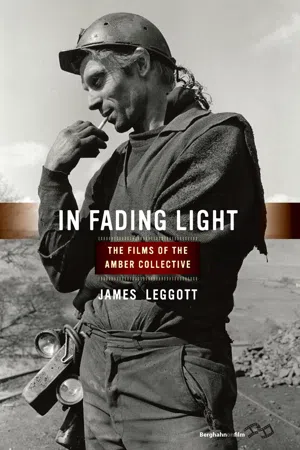
For over five decades, the Newcastle-based Amber Film and Photography Collective has been a critical (if often unheralded) force within British documentary filmmaking, producing a variety of innovative works focused on working-class society. Situating their acclaimed output within wider social, political, and historical contexts, In Fading Light provides an accessible introduction to Amber's output from both national and transnational perspectives, including experimental, low-budget documentaries in the 1970s; more prominent feature films in the 1980s; studies of post-industrial life in the 1990s; and the distinctive perils and opportunities posed by the digital era.
- 318 pages
- English
- ePUB (mobile friendly)
- Available on iOS & Android
eBook - ePub
About this book
Trusted by 375,005 students
Access to over 1.5 million titles for a fair monthly price.
Study more efficiently using our study tools.
Information
Chapter 1
HISTORIES OF AMBER

Amber’s formal history goes back to 1968, with the coming together of a group of like-minded students at the Regent Street Polytechnic who, the following year, decided to move to the north-eastern city of Newcastle upon Tyne to make independent films about working-class experience. However, when asked by an interviewer to describe the beginnings of Amber, Murray Martin, the group’s key founding figure, noted that ‘in a sense it starts in your history’.1 Born in 1943 in Stoke-on-Trent to a family of potters and miners, Martin studied Fine Art in Newcastle in the early 1960s before deciding to learn the craft of filmmaking. He identified that many in the group shared a similar working-class background, albeit in different places, and the experience, through education, of being ‘designed out of our background’:2 ‘there was a movement among the group I was in … to go back to your own roots, your own childhood and reconnect with your interests there.’3 According to Martin, the group gave themselves the rather anonymous, utilitarian name of Amber, not for its associations of preservation or precious stones but after ‘Amber Ale, which was the women’s drink, as the counterpoint of brown ale’.4 Prior to the collective’s move up north, Martin had already produced two ‘proto’ Amber student films of note: the didactic All You Need is Dynamite (1968), documenting anti-war riots, and the more gentle and Amber-like Maybe (1969), following the thoughts of an engine man on a ferry traversing the river Tyne.5
During the 1970s, the group produced a series of short documentary portraits of working-class culture. An early project to document pub-singing traditions did not fully come to fruition, and a film called Wallsend 72 about a brass band and a juvenile jazz band would fall into obscurity. But 1974’s Launch, with its iconic footage of a spectacular Wallsend ship launch, would become one of Amber’s signature early works. A mid 1970s cycle of films, often labelled by recent scholars, following Darren Newbury, as ‘salvage documentaries’, and mostly financed through regional arts council funding (Northern Arts), offered a record of disappearing or archaic workplaces: a drift mine in High Row (1973), a rope-hauled colliery railway in Bowes Line (1975), a recently closed brickworks in Last Shift (1976) and an industrial glass-blowing site in Glassworks (1977).6
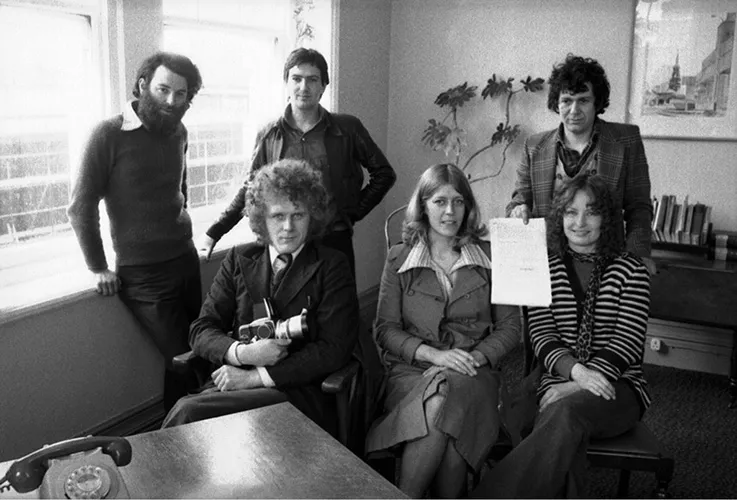
Figure 1.1 Signing Amber’s partnership agreement, 1974, Graham Denman, Graham Smith, Peter Roberts, Lorna Powell, Murray Martin and Sirkka-Liisa Konttinen. © Amber Film & Photography Collective.
On a surface reading, these are rather straightforward works of realist representation; the use of re-creation and staged elements in these films would anticipate Amber’s more complex and exploratory integration of factual and fictional components in later productions. With Mai (1974) and Laurie (1978), Amber produced the first entries in a sporadic series – continuing into later decades – of portraits of individuals who had inspired their work in some way.
The period also saw the first of Amber’s characteristic strategies of engagement taking shape. Sirkka-Liisa Konttinen, one of the group’s founder members, gained some public and press interest through her photographic documentation of Byker, a staunchly working-class suburb that had been scheduled for demolition in a slum-clearing drive, and which she chose to move into upon her arrival in Newcastle. Typical of Amber’s slow, organic approach to creativity, and their commitment to telling stories from deep within a particular community, it would take more than a decade for Konttinen’s Byker project to reach a culmination, in the form of a published book and film (both 1983). Amber’s River Project of 1974, in collaboration with a number of other artists and writers, involved the documentation of the industries along the river Tyne and the touring of existing work to those communities. In 1977, Amber established the Side Gallery for the exhibition of humanist documentary photography both by and commissioned by the group along with work it found inspirational and wanted to explore. The gallery was part of its premises in the city’s once run-down quayside area; this district inspired the poetic Quayside (1979), made as part of a campaign led by Murray Martin himself to preserve the threatened buildings in the locality.
The period of the 1980s and early 1990s was a particularly busy and fertile period for Amber but also for British oppositional film culture more generally. By this time, Amber had proved to be one of the most influential voices within what is usually termed the ‘workshop movement’ of oppositional, independent filmmakers working together in groups, albeit with differing politics, organizational structures and attitudes to exhibition. Amber had been formed around the same time as Cinema Action in London, and other key workshops founded in the 1970s and early 1980s include Liberation Films, the Berwick Street Film Collective, women-led groups such as the Sheffield Film Co-op and Leeds Animation Workshop, and black and Asian groups such as the Black Audio Film Collective, Sankofa and Retake Film and Video Collective. As Margaret Dickinson summarizes:
Workshops aimed to develop structures radically different from those of the film and broadcasting mainstream. Principles widely shared were collective management, integration of production, distribution and exhibition, flexible division of labour as opposed to rigid specialisms, continuity of employment as opposed to freelance working and non-hierarchical working relations, including relations between filmmakers, their subjects and audiences.7
The formation of the Independent Filmmakers’ Association (IFA) brought together individual filmmakers and workshops to promote these ideals and campaign for funding from organizations such as the British Film Institute (BFI) and regional arts associations and authorities.
Following a decade of campaigning by independent filmmakers, Murray Martin and Amber played a major role in the evolution of the Workshop Declaration of 1982, a union agreement reached by the Association of Cinematograph Television and Allied Technicians (ACTT), which gave allowance for cross-grade working and an egalitarian wage structure. The IFA also battled for support from the new Channel Four television station (which began broadcasting in 1982). Amber was awarded one of a number of franchises given to independent regional workshops by the channel’s Independent Film and Video Department, who commissioned work under the ACTT agreement.8
The security from this Channel Four funding gave Amber scope to expand their operations considerably. They also gained a stable exhibition platform, as the channel would broadcast much of their upcoming work throughout the decade, in addition to some of their back catalogue, in their Eleventh Hour and People to People strands, as well as their Film on Four seasons.9
Amber’s output in this period demonstrates an increasingly ambitious, experimental approach to the documentation of work practices and cultures, and a variety of creative approaches to the fusion of fictional and non-fictional elements. For example, Byker (1983), Keeping Time (1983), The Writing in the Sand (1991) and Letters to Katja (1994) were based around Konttinen’s photographic engagement with, respectively, a vanished inner-city community, a dance school in North Shields, the beaches of the North East and her Finnish homeland, to which she returned for a year. Double Vision: Boxing for Hartlepool (1986) and T Dan Smith (1987) used profiles of individuals – a boxing instructor and a notorious Newcastle council leader – as a springboard for an exploration of documentary ethics and reliability. Following 1981’s The Filleting Machine, essentially a record of an existing Tom Hadaway play, Seacoal (1985) was Amber’s first feature-length drama, although, like the more traditionally scripted In Fading Light (1989) about the fishing industry, it developed out of a long-term engagement with a particular community. Amber’s formal residency in North Shields, where they bought a pub as a simultaneous social and filmmaking location/base, also led to Dream On (1991), a film about women’s lives on the Meadow Well estate. During the 1980s, Amber also established a Current Affairs Unit, producing ‘trigger’ items to inspire debate on subjects such as the miners’ strike, pacifism and anti-nuclear movements, and the effect of Conservative privatization policy on local authority and hospital workers. A highly unusual production during this period was From Marks & Spencer to Marx and Engels (1988), a portrait of the town of Rostock, as part of a collaboration with DEFA filmmakers from East Germany.
By the early 1990s, Channel Four’s commitment to the workshops was in decline, and the feature Eden Valley (1995), set among a harness racing community, was the last to be funded through the franchise. By this time, Amber had shifted its emphasis to the former coalfield areas of County Durham, where activity included photographic commissions, a community video project called It’s the Pits (1995) and a trilogy of feature films dealing with the geographical, economic and psychological impact of deindustrialization. The female perspective of The Scar (1997), about a former activist during the miners’ strike embarking on a tentative relationship with the manager of an open cast mining site, was followed by Like Father (2001), which considers the effect of pit closures on three generations of the same family. These last two films had received some BBC funding, but the completion of Shooting Magpies (2005), Amber’s last feature drama to date, was enabled by a five-year revenue grant awarded to the group by the Northern Rock Foundation, which also funded related photographic projects. Shooting Magpies developed out of a few strands of Amber’s Durham-based work and in particular a community video project with teenage mothers. Focussing upon a young mother’s unsuccessful attempt to wean her boyfriend off his heroin addiction, Shooting Magpies is one of Amber’s gloomiest statements about communities in despair; it also marked a turn towards the use of digital video.
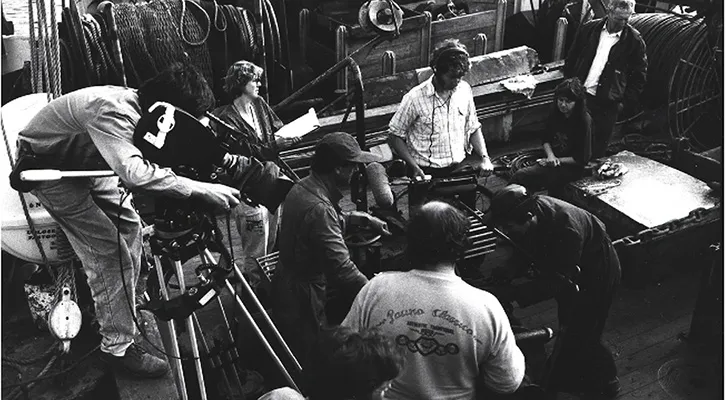
Figure 1.2 Filming In Fading Light in 1989. © Amber Film & Photography Collective.
As the collective entered its fifth decade, Amber’s attention turned increasingly to its own legacy. Their link with members of the ‘horsey’ world – that is, those involved in harness racing or associated with the travelling community – stretched back to the early 1980s. When the key founding member Murray Martin died in 2007, Amber decided to turn an unfinished documentary about the year in the life of a ‘horsey’ family into The Pursuit of Happiness (2008), a commemoration of Martin himself: an exploration of his life, philosophy, influence and fascination with his subjects. Today I’m with You (2010) concerned Sirkka-Liisa Konttinen’s photographic re-engagement with the ...
Table of contents
- Cover
- Title Page
- Copyright Page
- Dedication Page
- Contents
- Illustrations
- Acknowledgements
- Introduction
- Chapter 1. Histories of Amber
- Chapter 2. Salvaging the Past, 1968 to 1980
- Chapter 3. Can’t Beat It Alone: Current Affairs and Investigations, 1982 to 1988
- Chapter 4. The Sirkka-Liisa Konttinen Films, 1983 to 1994
- Chapter 5. Dream On: Drama Features, 1981 to 1991
- Chapter 6. From the Tyne to the Coalfields: Feature Films, 1995 to 2005
- Chapter 7. Still Here: Amber in the Twenty-First Century
- Conclusion
- Select Bibliography
- Amber Filmography
- Index
Frequently asked questions
Yes, you can cancel anytime from the Subscription tab in your account settings on the Perlego website. Your subscription will stay active until the end of your current billing period. Learn how to cancel your subscription
No, books cannot be downloaded as external files, such as PDFs, for use outside of Perlego. However, you can download books within the Perlego app for offline reading on mobile or tablet. Learn how to download books offline
Perlego offers two plans: Essential and Complete
- Essential is ideal for learners and professionals who enjoy exploring a wide range of subjects. Access the Essential Library with 800,000+ trusted titles and best-sellers across business, personal growth, and the humanities. Includes unlimited reading time and Standard Read Aloud voice.
- Complete: Perfect for advanced learners and researchers needing full, unrestricted access. Unlock 1.5M+ books across hundreds of subjects, including academic and specialized titles. The Complete Plan also includes advanced features like Premium Read Aloud and Research Assistant.
We are an online textbook subscription service, where you can get access to an entire online library for less than the price of a single book per month. With over 1.5 million books across 990+ topics, we’ve got you covered! Learn about our mission
Look out for the read-aloud symbol on your next book to see if you can listen to it. The read-aloud tool reads text aloud for you, highlighting the text as it is being read. You can pause it, speed it up and slow it down. Learn more about Read Aloud
Yes! You can use the Perlego app on both iOS and Android devices to read anytime, anywhere — even offline. Perfect for commutes or when you’re on the go.
Please note we cannot support devices running on iOS 13 and Android 7 or earlier. Learn more about using the app
Please note we cannot support devices running on iOS 13 and Android 7 or earlier. Learn more about using the app
Yes, you can access In Fading Light by James Leggott in PDF and/or ePUB format, as well as other popular books in Media & Performing Arts & Film & Video. We have over 1.5 million books available in our catalogue for you to explore.