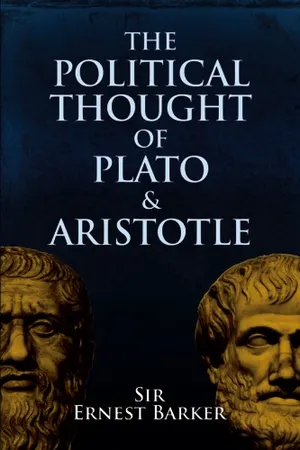
This clear and accurate exposition of Greek political thought offers a comprehensive exploration of the works of Plato and Aristotle. Students of political science and the history of Western philosophy will appreciate its insights into the sources of state power, the nature of political organization, the aims of the state, citizenship, justice, law, and related concepts. In addition to point-by-point discussions of Plato's Republic and Aristotle's Politics, this survey presents critical examinations of several of Plato's other dialogues along with Aristotle's Ethics. Further, it considers the origin of these ideas in the Greek political experience and in the contributions of other Greek theorists, including Heraclitus, Pythagoras, the Cyrenaics, and the Encyclopaedists. This classic of scholarship also includes epilogues that discuss the influence of Greek political ideas on such thinkers as Aquinas, Marsilio of Padua, Machiavelli, Spinoza, Hobbes, Rousseau, and Hegel.
THE PRE-SOCRATICS, SOCRATES, AND THE MINOR SOCRATICS
PROVERBIAL THOUGHT AND THE PHILOSOPHY OF NATURE
Proverbial philosophy
§ 1. THE beginnings of political and of moral philosophy in Greece are to be found in isolated apophthegms (
ματα βρ
χεα
ξιoμνημ
νετα, as Plato says), the product of the proverbial stage of thought, in which single aperçus are tersely expressed in a brief sentence. The time has not yet come for the reflection which sees life steadily, and sees it whole; but experience has taught, or inquisitive eyes have seen, some facet of the truth, and the sparkle which has thus been caught has been preserved for ever in some saying. Such sententious maxims were dear to the Greeks; and in the tragedies of the fifth century there are still many to be found. But the stage of proverbial thought appears in its purity partly in the sayings of the Seven Wise Men, partly in the writers of elegiac or even epic verse. Here we find something of a philosophy, sometimes marked by a crude utilitarianism, sometimes by homely expressions of a deeper truth. The Seven Wise Men were for the most part statesmen; and scattered among their ethical sayings, such as μηδ
ν
γαν, we naturally find political truths like
ρχ
νδραδε
ξει (“Office will prove the stuff of which a man is made” ). Plutarch, indeed, in the Convivium Septem Sapientium, introduces the Seven Sages in the act of discussing the conditions necessary to the greatest happiness of a State, and he professes to give the opinions held by each of the seven. Plato tells us that the fruits of their wisdom were dedicated by the seven in congress to the Temple of Apollo at Delphi.9 The Ampictyons inscribed their sayings on its walls, and they might thus seem to acquire something of the sanctity of a divine revelation. “In these celebrated names we have social philosophy in its early and infantine state.” 10 The political sayings of Homer or Hesiod must have acquired an equal reputation. Homer is a believer in the divine right of monarchy:
o
κ
γαθ
ν πολυκοιραν
ηε
ς κο
ρανος
στω, ε
ς βασιλε
ς,
δωκε Kρ
νoνπα
ς
γκυλoμ
τεω.11
Hesiod rebukes in advance the Sophistic view held by the “kings” of his generation ; and to their philosophy, “Better be wicked than just,” he answers by an appeal to Divine retribution.12 Among writers of elegiac verse the two who turned their attention most closely to political things were Theognis and Solon. The one represents the views of an aristocracy, with its sharp antithesis of “the Good” and “the Bad”. He laments the overthrow at Megara of a nobility of birth by a mob “wearing the skins of goats, and knowing nought of dooms or of laws”.4 Solon, the legislator of Athens,13 whom Athenians afterwards regarded as the father of democracy, told in verse the story of what he had done. It was not democracy which he had founded, but a “Polity,” as Aristotle would have said, a “middle constitution” which avoided the evils of the rule of the Good, and yet did not give absolute power to the Bad. “I gave the people such power as sufficed, neither taking from their due honour, nor giving yet more : I gave heed that men who had influence and were famous for their wealth should suffer nothing unseemly: I stood with my shield held aloft to guard both the rich and the poor, nor did I permit either to triumph wrongfully.” Here first appears the conception of a neutral and mediating State, which the Greeks were to seek so long, and in so many different ways, in order to escape the strife which raged between the sections of society. Not only the poetry of Theognis and Solon, but that of Alcæus and Tyrtæus also, bears the mark of this civic strife. If Solon had guided the State into its desired haven, Alcæus “cannot comprehend the strife of winds” which buffets the ship of state at Mitylene, where Pittacus is ruling as dictator; and Tyrtæus’ verse is not only a trumpet-call to battle, but a political sermon in praise of law-abidingness (ε
νομ
α).
Pythagoreanism
§ 2. The next epoch in the history of Greek political thought is that which is marked by the influence of natural philosophy. Here we reach the age of reflection. Puzzled by the riddle of the physical universe, seemingly composed of many elements, yet liable to changes which transmuted each one of these into another, men cast about to find the one identical, the single substratum of matter which underlay all the elements, and from which they all proceeded. This single substratum of matter, however it might be conceived, they called φ
σις—Nature. It is perhaps too readily assumed, that before Socrates men studied Nature alone, and that thinkers were first induced by his example to study Man (
θη).14 But the conclusions at which the pre-Socratics arrived about Matter were not mere theories of physical scientists dealing with a problem of chemistry : they were, to those who propounded them, solutions of the riddle of the universe. As such, they applied to the life of man as much as they did to the life of the earth. Conclusions with regard to the elements of physical nature and their mutual relations involved similar conclusions about the elements of man’s moral nature and the connection of those elements—about the elements of the State and the scheme by which they were united. This step from the physical truth to its moral counterpart was perhaps made most readily by the Pythagoreans of the fifth century, when they turned the ritual of Pythagoras into a system of philosophy. The unity to which they had reduced physical elements was not a material substance, such as was postulated by most of the Ionic philosophers, but the more immaterial 15 principle of number. Such a principle was easily extended to the moral world of man’s conduct. The underlying principle of that world, it might be argued, was also one of number, or the observance of number.16 In this way the Pythagoreans came on their conception of justice. Justice was a number
σáκις
σος : it was a number multiplied into itself, a square number. A square number is a perfect harmony, because it is composed of equal parts, and the number of the parts is equal to the numerical value of each part. If justice is defined as a square number, it follows that justice is based on the conception of a State composed of equal parts. A number is square so long as the equality of its parts remains: a State is just, so long as it is distinguished by the equality of its parts. Justice is the preservation of such equality. But how is such equality to be preserved ? By taking away from the aggressor, who has made himself too great and his victim too small, all the profit of his aggression, and by restoring it in its integrity to the loser. Hence the further definition of justice by the Pythagoreans as requital (τ
ντιπεπoθ
ς) : with what measure you mete, it shall be measured out to you again. As the aggressor has trespassed, so trespass shall be made upon the aggressor exactly equivalent to his own trespass. It is obvious that in this conception of justice there is much which was to influence profoundly the trend of later political thought.17 Here is the idea of the State as a sum of equal members: here is the idea of its aim as consisting in a harmony or equipoise called justice, which preserves the nice adjustment of the members. In the Republic Plato adopts this conception of justice, and gives it a more spiritual content and a deeper truth. Justice is an adjustment, but an adjustment which gives to each of the spiritual factors which go to form the State—reason, spirit and appetite—its right and proper place. In Aristotle’s theory of “particular” justice the formal and numerical aspect of the Pythagorean conception is still more obviously present. The theory of distributive and corrective justice in the fifth Book of the Ethics, and the application of a theory of justice to commerce in the first Book of the Politics, owe something to Pythagorean teaching.18
Pythagoreans in politics
Thus, then, had the Pythagoreans helped the growth of political science by their application of the principles of natural philosophy to the State. A later generation assigned to Pythagoras himself the tenets of his later disciples, and believed that Pythagoras had attempted to realise them in practice. Tradition told of a club of Three Hundred founded by Pythagoras at Croton, which consisted of young men trained, like the Platonic guardians, in philosophy, and, like them, governing the State in the light of their philosophy.19 The Pythagorean principle κoιν
τ
τ
ν φιλ
ν (“The goods of friends are common property” ) was interpreted into an anticipation of the communism advocated by Plato. We may, however, regard these traditions and interpretations as a later reading of Platonic ideas into the mind of “the master” : ipse non dixit. The Pythagorean order was in reality a body of Disciples, meeting both to hear the mysteries of ritual and taboo and to join in vegetarian syssitia (the basis of the supposed communism), and interfering in politics, as it did at Croton, only because its members formed an aristocratic club, and because any aristocratic club would naturally try to influence the State.20 In this indirect way philosophy (such as there was) may have come to influence the State ; and the history of the Pythagorean club might suggest to Plato the rule of philosopher kings. It is certain that Pythagorean ideas were vigorous in Plato’s time. Thebes had come under their influence : the Pythagorean Lysis was the instructor of Epaminondas, who called him father; and Aristotle tells us that at Thebes, “as soon as the rulers became philosophers, the city began to flourish”.21 Archytas of Tarentum was a famous Pythagorean of the fourth century, who for a long time was supreme in his native city, and served seven times as its general, in spite of a law to the contrary. A man like Archytas, general of his city, and also teacher of philosophy to his disciples in his garden-precinct at Tarentum, must obviously have served as a model for the Republic, even if the original club under Pythagoras was not present to Plato’s mind. When we remember that Archytas was living at Tarentum, and Epaminondas at Thebes, in the very days when Plato wrote, the Republic begins to assume a decidedly practical aspect.
Heraclitus
When we turn...
Table of contents
Title Page
Copyright Page
PREFACE
Table of Contents
CHRONOLOGICAL TABLE OF EVENTS BEARING ON THE TEXT
INTRODUCTION
CHAPTER I - THE PRE-SOCRATICS, SOCRATES, AND THE MINOR SOCRATICS
CHAPTER II - PLATO AND THE PLATONIC DIALOGUE : THE DEFENCE OF SOCRATES
CHAPTER III - THE REPUBLIC, OR CONCERNING JUSTICE
CHAPTER IV - PLATO’S VIEW OF MONARCHY, AND OF THE MIXED STATE
CHAPTER V - ARISTOTLE—HIS LIFE AND TIMES: THE PLACE OF THE POLITICS IN HIS SYSTEM
CHAPTER VI - [Politics, I., c. i.-ii.; IV. (VI.), c. i.-iii.; o. xiii.; III., c. iv.] THE TELEOLOGICAL VIEW OF THE STATE
CHAPTER VII - [Politics, III., c. i.-viii. ; VI. (IV.), c. iii.-iv.] THE STATE AS A COMPOUND
CHAPTER VIII - [Ethics, V. : Politics, II., viii. ; IIL, ix.-xviii.] ARISTOTLE’S CONCEPTIONS OF LAW AND JUSTICE
CHAPTER IX - [Politics I., c. ii.-xiii.; II., c. i.-vii. : Ethics, V. v.] ARISTOTLE’S PRINCIPLES OF ECONOMICS
CHAPTER X - [Politics, IV.-V. (VII.-VIII.)] THE IDEAL STATE AND ITS SCHEME OF EDUCATION
CHAPTER XI - [Politics, IV.-VI. (VI.-VIII.)] ACTUAL STATES AND THE LINES OF THEIR REFORM
EPILOGUE - THE HISTORY OF THE POLITICS
APPENDIX A - A NEWSPAPER ENTITLED OBSERVATIONS ON THE POLITICS
APPENDIX B - THE LATER HISTORY OF THE REPUBLIC.
INDEX
A CATALOG OF SELECTED DOVER BOOKS IN ALL FIELDS OF INTEREST
Trusted by 375,005 students
Access to over 1.5 million titles for a fair monthly price.
Study more efficiently using our study tools.
Frequently asked questions
Yes, you can cancel anytime from the Subscription tab in your account settings on the Perlego website. Your subscription will stay active until the end of your current billing period. Learn how to cancel your subscription
No, books cannot be downloaded as external files, such as PDFs, for use outside of Perlego. However, you can download books within the Perlego app for offline reading on mobile or tablet. Learn how to download books offline
Perlego offers two plans: Essential and Complete
Essential is ideal for learners and professionals who enjoy exploring a wide range of subjects. Access the Essential Library with 800,000+ trusted titles and best-sellers across business, personal growth, and the humanities. Includes unlimited reading time and Standard Read Aloud voice.
Complete: Perfect for advanced learners and researchers needing full, unrestricted access. Unlock 1.5M+ books across hundreds of subjects, including academic and specialized titles. The Complete Plan also includes advanced features like Premium Read Aloud and Research Assistant.
Both plans are available with monthly, semester, or annual billing cycles.
We are an online textbook subscription service, where you can get access to an entire online library for less than the price of a single book per month. With over 1.5 million books across 990+ topics, we’ve got you covered! Learn about our mission
Look out for the read-aloud symbol on your next book to see if you can listen to it. The read-aloud tool reads text aloud for you, highlighting the text as it is being read. You can pause it, speed it up and slow it down. Learn more about Read Aloud
Yes! You can use the Perlego app on both iOS and Android devices to read anytime, anywhere — even offline. Perfect for commutes or when you’re on the go. Please note we cannot support devices running on iOS 13 and Android 7 or earlier. Learn more about using the app
Yes, you can access The Political Thought of Plato and Aristotle by E. Barker in PDF and/or ePUB format, as well as other popular books in Politics & International Relations & Political History & Theory. We have over 1.5 million books available in our catalogue for you to explore.